Books to Read for Hispanic Heritage Month

Every so often, I like to share a list of reading recommendations–books I’ve either read or would like to read. Usually, they’re focused on a specific genre or location.

For example, in August 2024, to go along with the Summer Olympics in Paris, I shared a list of books by French authors or stories that took place in France. Earlier that same year in March 2024, I posted a list of books by Irish authors or with settings in Ireland to go along with St. Patrick’s Day..

As Hispanic Heritage Month gets underway, I thought it would be fun to compile a list of books by Hispanic authors or set in Spanish-speaking countries. The list covers a range of genres from literary and historical fiction to magic realism and romance. What I appreciate most about these stories are the unique characters and colorful settings. The true magic is in the storytelling, which brings the Hispanic heritage to life on the page.

I’ve broken the list into two sections: books I’ve read and books I’d like to read. Perhaps you’ve read these books yourself or have your own favorites to share. I welcome them in your comments.

Books I’ve Read

Bless Me, Ultima by Rudolfo Anaya.  I first heard about this book when it landed on PBS’ The Great American Read list of must-read books several years ago. It’s a coming-of-age story about a young boy’s spiritual transformation, guided by his mentor, an elderly medicine woman. I found the story fascinating. As with many stories written by Latino authors, there’s plenty of magic and surrealism. The book has been banned in some locations because of its Spanish profanity and occult themes.

Like Water, For Chocolate by Laura Esquival. I remember seeing this as a movie so I wanted to read the novel too. It has romance, magic and tragedy featuring an all-female family. Youngest daughter Tita has fallen in love with Pedro, but cannot marry him because Mexican tradition requires that she must stay and care for her mother until she dies. To stay close to Tita, Pedro marries her older sister. Meanwhile, Tita pours all her unresolved emotions into her cooking, which makes for some interesting results. 

The Alchemist by Paulo Coelho. It’s been a long time since I’ve read this book, which is considered a modern classic. It’s the story of a shepherd boy named Santiago who yearns to travel the world and the treasures he finds along the way. It’s a story about longing, the wisdom of listening to our hearts and learning to follow our dreams. I may have to re-read this one.

The House on Mango Street by Sandra (Esperanza) Cisneros. Written by Chicagoan Sandra Cisneros and structured as a series of vignettes, this novel appeared on The Great American Read list and is considered a modern classic. It follows 12-year-old Esperanza, a Chicano girl growing up in a Hispanic neighborhood of Chicago over the course of one year where she enters adolescence and faces the realities of living in a poor and patriarchal community.

In The Time of The Butterflies by Julia Alvarez. I loved this historical fiction novel about the four Mirabel sisters who fought back against the Trujillo dictatorship in the Dominican Republic. Written from their four different perspectives, their bond as sisters and family grew even as the world they once knew fell apart.

I Am Not Your Perfect Mexican Daughter by Erika Sanchez. This Young Adult novel features a young girl Julia dealing with the loss of her older sister and the pressures and expectations of her family, particularly her overprotective mother. Instead, Julia has dreams of her own, including moving out of her neighborhood to explore the world.

Mexican Gothic by Silvia Moreno-Garcia. I’ve had this book on my shelf for the past year, and I’m finally getting around to reading it. Though I’m only a couple of chapters in, I am enjoying it so far. The book is described as a blend of creepy horror and classic gothic tropes, set in a crumbling mansion in the mountains of Mexico in the 1950s. It’s earned high praise from critics and readers alike, so naturally I want to read what the excitement is about.

Books to Read on My TBR Shelf

One Hundred Years of Solitude by Gabriel Garcia-Marquez. This title lands at the top of almost every must-read list. It’s been sitting on my shelf for several years and I haven’t opened it yet because I find the size (more than 500 pages) is rather daunting.

In The Time of Cholera by Gabriel Garcia-Marquez. This one is also on my shelf. I tried to read it once, but it was at the start of the pandemic. The plot was too much like what we were all going through at the time.

How the Garcia Girls Lost Their Accent by Julia Alvarez. The follow up to In The Time of the Butterflies, this story spans 30 years in the lives of four sisters, told from their different perspectives, as they begin their adult lives in the United States. The cool thing about this novel is that the story is told in reverse chronological order with the story concluding in their native Dominican Republic as children.

The Spanish Love Deception by Elena Armas. For a change of pace from the somber tones and serious themes of previous works, here comes a rom-com I’m looking forward to reading. Besides, who wouldn’t want to be invited to a wedding in Spain?

The House of the Spirits by Isabel Allende. This novel has been on my wish list for several years. Combining elements of romance and magic realism, this title appears on many must-read book lists and has received praise from readers and critics alike.

Of Love and Shadows by Isabel Allende. Of Allende’s many other published works, this is next in line to read behind The House of the Spirits.

Romance, mystery and magic are hallmarks of these stories, which makes them more fun to read.

Neither a Plotter Nor a Pantser? Try Becoming a Puzzler

Photo by Ron Lach on Pexels.com

Writers usually fall into one of two categories: the plotter or the pantser.

Plotters prefer to plan out every aspect of their stories ahead of time, from the setting, character, theme, structure. They will plot out every scene from the opening paragraph to the final resolution. They have to know every detail in advance before starting to write. Plotting allows writers to view their story from all detailed angles. They know exactly what they want to write before writing it.

I’ve tried this plotting approach once before early in my fiction writing. It was the first story I attempted to write. I quickly gave up on it because I found it limiting. My plotting didn’t allow for new characters to show up, and I struggled to find the right place in the story for new scenes as I thought of them.

Still there are plenty of authors who have plotted their way to success. Fantasy author K.M. Weiland is a big proponent of outlining and story structure, and goes into a deep dive on these subjects on her blog. She’s also written several books about plotting if you want to learn more.

One disadvantage I see is the extra time it takes to get the details “just right.” It can take the wind out of your creative sails too. By the time you’re done plotting, you could lose interest in your story because you feel you’ve already written it in plotting form.

But not every writer works that way.

Then there are the pantsers . . .
I always believed I was a pantser, also known as a discovery writer, because I enjoyed discovering my story as I wrote. With only a vague sense of main characters and a few scene ideas, pantsers tend to begin writing if only to see where the story takes them, or whether there’s a story at all.

The advantage of writing by the “seat of your pants” is that it gives the imagination free rein. The story, without the limits of plotting, can go in a multitude of directions, and it can be fun to discover new characters and settings that you didn’t think of initially. Writers feel free to explore their story world without the limitations of a set of rules or structure.

The downside, however, is that by the end of the drafting phase, what writers have is a ton of material with no cohesiveness between scenes, characters or plot. That only makes the editing phase much harder because there’s so much material to dig through, and much of it will land on the cutting room floor anyway. As I quickly learned, pantsers usually have to do several rewrites to get the story to where you want it to be, which can be a drain on time and energy, not to mention patience.

What if you’re neither a pantser nor a plotter – or you’re a little of both?
While I’ve experimented with both of these approaches, I realized that I don’t fit neatly in either one. While I love exploring plots and characters organically, I also recognize that I need to plot my story to some extent so I know where it’s going. Otherwise, I’m only spinning my wheels, editing and rewriting sections until they feel right.

Enter Puzzling.

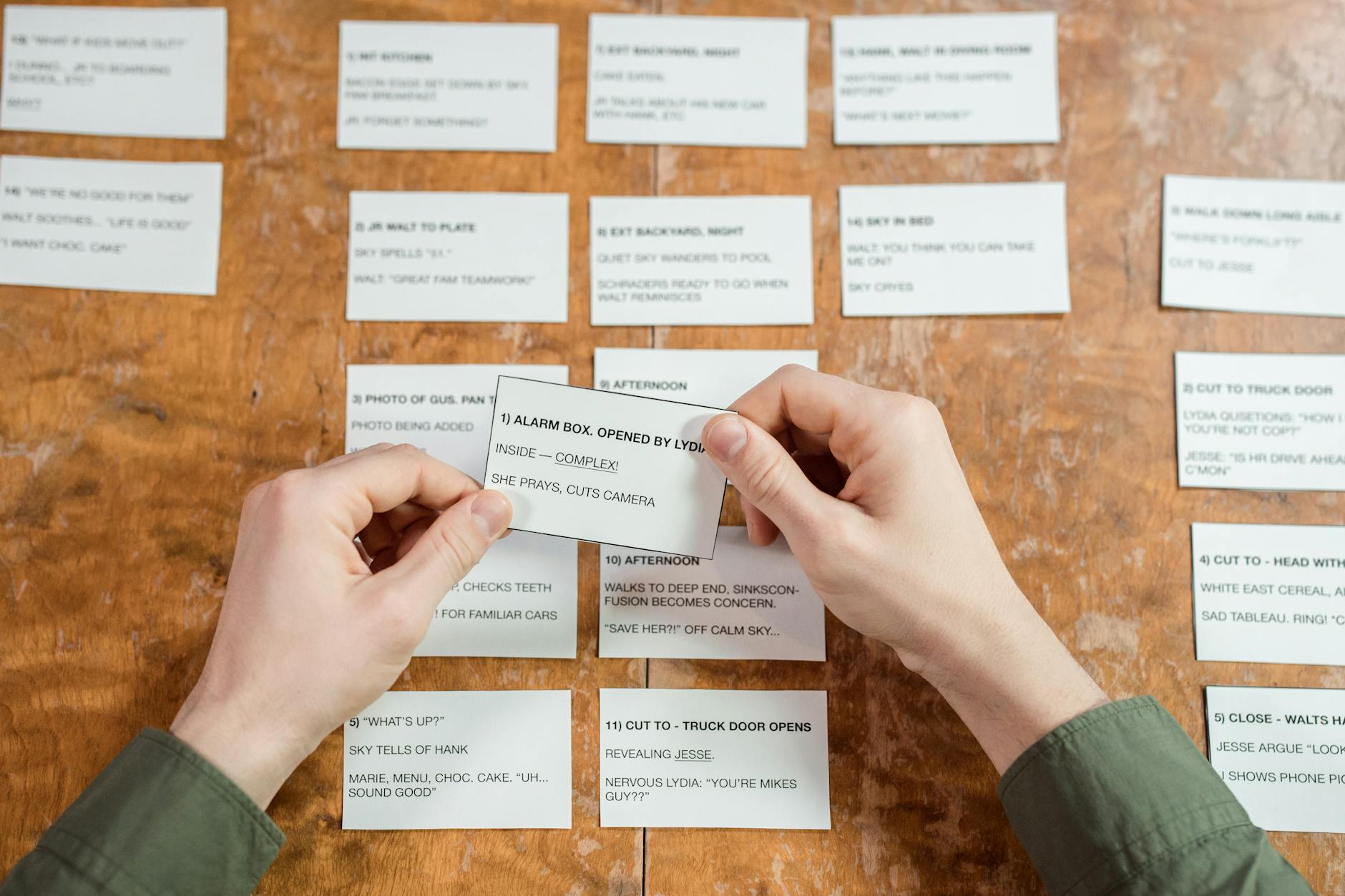
The Novel Smithy Lewis Jorstad explains that puzzling works by bringing elements of plotting and pantsing together.  For example, perhaps you have a brilliant story concept and can visualize several scenes in your mind, have a rough idea of characters and an inkling of how it will end. Using index cards or post-it notes, jot down each individual scene – one idea per card. You may not think of every scene right off the bat. You may only have three or four scenes to start. But that’s okay. What you are doing is creating a puzzle with various pieces that will eventually fit together. This is the discovery part.

Once you have a collection of scenes on index cards (or post-it notes), spread them all out on a table or tape to the wall so you can see them all at a glance. Then rearrange them in the order you think they should go. This is the plotting aspect.

Once the cards are in some story order, review them again. Note if there are any gaps in the sequence. Wherever there is a gap, insert a card indicating a scene to come.

The advantage to puzzling is that it allows you to generate scenes on the go. You don’t have to think of every scene before writing. You can write the scenes you do know, knowing the rest will come eventually. You don’t have to follow any structural rules.

Even while drafting, you may still come up with new scenes. When that happens, jot them down on a card and insert them where you think they might fit in the story. You can add or delete scenes and change the order of them as you go along. It gives you more control and flexibility than a straight plotting structure, which can be limiting to those who want to give their imagination free rein.

Another benefit is the ability to review your story at a glance scene-by-scene and make adjustments to the timeline. You can also identify which scenes are the key plot points of your novel.  I suspect this approach results in fewer rewrites.

Are there any downsides? So far, I haven’t found any, though I just started working with it for my current work in progress. In the short time I’ve been using this puzzler approach, I’ve learned a few things:

  1. It has helped me maintain my interest in the story. With previous approaches, I’ve invariably lost interest in my manuscript and given up on it, or got lost in the muddling middle.
  2. It allows me to assess my scene sequence and rearrange them as I see fit, without  having to rewrite anything.
  3. It helps me stay focused on one scene at a time. With one scene per card, I know what I’m writing next and I’m not left staring at a blank screen. The cards give me a clue and keep me on track.

    If you’ve tried plotting or pantsing, and they haven’t provided the results you want, give puzzling a try. You may find that being a puzzler makes you a more productive writer.  

Story Telling with a French Twist

(Image generated by AI).

Ever since I took French in high school, I’ve been in love with the French culture. During those four years under two different teachers, I learned about France through its music, art, literature and food. I learned to love the French Impressionists artists, like Renoir, Cezanne and Monet. We listened to classic ballads by Edith Piaf and Charles Aznavour.  As a class, we read The Little Prince (or should I say Le Petit Prince) by Antoine De Saint-Exupery. En francais, of course.

My high school experience culminated in a trip to Paris my senior year with my French teacher and classmates. We visited Montmarte, where a young artist drew my portrait. We toured Notre Dame and the Louvre, and we visited several chateaus outside Paris. And of course, there was always the Eiffel Tower and the Arc de Triomph in the background wherever we went. It was a memorable time.

That French influence is still with me several decades later. As an adult, I gravitate toward stories that take place in Paris or have a French theme. Kristin Hannah’s The Nightingale and The Little Paris Bookshop by Nina George are among my favorites. Some of the classics like Gustav Flaubert’s Madame Bovary and The Little Prince by Antoine de Saint-Exupery (this time in English) aren’t so bad either.

With the Summer Olympics well underway in Paris, it seems fitting to devote this week’s post to the novels that have been inspired by that beautiful city. My lists only scratch the surface, however. There are hundreds of novels set in France, which you can find on Goodreads or at your local bookstore or library.

Without further ado, here are my book lists featuring the City of Lights.

Contemporary novels that I’ve read and recommend to my fellow readers::
The Nightingale by Kristin Hannah
The Little Paris Bookshop by Nina George
The Little French Bistro by Nina George
The Hundred-Foot Journey by Richard C. Marais
The Alice Network by Kate Quinn
Sarah’s Key by Tatiana de Rosnay

I’m currently reading Suite Francaise by Irene Nemirovsky, a French Jew who was captured by the Nazis and sent to Auschwitz, where she later died. This novel was hidden and unknown for 64 years.

Contemporary novels set in France that are either currently on my shelf or on my wish list:
All the Light We Cannot See – Anthony Doerr
The Paris Apartment – Lucy Foley
The Paris Orphan – Natasha Lester
A Caribbean Princess in Paris – Adriana Herrera

Of course, we cannot forget the classics:

Victor Hugo, Hunchback of Notre Dame and Les Miserables
Alexander Dumas, The Three Muskateers, The Count of Monte Cristo.
Jules Verne, Around the World in 80 Days, 20,000 Leagues Under the Sea.
Charles Perrault. You may not have heard his name, but you know his fairy tales—Cinderella, Sleeping Beauty, Puss in Boots and Little Red Riding Hood.
Gustav Flaubert. Madame Bovary
Beauty & the Beast originally written by Gabrielle Suzanne Barbot de Villeneuve.

(Forget the Disney version. In the original version, Belle has three brothers and two sisters. There’s no Gaston, no magic and no curses on the palace staff.  Still it is an enduring story. Check out this film version released in 2014.)

While France resonates so much with me, you might have your own city or country that you gravitate toward with your reading choices. London? Greece? Italy? Asia? What is your favorite city or country to read about?

Entertain Readers with “Fish out of Water” Stories

One of the most commonly used tropes in story telling is the “fish out of water.” When written well, it can produce some laughs and high entertainment value for your readers. 

A “fish out of water” entails a person who is suddenly thrust into an unfamiliar world and faces numerous challenges when they try to fit in. They have to learn new rules of behavior, sometimes adopt a new dress code, and learn the language of the locals. Sometimes they can be at such a loss about what they’re supposed to do that they make things up as they go along. It can present some uncomfortable and hilarious moments.

You likely will recognize the trope from numerous movies, TV series and fiction. Think of Dorothy in the Wizard of Oz who wakes up after a tornado in Munchkin Land. Or Harry Potter who is transported to Hogwarts and is introduced to the world of magic. Or Mork, the extraterrestrial in the 70s sitcom Mork and Mindy whose errant spaceship lands on Earth.

The “fish out of water” story isn’t just for fantastical stories like Harry Potter and The Wizard of Oz. There are numerous examples you’ll find in everyday life.

  • In Hallmark Channel’s Summer in the City, a young woman with her own fashion business in a small Ohio town gets a job offer in New York City. How does she navigate life in the big city?
  • In The Beach at Painter’s Cove by Shelley Noble (which I just finished reading), a wealthy family suddenly loses their fortune and must figure out ways to earn a living.
  • In Open House by Elizabeth Berg, a middle-aged woman whose 20-year marriage ends in divorce. How does she navigate life as a divorcee?
  • A young pianist who loses a hand in a freak accident and must re-learn how to play using a prosthetic hand. (I made this one up.)

You get the idea.

Funny thing is, we’ve all been in situations ourselves where we felt like the fish out of water—starting a new job, getting married, getting divorced, having a baby, moving to a big city or a small town, winning the lottery, etc. In each of these scenarios, we experience that feeling of not knowing what we’re doing and needing guidance to simply survive. We want so much to fit in that we inadvertently stumble over our efforts, sometimes with embarrassing, if not humorous results.

That’s what makes these stories so relatable. Because we’ve all been there. We all know those moments of embarrassment of being found out, the secret fears of not fitting in. Of stumbling over new rules of behavior, like not understanding why you can’t utter the name of Lord Voldemort or how a modest Midwestern girl should hail a cab in Manhattan.

It’s also what makes these stories so fun to read and write. There are so many scenarios to show how complicated and challenging life becomes when your protagonist is thrown in the deep end of the pool and they must fend for themselves. Learning to live in this new world is the basis for your story, and how your protagonist deals with the trials and triumphs of adjusting is the basis of their character arc. It’s how we see them grow and adapt over time.

(Test yourself. Check out my latest writing prompt on my website, or create your own fish-out-of-water story.)

Being a fish out of water pertains to our writing careers too. Think about the situations you’ve found yourself in where you felt out of your element:
 
* Writing in a new genre that you’ve never written before.
* Attending a writer’s conference for the first time (in person, not on Zoom), surrounded by strangers.
* Approaching an editor about your latest project when you’ve never dealt with an editor before
* When you attempt to write in the first place
* Self-publishing your first novel

Being a “fish out of water” means trying new things, experimenting with different ideas. Visit places you’ve never seen, take a class, start a hobby, join a club. Don’t be afraid of embarrassing yourself when you find yourself in unfamiliar territory.

Feeling like a “fish out of water” is as common as breathing. Embrace the feelings of newness, of being the odd man out. Sure, it feels uncomfortable at first, but it can inspire stories of new adventures to entertain your readers.

Protagonists Behaving Badly

Photo by Mihai Stefan Photography on Pexels.com

Remember to check out the latest writing prompt on my website!

I’ve noticed an interesting trend in the books I’ve been reading lately. More and more, I’m reading stories with protagonists who aren’t the most likeable people on earth.

I’m not sure if it’s the types of books I’m reading, or that my self-study of writing has made me more aware of characters behaving badly. Perhaps I’m letting my moral compass dictate which characters I should and should not like. In any case, over the past year and a half, I’ve come across numerous protagonists with questionable habits and decision-making capabilities. Some of them I wouldn’t want to hang out with, let alone share a glass of wine.

I don’t necessarily like the term “unlikeable” in this sense. It implies that the character has no redeeming qualities, which is often not true. In you’re familiar with the Save the Cat storytelling method, writers are encouraged to give even the most awful villains some positive trait to balance out their personality. For example, after your character robs a bank and stabs a bank teller, he might come home and play with his two German Shepherds, a scene that shows his softer side.

Writing an unlikeable or unreliable protagonist isn’t necessarily a bad thing. Their flawed personalities might create chaos for the people around them and for themselves. Without their flaws, you wouldn’t have a story arc, an interesting, well-founded protagonist or conflict and tension that can keep readers reading.

Unlikeable protagonists can still be people we root for in the end. They can still earn our respect, even our compassion. It’s not always easy, but it can be done.

By my count, there are at least seven types of unlikeable protagonists (known in publishing as the anti-hero, which conjures up the song by Taylor Swift.) These characters simply get in their own way. I’ve listed them below along with a corresponding example.

1. Protagonists who don’t act their own age. These Immature characters act more like bratty teenagers than the mature adult they should be. Their behavior and decision making sets them up for trouble.

Example: The Girl I Was by Geneva Rose

2. A clingy protagonist or one involved in a co-dependent relationship. These individuals are so closely intertwined with another person that they lose sight of who they are and who the other person is. They’re so afraid of the future that they cling to the other person. Yet, they don’t recognize how the relationship has stifled their own existence.

Example: One Italian Summer by Rebecca Serle.

3. Protagonists with an addiction. Characters with an addiction to drugs and/or alcohol can find themselves in all sorts of trouble because their addition often clouds their perceptions and judgment. At their harshest moments, it can be difficult to feel anything for them. But of course, that is the basis of their conflict. Can they begin to resolve their conflicts despite the impact of their addictions?

Example: The Woman in Cabin 10 by Ruth Ware.

4. Protagonists who are unwilling to change their ways despite the truths they have faced. In a typical character arc, the character should experience some growth from point A to point F. But sometimes, the character doesn’t change much, no matter what they have learned or experienced in the story. Rather than embrace the changes that the plot begs them to accept, there is some aspect that scares them so much that they run and return to their old way of life.  

Example: Vanishing Acts by Jodi Picoult

5. A protagonist with an obsessive personality. After tragedy strikes or a personal crisis, the protagonist focuses all their time and attention on fighting a cause or in caring for another person. But when that character becomes so obsessed with that they lose sight of their own needs or the needs of other people in their lives, it can create unbreakable bonds. Only when a crisis occurs with other characters do they realize that their life is out of balance.

Example: Handle with Care by Jodi Picoult

6. A protagonist who treats others with disdain and arrogance. It’s hard to like someone who treats others like they’re dirt. At first glance, they may not have any redeeming qualities. Yet, if you look more closely, they usually do, and it’s usually buried under a veneer of anger or sadness or loneliness. Take, for example, Carrie Soto might be standoffish and arrogant around her competitors, but you have to admire her work ethic, her single-minded determination to win every tournament, and most important, her devotion to her father.

Example: Carrie Soto is Back by Taylor Jenkins-Reid

7. A character who takes advantage of the good, kind nature of a friend or loved one. These individuals have learned to live off of others, whether it’s because they grew up in poverty and never had enough growing up, or they believe they’re entitled to other people’s possessions. In other cases, they are starved for love and affection and believe they can get it by needing the help of others. Their neediness and manipulation can cause a lot of strife between characters. Sometimes the friendship survives.

Example: Best Friends Forever by Jennifer Weiner

By observing these characters’ struggles, we learn to empathize with these flawed characters. After all, we all have our own demons to slay. Why shouldn’t your own protagonists have them too? Let them reflect the people you meet in the real world, people who have their own private struggles, whether it’s dealing with grief, an addiction, job loss, a divorce, or a health crisis. That’s what makes these unlikeable characters a little more likeable—their relatability.

Writing experts offer a few suggestions for making these characters work well in your stories, despite their flaws.

1. Make them relatable. Give them problems to overcome, with their flaws acting as barriers to their resolution.

2. Give them redeemable qualities. Allow their humanity to show through. Give them a quality people will respect. For example, the playground bully who goes home every day and plays with his dog.

3. Show how they became flawed. Whether it’s through backstory or it’s a part of the novel’s set up, show how your protagonist became the person they are.

4. Sometimes, it’ not about the character’s personality but about their decision making process. It may be that you don’t agree with the decisions they make, whether they’re right or wrong.

Writing and reading about an unlikeable character can be both fun and enlightening. Just don’t take them too seriously; they are only fictionalized people, after all. Remember that all characters are flawed in one sense or another. As readers, we can learn to empathize with their struggles, no matter how likeable they may be.

Finding Your Creative Writing Niche

Photo by Suzy Hazelwood on Pexels.com

Editor’s note: I’m tied up with assignments this week, so please enjoy this reposted article from 2021.

When I first embarked on my writing journey, it was a challenge to shift from writing magazine features and website content to creative writing. It was a far cry from the business world, where the criteria was set by employers and clients. I had to shift from writing for business to creating whole new worlds in fiction.

Part of the challenge of being a creative writer is finding a niche. It’s deciding what kind of creative writing I wanted to do and what I was best suited for. Did I want to focus only on novels, or were short stories more my thing? Maybe I was drawn to the soul-baring essence of creative non-fiction, or the challenge of tackling a 100,000-word novel. Or would I be better suited for flash fiction where stories rarely exceed 1000 words? When I first dove into the creative writing pool, I thought I knew what I was doing. After all, I’d already had magazine features published and had received positive feedback about my writing from teachers and editors.

But I quickly realized there was a lot I didn’t understand. It was necessary for me to start from the beginning – to take classes, read up on story telling technique, and most important, to practice, practice, practice. I experimented with different writing styles. I attempted several novels as well as short stories and, more recently, novellas. I’ve submitted essays to competitions and sought feedback from writer’s groups. It’s all been part of a learning, growing process.

I’m still working toward finishing my current novel in the hopes it will one day be published. But I also understand that it takes more than talent to get there. It takes grit and determination and perseverance. It takes a consistent writing practice.

Here’s how you can find your own creative writing niche.

1. It’s important to read a lot, and to read a variety. In his book, On Writing, Stephen King says the best way to learn about writing is to read and to read widely. That’s how you learn how to craft stories, develop plot and character, create suspense and satisfy readers. By reading, you naturally absorb authors’ writing styles and adapt to your own. By reading, you also notice what works well in storytelling, and what doesn’t. Reading other authors’ works is a must to advance your own writing aspirations.

2. Know who you are as a writer and what you stand for. Julie Anne England of the Self-Publishing School says it’s important to assess yourself – your interests, your strengths and weaknesses, and your writing goals. That means understanding what you can tolerate in the world at large and what you can’t. Maybe writing critique groups aren’t your thing. Not everyone is cut out for them. Maybe you feel more inspired by writing in a semi-public place where there are other people nearby so you don’t feel so alone while you write. Or maybe you prefer to write at home alone. England advises writers to “be true to who you are. Trying to be someone you’re not will only impede your progress.”

3. Pay attention to the feedback you receive. Whether you get feedback from a writing buddy, a coach, a boss, or your website audience, pay attention to what they tell you. Do they like the way you describe a scene or the way you draw your characters? Conversely, are they confused by your plot structure or is your protagonist flat, lacking in emotion and personality? Then use their feedback to improve your work.

4. Learn as much as you can about the writing craft. Whether you’re just beginning your writing journey or you’ve traveled this road for some time, it’s important to keep learning. Readers’ tastes and publishers’ needs constantly change, so what was popular a year ago may be obsolete in another year or two. You need to stay on top of the publishing trends. Further, by keeping up with your professional development, you keep your skills fresh and learn new story telling techniques. You show agents and editors that you are willing to do whatever it takes to produce the best story possible.

5. Don’t be afraid to experiment with different genres and writing styles. Maybe you’ve been writing narrative non-fiction, but you’d like to experiment with writing short stories. Don’t be shy about taking a workshop about short story writing. You may decide after completing one or two stories that it just isn’t right for you. That’s okay. At least you tried, and there may be some things you learned about the writing process that can be carried over to your essays. Don’t be afraid to experiment to see what works best for you.

6. Be flexible and open-minded. Don’t get locked into your niche or specialty because it will likely change over time, writes Shaunta Grimes at The Write Brain blog. For example, when I started my blog in 2016, I wrote about a variety of writing and communications topics because that was my professional background. As time went on and I gravitated toward more personal writing and less business communications, my blog reflected that shift. Now I focus almost exclusively on essays about the writing life with some posts about fiction writing thrown in. Allow your personal interests to dictate your path.

If you want to know more about what kind of writer archetype you are, check out this quiz at The Write Brain blog. (Note: You will need to create an account to read the article on Medium.) Find out if you are a Hesitater, a Skipper, a Spiller, a Teacher or an Artist. It will help you learn what you write and why. (Btw, I’m a teacher, which should be obvious from my blog.)

The beauty of creative writing is that there are multiple paths to choose from, and it’s not uncommon for writers to specialize in more than one genre or writing style. Finding that niche, however, depends on knowing who you are and what you have to offer readers. 

10 Signs Readers Connect with a Story

Photo by Inna Lesyk on Pexels.com

Over the weekend, I stayed up past my regular bed time to finish a book I’d been reading. That doesn’t happen often. Usually, after reading a chapter or two, I’m ready to hit the sack.

But this book, The Truth about Forever by Sarah Dessen, made me want to keep reading until the end. With about 40 pages left to read and the climax fast approaching, I didn’t want to wait until the morning to find out how the story ended. So I kept reading.

That experience made me wonder about reader engagement. Are there certain signs or behaviors that show readers are engaged with your story? I thought about my own reactions when I read. I started to notice the differences between how I feel about a story that truly engages my heart and mind and ones that fail to connect with me.

There’s a lesson to be learned here for aspiring writers. When writing your own stories, think about how you want your readers to react to them. What do you want them to remember about your story? How do you want them to feel when they finish reading it?  

So how do you know your story is connecting with readers? Here are the signs I’ve noticed in my reading experience. Which of these reactions resonate with you?

  • I keep turning the pages to find out what’s next. Sometimes that means staying up late past my bed time to finish reading a book. Especially if I’m getting close to the end of the book and I want to finish it. It’s that feeling of unfinished business that prevents me from turning off the light. So I keep turning the pages until I get to The End.
  • I mark the pages with memorable passages. Some of the books that are the most engaging tend to have moments of profound insight. When I find a passage that’s especially poetic and insightful, I use a post-it note to tab those sections, just in case I want to go back and read them. That way, I can find them more easily.
  • I want to find out more about the author. Where are they located? Did they obtain an MFA? How many other books did they write? After reading Dessen’s book, I did a Google search about her and read summaries of her other books, making note of which ones I want to read.
  • I refuse to give the book away—at least not right away. After I’ve read my favorite books, they tend to sit on my shelf for several years sometimes. A part of me wants to stay connected with the story for as long as possible. By giving the book away, I feel like I might forget the story. So I hold onto it until I’m ready to part with it, usually when I need to make space for other books.
  • I share my experience with other readers. I gladly refer the book to someone else who’s looking for an engaging read. I might even take a photo of the cover and share it with my friends on Facebook. Or I might write about it here on my blog. If the book is that good, it’s a shame to keep it to yourself. I have to let other people know about it.
  • I tell myself that this is the type of story I want to write. I observe how the writer has weaved the plot points, developed the characters and created suspense. There’s a lot I can learn from observing how they developed their story. Add to it some emotional insight or message that resonates with me, and I’ve found the formula for success. I know then that that’s the type of story I want to write.
  • I constantly think about the story and the characters when I’m not actively reading it. I could be doing some house cleaning or going for a walk, but I may still think about certain scenes that somehow stay with me.
  • I occasionally think about the book long after I’ve read it. It could be six months later or several years later, and I’m still thinking about the story. Perhaps that is the greatest level of engagement—longevity. I will always remember how I felt reading the ending of The Nightingale, even though I read it about five years ago. Some books simply have staying power.
  • The book touches my emotions in some way. When I get to the end of a story, I check in with myself. How do I feel about how the story ended? Satisfied? Surprised? Disbelieving? When I finished reading The Messy Lives of Book People by Phaedra Patrick (which is still sitting on my book shelf), I recall having a big smile on my face. The book gave me such joy, and the journey the author took me on was satisfying in so many ways. Patrick resolved all the plots in a way that not only made sense, but made me feel good. That’s a mark of a smart story teller.
  • I develop a relationship with the main character. When I can connect with the main character, I have more at stake in the story—the protagonist’s story. I’m a bit partial to first person POV, and Dessen used it effectively to bring emotional depth to her main character. I felt her pain and her joy. I saw what she saw and experienced what she did. When I connect with the main character, I want to keep reading to make sure they find their happily ever after.

    What about you? What signs do you see in your own reading experience that show you are truly engaged with the story?

Tips for Creating a Compelling Opening Chapter

I had planned to write a post about what makes a great opening chapter or first 10 pages, then I realized I had already written a post about it several years ago.. I couldn’t think of any way to improve it, so I am repeating it here. The information is especially helpful for those participating in National Novel Writing Month (NaNoWriMo).

Photo by Suzy Hazelwood on Pexels.com

If you’ve ever read The Nightingale by Kristin Hannah, you probably remember this opening line:

“If I have learned anything in this long life of mine, it is this: In love, we find out who we want to be; in war, we find out who we are.”

I’d be hard pressed to find any opening more poignant than this one. From the very start, readers are taken on an emotional journey that doesn’t end until the final sentence.

Writers are tasked with the challenge to create a similar experience with their readers. The start of any  novel should accomplish several things: create the tone of the story, provide the point of view, reveal character, and show tension and conflict, among other things. Certainly, the opening line from The Nightingale accomplishes most of these objectives. Does your story do the same?

Why is the opening so critical? Because if it doesn’t grab the reader’s interest and keep it for the first few pages, the reader will likely close the book and set it aside, never getting to the end of it. Ask any published author, editor or agent what makes a strong opening, and you’ll hear a number of answers, which are summarized below. And these suggestions don’t just pertain to fiction, but to short stories, memoir and non-fiction works too. Without a compelling start, readers will dismiss your effort.

If you are participating in NaNoWriMo (National Novel Writing Month), keep the following suggestions in mind as you write the opening of your novel.

1. Skip the prologue. There is ongoing debate about the merits of a prologue. Many editors and agents feel they aren’t necessary. I tend to agree with them. I’ve rarely read a prologue that made a difference in my understanding of the plot. The one exception is Caught by Harlan Coben, which provided sufficient background on one of the main characters to make you second guess the outcome. But if you plan your story well and write the opening pages right, there shouldn’t be a need for a prologue.

2. Create a protagonist that readers will care about. The opening is your opportunity to reveal your protagonist’s character. Is he/she rebellious, angry, ambitious or curious? In the above opening from The Nightingale, the character speaking is introspective and perhaps has gained wisdom from life experience. It makes me care about who she is and what else she (and it is a she, btw) might have to say.

3. Ground your reader in the story’s setting. According to the Write Practice blog, let readers see where the story takes place. Establish early on what the setting is for the story – the time period, the location, the season of the year, etc. When the reader feels grounded in the setting, they feel mentally prepared to experience the events as the characters do.

4. Create conflict and tension. Identify what the inciting incident is – that starting point to your story that changes the status quo. Where is the conflict? Is that conflict with another character, with a situation or within themselves? That conflict is needed to create tension, which helps draw readers in and keep them reading to see how the conflict is resolved.  

5. Don’t frontload with dialogue or action. According to Fuse Literary, too much action or dialogue can confuse readers. Sure, you want to start with some sort of action, but an opening chapter heavy on action and dialogue and not enough narrative or backstory can be confusing to readers who may need a point of reference to understand what is happening on the page. You need some action, of course, but balance it with some narrative so you don’t lose readers’ interest.

6. Don’t overload the opening with backstory either. According to recent Reedsy webinar, Crafting a Novel Opening, writers should focus on what the reader needs to know at that moment. There’s plenty of time to reveal backstory and world building as the story progresses, says Shaelin Bishop who led the discussion. Weave in backstory throughout the length of the manuscript, and allow details to breathe between scenes. This approach will help with the pacing too. If readers are overloaded with details up front, they may feel overwhelmed.

7. Hook the reader with an interesting twist. Start where the story gets interesting, which is usually at the point where there’s a change in the status quo. For example, the protagonist gets a letter with good news or bad news, a new person enters the protagonist’s life, or they get into an accident that alters the course of their life.  “Show what is interesting rather than focusing on the mundane. It’s okay to show less of the status quo than you think you need to,” says Shaelin Bishop with Reedsy. This approach avoids overloading your opening chapter with too many details that can bore your reader.

8. Every scene should serve several purposes. For example, one scene can establish the tone of the story, reveal something about the character and hint at future conflict. This sounds complex, but it’s necessary to keep the story moving forward and keep readers interested. Don’t waste your first sentence, or any sentence for that matter. Write every scene with a purpose in mind. If it doesn’t serve  purpose, and if a character doesn’t serve a purpose, cut them out.

To get into the habit of writing stronger openings, try these two exercises.

Exercise 1: Take 10 minutes and create as many opening sentences as you can think of. It could be for a current work in progress or any other story. Experiment with different perspectives. Here are a couple of examples of intriguing openings that made me keep reading:

“You would think it would be impossible to find anything new in the world, creatures no man has ever seen before, one-of-a-kind oddities in which nature has taken a backseat to the coursing pulse of the fantastical and the marvelous. I can tell you with certainty that such things exists ….”
The Museum of Extraordinary Things, Alice Hoffman

“My name is Serena Frome (rhymes with plume) and almost forty years ago I was sent on a secret mission for the British Security Service. I didn’t return safely. Within eighteen months of joining, I was sacked, having disgraced myself and ruined my lover, though he certainly had a hand in his own undoing.”
Sweet Tooth, Ian McEwan

Exercise 2: Select five novels from your collection that you enjoyed reading. Go back and read the first page from each one. What made you turn the page? Why did it grab your interest? Did it reveal anything about the setting, tone or character? Did it create tension and conflict? What can you learn from these first pages that you can adapt to your own work?

Follow these tips to make your opening chapter compelling enough to keep readers engaged to the very end.

Eight Favorite Romantic Tropes to Make Readers Swoon

Photo by Mihai Stefan Photography on Pexels.com

February is the month for love, and if you’ve been following my blog, you know I’ve been talking a lot about romance – the language of love. Romance novels are more popular than ever these days. Who doesn’t want to read about a happily ever after? Most people, I think, still believe in true love, or that love conquers all.

Sure, the romance genre has its critics who say these stories are predictable, they can’t be taken seriously, or that they don’t reflect real world relationships. It’s true that romance stories can be predictable. You sort of know what is going to happen from page one. But it’s that expectation of predictability that appeals to many readers. Readers expect a happy ending, and they expect the couple in question to struggle through their attraction.

What make romances even more interesting are the tropes that help set up the romantic plot. You may find everything from a fake engagement to enemies-to-lovers story lines, May-December romances and second chance relationships. There are dozens of tropes used in romance novels, and some are more intriguing than others.

Below are some of my favorite romantic tropes and why I think they work.

  1. Secret identity – My personal favorite is the secret identity in which one person hides some aspect of themselves. Perhaps they’re ashamed of who they really are, or they’re trying to gain a professional advantage or they feel that they won’t be taken seriously if the other person knows who they really are. For example, a wealthy person might pretend to be an average blue-collar worker to blend in with the community, or a member of royalty decides to live among the commoners. This trope is my favorite because it creates the most intrigue and mystery within the romance. When and how will the protagonist reveal their true self? How will the love interest react when they find out who the other person really is? Will they still love each other in the end? There’s usually of fear of being found out, or wanting to find the right moment to reveal themselves. Except while hiding out, they learn to care for the other person.
     
  2. Road trip – There’s nothing like a long-distance road trip that can force two people to come together—against their better judgement. They usually disagree about something or have opposing points of view that creates the tension in their relationship. At some point, something or someone has to give in. Either they come to an understanding and learn to respect, if not love, each other, or they are ready to tear the other person apart. This doesn’t have to be a romantic relationship either. Think of films such as Driving Miss Daisy or Green Book.

  3. Girl/Guy next door – I think this is one of the simplest and most overlooked tropes because I think it happens in real life more often than we think. Sometimes our best love connections live right across the hall in our apartment building or in the house next door. These characters already have something in common – they live in the same building or neighborhood. The closeness forces the neighbors to keep running into each other, so they’re bound to start up conversations, which can lead to coffee dates, movies, and so on.

  4. Fish out of water – This trope can be the most creative and humorous because you see a character who it totally out of their element. Think of the movie Enchanted when Amy Adams’ princess character complete with her pink gown is clearly out of place in downtown Manhattan. The humor comes from seeing the missteps and assumptions the character makes to try to fit into her new environment. Enter the unwitting partner who helps the out-of-place character become more acclimated and falls in love with them in the process.

  5. Stuck together/stranded together – Whether it’s an elevator, a raft a long way from shore or inside a locked bank vault, when two people are stuck together for a short period of time, it’s bound to create a sudden kinship that wasn’t there before. They have no choice but to work together to get themselves out of their enclosed quarters, but once they do and they are free, what happens after their brief encounter? Do they decide to see each other again, or do they move on as if they had never met?

  6. Ghost/angel – Who doesn’t like a little bit of divine intervention to help a romance blossom? In this scenario, when a character struggles to find true love, a ghost/angel intervenes on the character’s behalf, usually dispensing sage if cryptic advice, and it’s usually up to the character to figure out what that means. Perhaps the angel is someone from the character’s past, or it’s an angel who is working toward earning their wings. Sometimes it’s the angel/ghost character who wins the person’s love, while other times they simply act as a guide to help the two lovebirds find each other.
    Examples: City of Angels with Meg Ryan or Hallmark Channel’s Christmas in Angel Falls.

  7. Belated love epiphany – This is another underused trope, yet I think it’s more reflective of the real world. In this scenario, two people have known each other for years as mere acquaintances, colleagues or friends. They spend so much time together in a neutral setting yet neither sees the other as a potential love interest. But as soon as one person leaves or threatens to disappear from  everyday life or marry someone else, the other person suddenly realizes how much they love them and fights to win them back.

  8. Forced proximity – Two characters fall in love after being forced to live or work in close proximity to one another. Maybe they have to work together on a project but come with opposing viewpoints and agendas, like writing a book or training to compete in a sporting event. Or they’re stuck in the same country cottage on vacation because the company doubled booked the accommodations. Now they have to figure out how to live together or find other living arrangements. After a few hours stuck together, they manage to enjoy each other’s company.

There are many more tropes, and many overlap. You’ll likely find several tropes used within one story. While they may not be the most imaginative of scenarios, readers and audiences still crave them. They bring a sort of comfort because they’re familiar. To make them interesting, however, try mixing and matching the tropes or turning them upside down in some way.

When used well, tropes can help you create a romance that readers will swoon over.

Tips for Developing Suspense in Your Novel

Photo by Anete Lusina on Pexels.com

When you read a book, what is the one element that keeps you turning the page? Most likely, it is suspense.

Everyone has their own definition of suspense. Some dictionaries describe it as a state of excitement, anxiety or mental uncertainty. For works of fiction, book coach Samantha Skal defines suspense as “the question asked.”

It’s an odd definition, to be sure. But think about the myriad of questions you ask yourself, however subtly or subconsciously, as you read a story.

* Will the hero stop the bomb in time or will it explode?
* Will the couple get together at the end, or won’t they?
* Will she keep her baby or give it up for adoption?
* What will they do next?

“Suspense is the engine that keeps the story going,” says Skal who spoke at a recent Pro Writing Aid Romance Week event. “It increases reader engagement, reader satisfaction and improves pacing of the story.”

There are different types of suspense. There’s the big, scary kind where the serial killer terrorizes the town. Romantic suspense teases readers with the promise of two people getting together. There’s emotional tension, too, when the main character is battling internal demons, such as guilt or resentment. Finally there’s goal tension when readers wonder whether the character will finally earn that promotion or new job.

The simplest way to achieve suspense is to put obstacles in the way of the characters. Whether you’re writing a thriller, science fiction or a romance, several techniques can be used to add suspense to your story.

  1. Reveal inner thoughts and reactions of the main character. This is especially true if you’re writing in first person or third person close. By revealing the main character’s thoughts and perspective. In this way, readers are able to see the action in the same way and at the same time as the main character. So when the character feels tension makes an assumption about another character or misinterprets what they see or hear, readers witness that experience too. That moment when the character experiences a crisis creates tension that the readers feel.   

  2. Use hanging questions. Ending chapters with a hanging question often leaves audiences wondering what will happen next. For example, the character may ask themselves how they got themselves into such a mess, which may make readers wonder how they will get out of it. Hanging question keeps the action going, and keeps readers turning the page to find out what really does happen next. Make sure you answer the hanging questions right away, preferably in the next chapter. A word of caution though. If you have too many hanging questions in consecutive chapters, it can appear redundant. In other words, boring.

  3. Ramp up tension gradually. Skal suggests establishing tension as close to the action as possible. Then gradually ramp up the intensity with each chapter. At the halfway point of the story, something in the story changes, moving it in a new direction. At the resolution, wrap up all loose ends. But just to be sure you haven’t lost readers’ interest, add another twist or surprise revelation at the 95% mark.

  4. Emotionally manipulate your readers. Skal says it’s okay to do that since most readers expect certain things to happen at certain times in the story. In mysteries, for example, readers look for the mystery to be solved. In thrillers and suspense stories, they want to feel a low-grade fear the whole time, and they want to feel their heart racing.

  5. Be intentional about what you reveal – and when. Details about a character’s backstory, family history, and personality should be sprinkled throughout the story, when it makes sense to a particular scene. If you reveal everything at one time, it can be overwhelming for the readers. Also remember that if you mention a detail early in the story, it should have a purpose later on. For example, if your character notices a clock that has stopped early in the story, that detail should come into play later on.

Without suspense, your story won’t keep readers interested until the very end. By paying attention to these techniques, you can create stories that will keep readers turning the page.