Know the Pros and Cons of Ghostwriting

Photo by Karolina Grabowska on Pexels.com

October theme: Scary, ghostly things related to writing

As a writer, there are numerous paths to take in your career and different ways to specialize. Ghostwriting is one of them.

According to content marketing platform CrowdContent.com, ghostwriters are “professional writers who craft material for others, taking a client’s vision, story or idea and creating a polished, publication-quality product that the client can attach his name to and call his own.”

You likely equate ghostwriting with celebrity memoirs, autobiographies, novel series and nonfiction e-books, but ghostwriting can be done for business writing too, such as press releases, blog posts, opinion pieces and speeches. You might have done a few ghostwriting assignments without recognizing it as such. Maybe you wrote a speech for a community leader or a VIP at your job. Or maybe you wrote a letter to the editor on behalf of someone else. Ghostwriting is just one more service to offer clients.

But breaking into ghostwriting isn’t easy and assignments are difficult to find, which can deter novice freelancers from entering the field. But there are advantages to writing for others too. Below is a brief breakdown of the pros and cons of becoming a ghostwriter.

Pros

1. Ghostwriters can earn income while pursuing your own projects. While you give up the byline, you get paid for your efforts. Plus in between ghostwriting assignments, you have time to work on your own projects.

2. Assignments can cover almost every topic under the sun. You may be assigned to write about anything whether it’s a self-help book, the Vietnam War or home decorating, you can learn plenty along the way. If you love to do research and are open to learning about different topics, ghostwriting might be the right gig for you.

3. You don’t need special credentials to enter the field. According to Careermetris.com, Advanced degrees and special certifications aren’t required to become a ghostwriter.
As long as you can write well, listen to your author carefully and take copious notes, you can succeed as a ghostwriter. As writer Jon Reiner writes, “A successful ghostwriter is first a good listener, and then a good writer.”

4. You are responsible only for writing, nothing more. Once the project ends, your responsibilities end too. You aren’t involved in other aspects of the project, such as production and marketing. Writers don’t need to be concerned with making public appearances and interviews to promote the book either since that will be the author’s job.

5. Once established in the field, ghostwriting can be lucrative. According to Fast Company, less experienced ghostwriters can earn $20,000 to $30,000 per project while intermediate level writers can earn more than $50,000. Once established, early assignments can lead to bigger and better paying ghostwriting gigs.

Cons

1. Ghostwriting is a competitive field. There are few opportunities available, and few of them are openly advertised on job boards. Assignment lead can be difficult to find and it can be painstakingly slow to develop contacts to find potential leads. Patience and persistence are needed to find that first assignment.

2. You have to give up a byline. Your name usually does not appear on the finished product. You do all the work but not the credit, though you do get paid.

3. You have to work for someone else. That person makes the decisions, which you may not agree with. You have to set aside your ego to work with them, and you will have little control over the project outcome.

4. There may be strict deadlines and fast turnaround times. According to CareerMetris.com, you might be required to work longer hours to meet a deadline because the author wants to publish a book to respond to current events.

5. The work may not be very interesting. Despite the fact that ghostwriters might cover a myriad of topics, you may find those topics boring or beyond your expertise.

Before specializing as a ghostwriter, consider the pros and cons. Which of these conditions can you live with, and which of them are deal breakers?

It might be helpful to talk to a few established ghostwriters to learn about their experience. Check out the Association of Ghostwriters to learn more about this niche.  

Despite the potential downsides, ghostwriting for others can be a satisfying way to earn an income while pursuing your own passions.



The Seven Scariest Excuses People Make to Avoid Writing

Photo by Suzy Hazelwood on Pexels.com

If you’re like most people, you’ve probably made a myriad of excuses for not getting any writing done – lack of time, fear of failure, too busy, no privacy, nothing to write about, etc.

Below are the seven most common excuses I’ve heard people use to explain why they aren’t writing. I call them the Seven Deadly Excuses because they can kill a person’s writing practice before it has a chance to flourish. Many of these excuses are influenced by negative messages and assumptions you’ve heard since childhood. By reframing these messages and taking positive action, those fears will diminish over time.

Excuse 1: “I don’t have time to write.”
A lack of time is the most common excuse people make about not writing. If this is your biggest fear, chances are your writing practice has never gotten off the ground, or you write in fits and starts. You always talk about wanting to write, but you never do anything about it.

The problem isn’t that you don’t have time to write, but the expectation of how much time is needed for writing. If you expect a writing practice to take up two, three or four hours every day, that is unrealistic. No one has that kind of time. With full-time jobs, clients to take care of, families to raise and other important responsibilities, there’s little time left over for writing.

The truth is, you don’t need hours at a time to write. When you’re just starting a writing practice, only ten or fifteen minutes a day will suffice. For example, while working as an attorney, A Time to Kill author John Grisham set a goal of writing one page per day, roughly 200 words. Grisham shows it is possible to fit writing into your schedule.

Excuse #2: “I’m too busy.” 
When you say that you’re too busy to write, what you may actually be saying is that writing is a low priority compared to other responsibilities, such as a work, school, taking care of kids or aging parents, etc. Who has time to begin a writing practice when all these other priorities compete for your attention?

Perhaps you learned in childhood that school work and household chores came first before you could watch TV, play with your friends, or write in your diary. If this was your experience, writing became a low priority.

But maybe it’s time to rethink those priorities. Maybe it’s time to make writing a higher priority than before. When you make writing a priority, you’ll find it’s easier to begin a regular writing practice. If all you need is fifteen minutes a day, that’s time well spent, no matter how busy you are.

Excuse 3: “My writing isn’t good enough.”
From the first moment you put pen to paper, your writing probably won’t be very good.
That’s normal for most beginning writers. But it’s true for experienced ones too. Kristin Hannah, author of The Nightingale, writes as many as 10 drafts of each novel because she knows the first draft isn’t her best or final work. It’s simply the starting point that she can build on.

If you continually tell yourself that your writing is not good enough, ask yourself why you feel that way. What is your writing not good enough for? Publication? For other people to see?

Instead of berating yourself for not writing well, make a plan to keep improving. Read authors whose work you admire, so you can learn from them. When you write something, ask for feedback. Constructive criticism can help you spot recurring errors. Most important, write, write, write.

Excuse 4: “I don’t know what to write about!”
Do you suffer from blank page syndrome – the act of staring at a blank page or computer screen with no idea what to write about?  Or when you do come up with a story ideas, do you dismiss it as uninteresting?

When faced with a blank page, you may be overlooking the best source of story ideas: personal experience. You have plenty of life experience to draw from, so explore those events from your past to adapt to your stories. One way to access this reservoir of life experience is with writing prompts. You can find hundreds of prompts on sites such as  Writer’s Digest and DIYMFA.com.

Excuse 5: “I don’t have a private space to write.”
If you share a home with a spouse, three children, a dog and two cats, it may be difficult to find a quiet, private space to write. Others believe that without ideal circumstances, such as a desk and comfortable chair, their favorite coffee mug and favorite pen, they’re just not able to write.

You need to ask yourself if the problem is an actual lack of space, or the expectation that you need a lot of space to write. I’ve drafted blog posts on breaks at work, on buses and trains or while waiting for appointments. If you wish you had ideal surroundings and your current environment is far from ideal, you may be waiting forever to start writing. The truth is, your environment does not need to be perfect to begin writing.

Excuse 6:  “I’m afraid to fail.”
Another common excuse writers make is “What if I fail?“  The answer depends on how you define failure. What does failure look like to you? Not getting published? Not finishing your current work-in-progress? Not having anyone read your work? Not having anyone take your writing as seriously as you do? Everybody has their own definition of failure, but in reality, there is only one true failure: not writing at all.

To remove that fear of failure, it might be helpful to start small and work your way toward bigger projects. Start with stories of 100 words, then increase it to 200 words, and so on. Every week or so, add to your daily word count. When you reach these smaller goals, you gain confidence in yourself and you achieve small successes that you can build on.

Excuse 7: “What if I’m successful?”
While fear of failure is common among writers, others suffer from a different malaise:  fear of success. “How can anyone be afraid to succeed?” you ask. You’d be surprised at how many people fear success, myself included.

Fear of success might manifest as an unfinished project – or two, or three or ten. You have several projects in various stages of completion but never seem to finish any of them. In your mind, finishing one of them means you’ve achieved success. Then you worry about what happens when you finish that project. Perhaps you edit your piece over and over again, never fully satisfied with what you’ve written – a useful delay tactic preventing you from finishing your work.

If you fear success, then you may need to rethink what success means to you. What does it look like? It may look and feel differently to you than to your spouse or your best friend. Are you defining success on your terms or someone else’s?

When you define success on your terms, there should be no reason to fear it because you’ve defined it based on real, concrete and meaningful terms. It’s when you follow the path of success that others have defined for you that can strike fear in you. Write  according to your definition of success, not anyone else’s.

When you manage your expectations to conquer your fears, the writing life won’t seem so scary.


Six Lessons Writers Can Learn from the Life and Career of Ruth Bader Ginsberg

Photo by Matthis Volquardsen on Pexels.com

Like most people I know, I was devastated to learn of the passing of Supreme Court Justice Ruth Bader Ginsberg. She had been a mainstay on the U.S. Supreme Court for several decades, and only the second woman to serve behind Sandra Day O’Connor.

Her passing has made me think about my own legacy. What kind of impact do I want to make in my career as a writer? I can’t possibly live up to the same standards of success as RBG, but certainly I can make the world a better place in my own way through my writing.

Fight for the things you care about, but do it in a way that will lead others to join you.” Ruth Bader Ginsberg

As writers, we can all learn something from Ginsberg through her experience as a law student, an attorney, college professor, circuit court judge and Supreme Court Justice. Here are a few of them.

1. Don’t let rejection deter you from your goals. Ruth Bader Ginsberg graduated from law school at a time when women weren’t allowed to practice in law firms. She applied to hundreds of law firms and was turned away because she was a woman. RBG altered course and did what most other women who graduated law school did – she went into teaching. But she used her legal education to take up the fight for gender equality so that women wouldn’t experience discrimination like she had.

As writers, we’re bound to receive hundreds of rejection letters. But that shouldn’t mean we stop writing. Don’t let rejection deter you from writing. There’s always something to say, something to write about, even if others don’t want to read it or publish it. Keep writing. Somewhere there is an audience for your work.

2. Find a cause to be passionate about. After her numerous rejections by law firms, Ginsberg found her cause – gender equality and civil rights. And she persisted in her fight for equal rights throughout her career.

Writers too can find a cause to be passionate about. Whether that cause is social equity, climate change or rescuing homeless pets, your passion can fuel your writing. Write essays, letters to the editor, opinion pieces, even short stories that carry a theme around your cause. Use your words to fight for a cause that’s important to you.

3. Have a Plan B. I heard an interesting story during RBG’s televised memorial last week. Sandra Day O’Connor, the first female Chief Justice of the Supreme Court, once asked Ginsberg, “Where do you think we’d be if we had been accepted into a law firm? We’d most likely be retired from a law firm.”

In other words, neither woman would ever have been named to the Supreme Court. Their rejection by so many legal firms proved to be a blessing in disguise for it paved the way for a different legal career path.

As writers, it’s important to view repeated rejection as a sign that it may be time to change course, to redirect your energies elsewhere. For example, if you keep looking for work in the corporate world and keep getting turned down, it may be a sign that your talents are needed elsewhere, perhaps in a new industry or as a freelancer. It’s up to you to figure out how and where. Sometimes rejection means a better opportunity awaits you in a direction you never considered.

4. Do your homework and get the facts. For every case Ginsberg ever worked on, she needed to do research. Her ability to review past cases, study data, and conduct interviews was key to making her case in a court of law. As a Supreme Court Justice, there were numerous cases to review, hearings, review testimonies and more reading and research. Only then was she able to provide her judgment on key issues.

As writers, especially those in journalism, research is a key component of your work. It’s necessary to get all the facts, interview credible sources, and be thorough in your investigation. Presenting factual data helps establish your authority and credibility. People will want to believe you because you’ve taken the time to do your homework.  

5. Work for the common good. Whether through her teaching, trying cases on behalf of the ACLU, or hearing cases as a Supreme Court Justice, Ginsberg made sure she made decisions that benefited all people. She was committed to making the world a better place.

As writers, it’s important to write for the common good too. Use your words to persuade, examine, educate and inspire others. Like RBG, be kind and helpful to others, even if they don’t share your views.

6. Surround yourself with a strong support team. Ginsberg’s husband Marty saw Ruth’s potential while they were in college together. Many years later, when RBG was nominated for the Supreme Court, Marty became her cheerleader. Because she didn’t care for schmoozing, Marty met with Senators to persuade them that she was the right person for that role.

Writers can benefit by having one or two people in your inner circle who will go to bat for you, who will cheer you on when you finish that first novel, promote your work, and give constructive feedback. We all need that one person who supports our work and who sees our potential long before we do.

Throughout her long and productive career, Ruth Bader Ginsberg made a big difference in many people’s lives. As writers, we can all learn to approach our life’s work with the same grace, compassion and wisdom that made RBG so successful.

Nine Ways You Can Benefit from a Consistent Writing Practice

Photo by Leah Kelley on Pexels.com

As I’ve developed my writing practice over the years, I’ve noticed that my writing has improved significantly, and my approach to storytelling has changed. I’m finding my writing voice, and I think that’s due to my willingness to experiment with different techniques and reading more books from different genres and authors. My writing practice has also helped me build a collection of work, whether published or not, that I can be proud of.

Ask any writer about how writing has improved their lives, and they will tell you all sorts of stories similar to my own. Here are examples by Jeff Goins and Darius Foroux. Below are some of the ways that a regular writing practice can benefit you.  

* A writing practice helps you build confidence in your abilities. If you’re just starting a writing practice, I advise you to start small. Start with 100 words, then after a week or two, increase your word count to 250 words. Then maybe after another couple of weeks, you can work your way up to larger pieces. As you reach each goal, you gain confidence in yourself and you feel ready to tackle larger pieces.    

* A writing practice allows you to experiment with different genres. You may not know how to write an essay or short story, but a writing practice gives you the space to experiment. Until you try to write in a certain style, you won’t know what you’re capable of. With each small success, you gain confidence in your abilities.

* A writing practice helps you find your voice.
When you begin to write, you may be unsure what your writing voice sounds like to your own ears, or what it feels like within you. It may be tempting to copy the writing voice of a favorite author. But that likely won’t feel authentic, and it certainly won’t appear authentic to readers. Writing every day, even for just 15 minutes, helps you tune into your own thoughts, ideas and memories. You become more in tune to yourself. With time and practice, your voice emerges on the page.

* A writing practice helps you improve technical skills, such as grammar and punctuation. The more you write and read, and the more you get feedback about your writing, the more your writing will improve. According to the Grammarphile blog, as you write, you naturally learn more about the mechanics of writing – and reading – and you develop a stronger vocabulary. Once you know the rules of grammar and punctuation, you know when it’s okay to break those rules when it’s appropriate for your story.

* A writing practice improves your mental and emotional well-being. By writing, you release emotional burdens you may not have known you were carrying. By writing about emotional issues, you begin to make sense of them. While the experience may never leave you entirely, the writing process serves as a vital outlet for healing.

* A writing practice clarifies your thought processes. When you begin to write about a topic, especially one you know very little about, your thoughts may start out in a confused jumble of words. As you continue to write, however, those thoughts seem to straighten out, the fog lifts and you can express your beliefs and ideas more clearly. Again, it may not happen overnight. It may take several sessions of writing, but your thoughts eventually gain clarity.

* A writing practice opens a path to greater creative self-expression. This benefit seems obvious. Not only do you gain clarity of your thoughts, you’re able to delve into more creative ways of expressing those ideas. The more your write, the more your mind works to find different phrasing and rhythms in your words that help you tell your story.

* The writing process gets easier with time. I find that the more I write, the more easily words begin to flow as soon as I put a pen to paper. Writing becomes less forced, and I’m able to accomplish more in less time. Don’t get me wrong. Writing will always be difficult, but the process seems to get easier over time as you continue to work at developing your craft. The key is consistency.

* A writing practice turns your daily output into potential projects. Judy Reeves, author of A Writer’s Book of Days, says a writing practice can result in beginnings, middles and endings of writing projects you didn’t know you had within you. When you begin writing, you may be so focused on putting words down on the page that you don’t see the potential of the scene you’ve just written until you see its connection to other scenes you’ve written previously. 

With so many potential benefits to enjoy, why wouldn’t you want to start a writing practice?

What benefits have you received from your regular writing practice?

Update Your Reference Library With These Writing and Creativity Books

As writers, it’s important to keep up with our reading, especially when that reading pertains to the writing craft. Sometimes you need to read about writing to motivate you to keep writing, experiment with a different writing style or improve your skills. There’s always something new to learn by reading about other writers’ experiences of their writing journey that you can adapt to your own situation.

The three most important books I keep on my shelf is a dictionary, a thesaurus and the classic The Elements of Editing by Strunk and White. In addition, I have the AP Stylebook for when I write magazine articles.

If you want to add to your library, or you’re just starting one, there are numerous other books that are worthy of adding to your collection.

Below is my list of recommended reading. Admittedly, I’ve only read half of them. The other half are either currently on my bookshelf waiting to be read or on my “to be acquired” list because they were recommended by other writers.

What about you? Do you have a favorite book about writing that you like to refer to over and over?

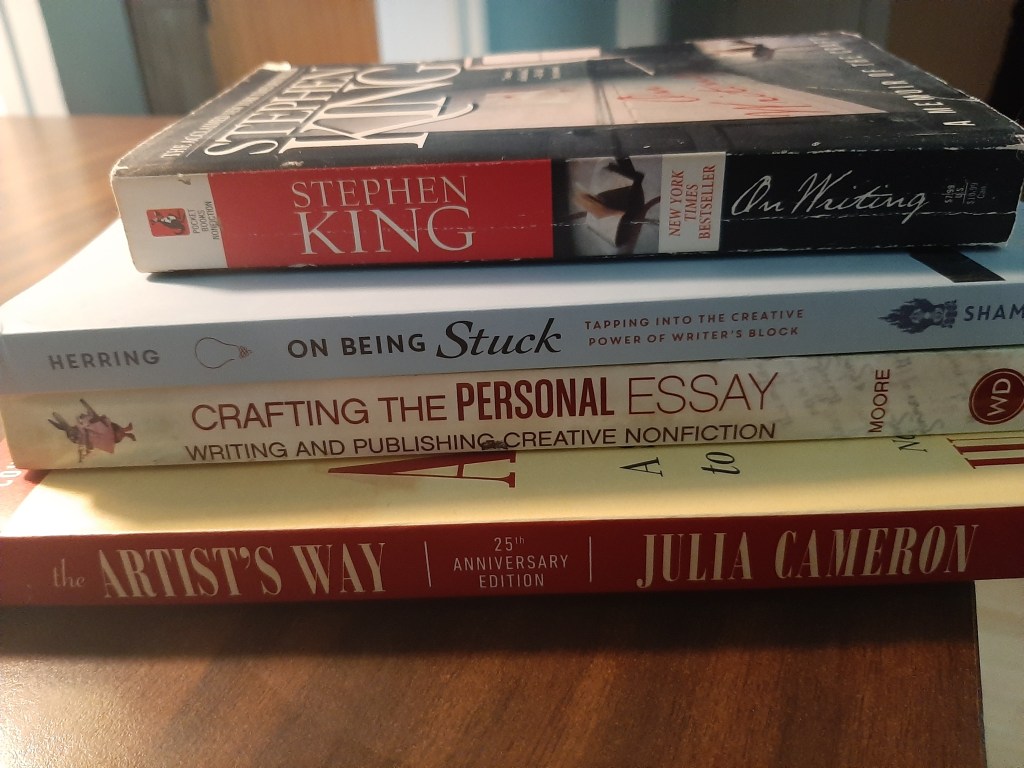
1. On Writing by Stephen King. You’ll find King’s book on numerous recommended lists, and it’s easy to see why. Part memoir and part writing toolbox, there are so many practical tips that makes it easy to jump into a regular writing practice. I appreciated his honesty about the writing life – it’s not always easy and you’ll find bumps along the way.

2. Crafting the Personal Essay by Dinty W. Moore. If you want to start writing personal essays, this is a must-read book. Moore breaks down the art and craft of essay writing in simple, easy-to-understand ways. He covers different types of essay writing too – food, travel, childhood experiences, etc. Moore, by the way, is editor of Brevity’s Journal of Concise Literary Nonfiction.

3. Bird by Bird by Anne Lamott. If you prefer a little humor with your writing advice, you’ll enjoy Lamott’s personal odyssey in writing. She covers everything from getting started to joining writer’s groups and attending conferences. You’ll learn a thing or two as you laugh.

4. Zen and the Art of Writing by Ray Bradbury. The best part of Bradbury’s book is his description of how he comes up with story ideas, which is by word associations. If you’re tired of doing writing prompts, Bradbury’s approach might be worth a try.

5. Writing from the Heart by Nancy Aronie. While this title is not as well-known as others on this list, it is a worthwhile read. Her goal is to create a safe environment for people to write. Not everyone finds the writing process easy, and Aronie takes you through the process step by step so you don’t feel so intimidated.

6. Callings: Finding and Following an Authentic Life by Gregg Levoy. While not a book about writing, it is about finding your calling. If you believe that writing is your calling, then this is a must-read to help you get over any fears and self-esteem issues that may be holding you back from accomplishing your goals. Levoy is not only a terrific story teller, he relies on his personal experience and the experiences of other people to show how it is possible to live an authentic life. I read Levoy’s book twenty years ago, and I still go back to read sections that resonate with me.

7. The Artist’s Way by Julia Cameron. Many writers point to Cameron’s book as the one that got them started writing. She is most known for her freewriting exercise: writing three pages non-stop first thing in the morning. The exercise is intended to help you remove the toxic thoughts and emotions that build up in your mind and body. Once you release those thoughts, your mind is free to create. If you’ve already read The Artist’s Way, check out Cameron’s follow up, The Right to Write.

8. Writing Down the Bones by Natalie Goldberg. This book has appeared on numerous reading lists and it’s been on my to-read list for a couple of decades. According to the book summary, Goldberg believes that “writing is a practice that helps writers comprehend the value of their lives.” Included are chapters about using verbs, listening, writing first thoughts (writing nonstop, keeping your pen on the page and not crossing anything out), and overcoming self-doubt.

9. The Creative Habit: Learn It and Use It for Life by Twyla Tharp. Tharp may have been a famous dancer and choreographer, but she also knew a thing or two about tapping into one’s own creativity. She describes the empty space of the dance floor (or the blank page) as the starting point for creativity. If you’re looking to start writing or creating on a regular basis, Tharp’s book may help you get past “writer’s block.”

10. On Being Stuck: Tapping into the Creative Power of Writer’s Block by Laraine Herring. Speaking of writer’s block and getting stuck, Herring’s book explores the possibilities that writer’s block holds. She speaks about using these sticking points to your advantage rather than getting stymied by the creative process. Herring has written another book worth checking out, Writing Begins with the Breath.

11. The Successful Author Mindset: A Handbook for Surviving the Writer’s Journey by Joanna Penn. I always thought Penn had the perfect name for a writer. While I have not read this book, I have read her The Creative Penn blog on occasion, which is chock full of helpful tools and advice for developing a successful mindset for your writing career.

12. The Writing Life: Writers on How They Think and Work by Marie Arana. I only recently came across this title. I’ve always found it intriguing how other writers begin their writing journey. We all can learn something from their experiences.

I hope you find these titles helpful. As you continue your writing journey, it helps to pause to read about the experiences of other writers, if only to inspire you to keep writing.

Tips for Overcoming Blank Page Syndrome

Photo by Ylanite Koppens on Pexels.com

It can be scary and intimidating to start something new, especially a new writing project. What winds up happening is you stare at the blank page, suddenly feeling overwhelmed by the prospect of it all. Many writers are afraid they won’t be able to fill the page with the right words to tell their story. Others fear not having an interesting story to tell. What if it all comes out wrong?

But you can take comfort in the fact that many writers and creatives have faced blank pages (or empty computer screens) for centuries, and they somehow manage to overcome their fear of it.

In her book The Creative Habit, choreographer and dancer Twyla Tharp writes: “The blank space can be humbling. But I’ve faced it my whole professional life. It’s my job. It’s also my calling. Bottom line: filling this empty space constitutes my identity.”

Though Tharp writes from a dancer’s perspective, what she says resonates with many writers. It’s our job and our calling to fill up empty spaces with our creativity, whether that comes in the form of words, dancing, or musical notes. In her mind, the empty space is not to be feared. It’s simply the starting point of the creative process.

When you begin to view the blank page as the starting point of your creative project, then you are less likely to feel intimidated by it. Rather than fearing it, writers should embrace it. The blank page represents endless possibilities for creation. It’s a positive energy, not a negative one. Don’t let the blank page weigh you down. Embrace it as an old friend, one who supports you in your creative endeavors.

The experts at Masterclass define blank page syndrome as writer’s block. So naturally, the best way to deal with blank page syndrome is the same way you do for writer’s block. There are several reasons writers feel intimidated when they face blank pages.

1. Writers fear exposing too much of themselves. It’s always scary to put yourself “out there.” Writing is an expression of your identity. Every time you put words down on the page, you are connecting with yourself in some way, whether it’s a memory, a fantasy, a heartache, or a desire. You can’t always hide behind your words. The prospect of revealing parts of yourself frightens writers. But without those deeply felt emotions and personal experiences, writers wouldn’t be the people that they are. Sometimes the only way to deal with the harshest realities of your existence is to write about it.

2. Writers expect perfection from their prose. They want the words to flow on the page in perfect harmony. They want the words to say precisely what they want to say with no mistakes. Writers have a vision of how they want the story to start and end, but when the words come out, all they see is junk. When you expect so much from yourself at the start of the writing project, it can put you in a form of paralysis. You wind up staring at the page instead.

To overcome these unrealistic expectations of perfection, try satisficing it – that’s combining satisfying and sacrifice, according to the Center for Writing Studies at the University of Illinois at Champaign-Urbana. Just put down a reasonable solution to start the ball rolling. Anything will do – notes, phrases, even diagrams. Then make a note to come back and fix it later.

3. Writers fear the endless possibilities that blank pages represent. When you stare at a blank page or screen, you’re faced with endless possibilities for storytelling. Should you write an essay or a short story? Maybe you might try your hand at poetry instead? There are numerous possible ways to fill that empty space.

Some people feel confused and overwhelmed when they consider all the possibilities ahead of them. They feel overwhelmed by the open-ended book facing them. These writers are the type of people who need everything spelled out for them, and they look around for a handbook of sorts with step-by-step instructions on how to navigate those endless possibilities.

Others embrace the future, even though it may look fuzzy and uncertain. They see the future as an adventure, and the world – as wide and mysterious as it is – is something to explore. They welcome the endless possibilities of the blank page because they know that it’s a forum for their creativity. Since they want their creative expression shown in whatever way possible, the blank page doesn’t frighten them.

Which writer do you want to be: the one who welcomes those endless possibilities and sees opportunity in them, or are you the person who needs a guide to show you the way? Do you recognize yourself in either of these scenarios? 

4. Writers lack vision for the end product. Because anything is possible with the blank page, some writers may not have a clear idea what to write. There are so many things they could write about so it’s difficult to know which idea will work best. If you lack vision of your end product, if you have no clue what to write about, step away from the page. Set aside time to brainstorm ideas. Jot down as many of them as you can think of. Use a favorite prompt. I find that the prompt “I remember,” works well for me.

Also try freewriting – writing nonstop for five or ten minutes. You never know what ideas spring forth from that exercise. Once you have a general story idea in mind (or several), you may feel less anxious about the blank page.

Yet another technique shared by Masterclass experts is starting at a different point in your story, such as the middle or the ending. Sometimes it helps to work backward to the beginning when you’re unsure how to begin. The important point is to keep writing. It is only by writing a little every day that you’ll figure out how to overcome that blank page.

The blank page or computer screen doesn’t have to be scary or intimidating. Take Twyla Tharp’s word for it, and welcome the blank page as your friend. See it for that friend who takes your hand and helps you face endless creative possibilities with courage and conviction.

Looking for a New Creative Writing Challenge? Enter a Writing Contest

Photo by Mateusz Dach on Pexels.com

Now that the calendar has flipped over into September, it’s time to get serious about your creative writing. While many publications accept submissions throughout the year, there appears to be an uptick in calls for contest submissions after September 1.

If you’ve ever wanted to participate in a writing contest, now might be a good time to take the plunge and get your writing to stand out from the crowd. (Note that with COVID-19, some publications have put their contests on hiatus. Always check the website to confirm, but with the contests I’ve shared below, I’ve already done the leg work for you.)

There are many great reasons to participate in creative writing contests.

* There is the pride of performance, of knowing you’re submitting your best work to be reviewed (which I suppose can be scary as hell too). Just having the courage to submit your work can be a victory in and of itself.

* There’s the chance to win big cash prizes and publication for your work. Many publications I’ve come across are offering cash awards of $1,000 or more with several smaller cash prizes for second and third place.

* There’s the opportunity to gain a wider audience for your writing than you could achieve on your own, including being noticed by editors and literary agents who may be among the judging committee members. Who wouldn’t want to earn that advantage?

* Contests also are a great way to challenge yourself to complete that work-in-progress hidden in your desk drawer, or start a new project in a different genre. Perhaps you’re used to writing creative nonfiction and want to try your hand at writing flash fiction.

Some contests specialize in one kind of writing, such as poetry or fiction. Other publications offer awards in three categories: essay, poems and short fiction. Poets & Writers magazine publishes a comprehensive list of contests, including a nifty calendar with all the submission deadlines.

Below is a very brief roundup of contests taking place this fall, some with deadlines coming up within the next couple of weeks. Hurry and submit your work before these deadlines pass.

QueryLetter.com
Can you write a back cover blurb for a hypothetical novel? In 100 words or less, write a blurb about a non-existent book. Make sure you set the stage for the novel, establish the characters and raise the stakes to make the reader want to read more. One winning entry will receive $500 prize.  Deadline is noon, September 15, 2020.

Writer’s Digest Personal Essay Awards
Writer’s Digest magazine is holding its first ever personal essay contest. In 2,000 words or less, write about any topic or theme. One grand prize winner receives $2,500, a paid trip to Writer’s Digest annual conference, and their essay published in the May/June 2021 issue. Other prizes will also be awarded. Early bird deadline is September 15, 2020; final deadline is October 15, 2020.

Boulevard – Nonfiction contest for emerging writers
Great opportunity for new, emerging writers to have their work published. Essays must be 8,000 words. Winning entry receives $1,000 prize. Deadline is September 30, 2020.

Boulevard – Short fiction contest for emerging writers
Another great opportunity for emerging writers, this time for short fiction. Stories must be 8,000 words. Winning entry receives $1,500 prize. Deadline is December 31, 2020.

Ghost Story Supernatural Fiction Award
Are you dying to write a ghost story?  Does the thought of telling paranormal or supernatural stories send chills down your spine? Then this contest is for you. Ghost Story is looking for short stories with a supernatural or magic realism. 1,500 to 10,000 words. $1,000 prize to the winning entry. Deadline is September 30, 2020.

LitMag
Virginia Woolf Award for Short Fiction
Write a short fiction piece of 3,000 to 8,000 words. First prize is $2,500, plus publication in LitMag and a  review by several literary agents. Deadline is December 31, 2020.

Anton Chekov Award for Flash Fiction
LitMag is also looking for flash fiction. Stories must be 50 to 1,500 words. First prize is $1,250, publication in LitMag and a review by several literary agents. Deadline is November 30, 2020.

ServiceScape Short Story Award
The freelance platform for writers, editors and graphic designers is looking for short stories of 5,000 words or less on any theme or genre. The winning entry receives a $1,000 prize. Deadline is November 29, 2020.

Prose.
Not interested in a contest but still want to challenge yourself? Check out Prose. This site posts numerous writing challenges and prompts to test your skill in writing prose. Most prompts are posted by the community, but others are shared by literary agents and publishing houses looking for new talent. They occasionally post contests, but as of this writing, none were posted.

As always, it’s a good idea to check out past winners before submitting to get an idea of what the publication is looking for.

Good luck, happy writing, and be safe this Labor Day weekend.

Achieve Your Writing Goal in One Year (or Less)

Photo courtesy of Hubspot


Have you heard this questions before? “Where do you see yourself in five years?”

I’ve always hated that question in job interviews because I could never answer it without making myself look like a disorganized mess. I would hem and haw, waiting for inspiration to strike me with an appropriate answer before finally settling on a very safe one: “Working here.”

The truth is, I’ve always had difficulty setting and keeping five-year goals because I could never think that far ahead. Too much can happen between this moment and five years from now that could alter my long-term plans, so why bother making any?

These days, my goal-setting is simpler because I focus on short-term goals and I look no further than one year ahead. Instead, I ask myself, “Where do I want to be one year from now?” I figure as long as I take care of the short term goals, the long-term future will take care of itself.

The one-year plan includes several interim goals to measure your progress. I borrow this approach from publishing production schedules, which establishes the publishing date first and then works backward to the starting point of the production cycle. In between, there are deadlines for writing, proofing, artwork and so on.

Think about what you want to accomplish with your writing practice. Where do you see it one year from now? Maybe your vision is to manage a blog. Maybe you want to complete a collection of travel essays. Or maybe you want to write stories from your life to pass onto your grandchildren. Whatever that goal may be, start with your year-end vision, then break it down into smaller, achievable tasks. Those tasks become your interim deadlines. When you know you want to achieve X one year from now, it’s easier to work backward to set the interim deadlines.

I find a good time for these goal-setting sessions is the beginning of the New Year, your birthday, or the beginning of the school year. Those times signify fresh starts when goal setting can help you stay motivated. But any time of year is a good time to make goals for yourself, no matter what you want to achieve with your writing.

To help you with this goal-setting exercise, answer the following questions.

1. Name one thing you would like to achieve in your writing practice one year from now. For example, complete first drafts of 12 childhood memoir essays to be included in a published collection. (Twelve is a random number that I chose based on the calendar months of the year. That equates to one memoir essay each month.)

2. Name one thing you would like to achieve in six months. Perhaps your six-month goal is to review the essays you’ve written so far leading up to your one-year goal. How many essays have you completed toward your year-end goal? Do they need editing? Perhaps your six-month goal is to hire an editor or have someone review the work you’ve done.

3. Name one thing you would like to achieve by the end of three months. Perhaps in three months, you would like to read one or two memoir collections that other people have written to help you understand how it’s done. Or maybe your goal is to write three essays that will be included in your collection.

4. Name one thing you would like to achieve within one month. Your goal could be to write for 30 minutes at least three days a week, or it could be to complete a draft of one essay for your childhood memoir.

5. Name one thing you’d like to achieve within the next two weeks. It could be to evaluate your daily schedule to see what you can change to make room for writing. Or it could be brainstorming ideas for your collection of memoir essays.

By the end of this exercise, you will have set five goals for your writing practice at five different time periods – two weeks, one month, three months, six months, and one year. Make sure they are reasonable, measurable and realistic to achieve. Then review your goals every few months to see how much progress you have made. If you find that you haven’t achieved any of your goals, do not beat yourself up over it. Just modify your goals and start over again.

By developing a one-year plan with smaller goals at interim points, you can stay focused on the tasks at hand while letting the long-term future take care of itself.   

What kind of writing plans do you make for yourself? Are you able to stick to them?

Three Questions Every Writer Should Ask Before Starting a Writing Routine

Novice writers often ask, “How often should I write? And should I write every day?”

Browse the internet and you’ll likely find a variety of responses to these questions. Some responses suggest making time goals, such as one hour a day, while others suggest word goals, such as 500 words. For example, Stephen King in his book “On Writing,” advises new writers to aim for a lofty 1,000 words a day.

To add to the confusion, novice scribes are advised to write every day to achieve consistency with your writing. If you don’t write every day, experts argue, you might lose momentum and motivation. After missing several days, you may never get back to writing.

While their arguments are valid, they may not be practical. Not everyone has time to write every single day because of demanding schedules. Further, the thought of writing every day can be daunting, especially for novice writers who haven’t a clue how to get started. You might say to yourself, “Write every day? I can’t possibly do that! That will take up too much of my day!”

That kind of reasoning assumes that writing is time consuming. But the truth is, writing isn’t nearly as time consuming as we imagine it is. That’s because many of us have built up scenarios in our brain in which we imagine sitting in front of our computer for several hours a day. That scenario might be accurate for well-known authors and professional writers, but not for beginning writers like you and me.

How much time you devote to writing depends on several factors: what you’re schedule allows, whether you’re new to writing, and what you want to achieve with your writing. No two writers will have the same answers. Below are several questions you need to ask yourself before establishing a writing routine.

Question 1: Are you new to writing?

If you’re new to writing, it might be helpful to start with a small goal and work your way up into larger goals as you gain more confidence in your abilities. Set a word goal of 100 words, for example. If after a few days, 100 words is too easy, you can raise the goal to 250 words.

For other writers, a time goal may be a better option, say 15 minutes or 30 minutes. Even five minutes is better than none at all. As you gain more confidence, you can add more time to your sessions, moving from 15 minutes to 30 minutes, for example.

Shannon Ashley at the Post-Grad Survival Guide blog writes that it’s important to achieve consistency with your writing. But how much time and energy you put into it is up to individual writers and what they want to achieve. But it’s not necessary to write every day to achieve that success. It is important if you want to achieve consistency, especially for newer writers.

I recommend setting a small goal of 100 words per session. That is the equivalent of three or four paragraphs, something that is easy to achieve if you write every day. However, if you don’t have time to write every day, you can choose to write two or three times a week or even just weekends. You can still achieve consistency with your writing by committing to writing three days a week.

As you gain more experience, you will learn to write faster and get more writing done in less time. That’s when you can set higher goals for yourself and create more flexible writing schedules.

Question 2: Do you prefer a structured routine or write when you can?

Some writers prefer having a set schedule because they enjoy the structure that it gives them.  Writing every day for a set amount of time or specific word count provides a sense of accomplishment. Just sitting down and writing at the same time every day is an accomplishment in and of itself.

The reality is, there is no set rule that says you have to write every day, writes Ali Luke at WritetoDone blog. It’s simply a goal to work toward. Only you know what is best for you considering your schedule.

On the other hand, some writers with more demanding work schedules may not have a lot of spare time for writing. Or they may simply thrive in unstructured work environments. Sometimes it’s necessary to find time to write wherever you can squeeze it in. For example, you may jot down notes while riding on the bus to work, or cram in a half hour of writing before bedtime. Further, it may not be possible to commit to writing every day. It may be that you are weekend warriors, writing in chunks on Saturday and Sunday.

Knowing which type of person you are – structured or unstructured – can help you decide how to set up your writing routine or whether you should have one at all.

Question 3: What do you want to accomplish with your writing?

If writing is a hobby, then you can be more flexible with your schedule since you are not tied to any deadlines. You can write whenever and wherever you want, and you can make your sessions as short or as long as you want – as your schedule allows. It might be easier to squeeze in writing time before doctor’s appointments and work breaks.

But if your goals are more serious – such as writing an essay or article that you want to have published – then you might need to devote a longer work session to complete it. That’s quiet, uninterrupted time to research, contemplate and prepare your finished piece for an editor. Since it requires greater care, then you will need longer stretches of time to work on it.

The bottom line is this: the more you want to accomplish with your writing, the more time you will devote to your craft. If you love to write, the more time you will make for it. That’s the difference between those who see writing as a casual leisurely pursuit and those who view it as their life’s work.

15 Writing Ideas for Your 15-Minute Writing Session

Photo by Negative Space on Pexels.com

So you think you don’t have time to write. That’s very possible, considering all the demands on our time these days. Work (or looking for work), home schooling your kids, household chores, cooking, and all the other responsibilities we have that can get in the way of our writing time.

Don’t get discouraged if you’re not able to accomplish as much writing during your writing sessions. If you can make time for 15 minutes of writing, you can accomplish more than you think. You just have to go into your session with a goal. Know what you want to accomplish or what you want to write about. When you know what you want to accomplish, you can make the best use of your time. Then get down to work.

Here’s what you can do with your 15-minute writing session.

1. Freewrite for 15 minutes straight without stopping. Let the ideas flow from your brain to the page. Aim to write 100 words every session – at a minimum. Do not stop to edit or rethink what you just wrote. Just keep writing. You may be surprised at the ideas that you see on the page afterward. If you do this consistently, over 10 sessions (aiming for those 100 words), you should be able to complete a 1,000-word essay.

2. Draft a dialogue between two characters. Start with one character asking the other person a question. See where that dialogue takes your characters. Avoid writing back story or other narrative. Focus only on the dialogue.

3. Choose an object on your desk or somewhere in your room. Describe it in detail including the color, shape and texture of it. How did you acquire that item? Is there a story behind where that item came from?

4. If you have a pet, give the animal a voice. Write a few paragraphs as if the pet is speaking to you. What would the animal say? Would he lavish you with praise, or whine and complain that you don’t pay enough attention to them?

5. Create a bullet list of stories you’d like to write. Use a prompt like “I remember” or “What if?” to kick off your ideas.

6. Write a brief review of the last book you read or the last movie you watched.

7. Write the final chapter of your current work in progress. Sometimes by writing the ending first, you have a clearer idea of how to start your novel.

8. Browse through old vacation photos. Describe the place as you remember when you visited it. Add as much detail as you can recall.

9. Create a character sketch of your protagonist, antagonist or other major character. Describe their appearance, then write as much detail about what they are striving for in your story. What is the character’s back story?

10. Recall the last dream you had. Rewrite it as you might read it in a book or see on a movie screen.

11. Write a letter to a friend or loved one, especially someone you have not seen in a long time. Or write a letter to a historical figure you admire and wish you could meet. What would you say to them?

12. Play writing games. For example, choose three words at random from the dictionary (close your eyes, open to a random page and let your finger stop on a word) and write a story using those three words. The story can easily be two to three paragraphs.

13. Think of a book or movie in which you did not like the way it ended. Rewrite the ending. Remember you only have 15 minutes, but you can jot down the key ideas.

14. Close your eyes and listen to the sounds around you. What do you hear? Describe the sounds and the images that come to mind when you hear them. Are there birds chirping? Is there a plane flying overhead? Is someone playing their stereo loudly?  You can do this same exercise with other senses as well, such as touch, taste and smell.

15. Listen to a piece of music, preferably instrumental. Close your ideas as you listen to it. What images come to mind? Does it bring back any memories? Then write about your listening experience.

No matter how busy you may be, there is always time for writing, even if it’s only 15 minutes. Your writing practice shouldn’t suffer because you believe you don’t have enough time. There is always time, as long as you have the desire to write.

If you like this post, please feel free to share it with your friends.