
Overcoming Rewriting Paralysis

Photo by Andrea Piacquadio on Pexels.com

Whenever I get to the end of my first draft of whatever novel I’m working on, I’m filled with a range of emotions: joy, relief, satisfaction and pride. After spending weeks and months crafting a story I hope readers will love and creating characters I care about, I’m ready to celebrate.

The celebration is short-lived, however. Because I know there’s more work to do. A LOT more work. Being an intuitive writer, I don’t do much planning beforehand except sketching out the initial scenes. By the end of the drafting phase, my manuscript is a mess. That’s when I come face to face with the monster in the room – the rewrite.

For me, revision and rewriting is a daunting process, much like getting my wisdom teeth pulled. I usually spend hours staring at my pages wondering what to do next.

Recently, I came across a term for this. It’s called rewriting paralysis, defined by a state of being stuck and unable to move forward with a writing project because you’re frozen by the daunting task of revision.

For more information, check out this excellent piece by creativity coach Anne Carley who explains what rewriting paralysis is all about. There are several signs that you’re experiencing rewriting paralysis (sometimes called analysis paralysis because you’re over-analyzing a writing problem).

* You experience brain freeze. Or what others might call writer’s block. After looking at so many scenes, your mind goes numb. You wonder if you’ve covered every aspect of your story. Even if you do sense you’re missing a scene or two, your brain stops working. When you try to finish your story, the words won’t come.

* You feel emotionally spent. You’ve poured so much of your emotional energy into writing the first draft that you have nothing left for the rewrite.

* Your inner critic takes over the creative process. Maybe it berates you for sloppy work or keeps reminding you that you’re wasting your time. The critic’s non-stop chatter discourages you from finishing the rewrite.

* Self-doubt creeps in. Now that you’ve finished the draft, you’ve given the manuscript time and space to breathe. But in that space, the critic’s cousin Self-Doubt makes its presence known.  The more you doubt yourself, the more you wonder if you’re doing the right thing or if you should start over.

* You feel overwhelmed by the task ahead. Paralysis sets in because the project suddenly seems too big and overwhelming to tackle on your own. You’ve created a monster, but now you wonder how to turn it into Cinderella. You’re not sure how or where to begin the rewrite process, so you set aside the manuscript and hope for inspiration.

Fortunately, there are remedies to re-energize your project and push through the rewriting phase. I’ve experimented with some of these with some success. They might help you too.

Strategy 1: If the project seems too big and overwhelming, it might help to attack the rewrite by breaking it down into smaller sections, working through each Act or several scenes at a time. Author and book coach Janice Hardy suggests creating an editorial map that lets you see how your story is progressing. She also recommends creating a revision plan to organize each edit and check them off as you finish them.

Strategy 2: Draft a synopsis of your current work-in-progress. The end of the first draft may be the perfect time to draft a synopsis to make sure the story is progressing the way you imagined. The synopsis can reveal problem areas that need to be fixed. For example, when I drafted a synopsis for my current project, it revealed part of my protagonist’s backstory that explained why she felt so conflicted toward her deceased mother. Up to that point, that backstory had been a mystery to me.

Strategy 3: Review story structure. Paralysis might occur because you haven’t worked out the plot of your story, or it might be missing certain elements. The end of the drafting phase might be a good time to review story structure. There are multiple structure types, and it’s not always easy to choose the best one that fits your story. For information about story structure, check out this guide from Reedsy or this blog series and book, Structuring Your Novel by author K. M. Weiland.

Strategy 4: Study the revision process or take a course in revision. Author and book coach Jessica Brody teaches an online self-study course The Complete Novel Revision course which breaks down the process into three levels: story edits, scene edits and page edits. Whether you follow Brody’s process or use someone else’s, it takes time to review, reassess and rewrite your story to whip it into shape. Be patient with yourself and with the process.

Of course, before starting any rewriting or revising, it’s helpful to set aside the draft for a few weeks or months. Then print out the manuscript and read through it as a reader would. The time away from your story will clear your head and you’ll see the story with fresh eyes.

Armed with these strategies, you can easily overcome rewriting paralysis and create the novel of your dreams.

Why Writers Need to Celebrate Their Failures

Photo by Tairon Fernandez on Pexels.com

As you might have heard, the Chicago Marathon took place last week, winding its way through the streets of our grand city. Watching the coverage on TV, one comment stood out–that just starting the race is a victory and success in itself.

It’s often said that writing a novel is a lot like running a marathon. The two activities have much in common:

  • Both require hard work to prepare for the long haul. While a writer’s legs may not be moving as they write, their brains are to conjure up plots and dialogue. 
  • Both require commitment of time and energy to keep training and working toward the end goal.
  • Both require continuous learning and dedication. Athletes continue to learn about how their bodies respond to the physical demands of running a race, while writers continue to learn about their craft and how their creative minds work. 

Perhaps the biggest similarity is this: Success comes by getting to the starting line or by sitting down to write. Because the only true sign of failure is not showing up. 

That’s why we must honor our successes AND our failures. After all, failure has a lot to say about our success.

For runners, failure might look like pulling up lame during a race and having to quit, or it might mean an injury or illness sidelines them. For writers, failure might mean never finishing a story you started writing or receiving rejection letters for a story you poured your heart and soul into. 

The Rome Business School in Italy outlines several benefits of embracing failure in our work, no matter what kind of work that might be. Failure can help you:

  • Develop resilience – the ability to bounce back from setbacks and challenges.
  • Encourage creativity – It forces you to consider other solutions to your writing problems and think outside the box.
  • Foster a growth mindset – It helps us view challenges as opportunities, which we use as a stepping stone toward our main goal
  • Build confidence – Failure doesn’t have to define you. Instead, it can set the stage for figure efforts.

Thomas Edison, who invented the light bulb, phonograph, and movie camera, among other things, failed many times. He was noted for saying: “I have not failed. I’ve just found 10,000 ways that won’t work.”

The lesson to be learned from Edison is this: If we find something that doesn’t work, it doesn’t mean we failed. It simply means that we need to explore other possible solutions. 

Since failure can be instrumental in our career growth, it might be worthwhile to celebrate and honor your writing failures as much as your successes. Here are some possible suggestions:

  • Compile all your rejection letters and save them in a file. Occasionally read them to remind you of how far you’ve come in your writing journey. Seeing the feedback can spur you to keep working toward your goal or to find solutions to some of your nagging writing issues. Some writers even frame their rejection letters so they can see them all the time.
  • Light a candle and read each rejection letter out loud. Alternatively, if you’re working with beta readers or an editor, read aloud any of their negative feedback. Try not to react viscerally to comments, but allow their meaning to sink in. Maybe they didn’t get the message you were trying to convey in your story, in which case you may need to rewrite the message differently.
  • Journal your reactions to failure and rejection. As you write, you might discover why rejection makes you feel like a failure or why it has such a strong hold on you.
  • Rethink the role of failure in your work. Sometimes you have to view it as a stepping stone toward your ultimate goal rather than a dead end. What can you learn from the failed experience? Failure can teach us many things–courage, perseverance, resilience. It can coax you to try new techniques and pull you out of your comfort zone.

Whether you’re an athlete training to run in the next marathon or a writer working on their first (or tenth) novel, it’s okay to embrace failure. It has a lot to teach us if we’re willing to listen to its lesson and learn from it. The only true failure is not trying.

The Path from Journalist to Fiction Writer

Photo by Andrea Piacquadio on Pexels.com

Writers come from all walks of life. Many have had previous careers, such as lawyers, doctors and journalists. No matter our background, we have one thing in common: a desire to tell stories. However, the journey to get published isn’t the same. In fact, it’s a struggle for most. That shouldn’t stop us from trying however.

I came from a professional background in association publishing. I knew how to string together complete sentences to present clear ideas. But how that would translate into a fiction writing career remained to be seen.

For me, writing an 85,000-word novel was a huge challenge. But did I have the patience and determination to see it through? That was the question. One I was itching to find out.

I started on this writing journey for several reasons.

* To determine the next chapter in my career. I was at a crossroads and wasn’t sure what was next for me. I had just left a full-time job after eight years and I wanted to take time out to consider other options. One thing I knew for sure was that writing was the core of my being, and it would play a significant role in my career in some shape or form.

* To fulfill a fantasy. I had toyed with the idea of writing a novel earlier in my life, but did nothing with it, likely because I didn’t know what I was doing. I knew nothing about story structure or scene development back then, nor were there the amazing number of sources available to help a newbie like me to learn the ropes.  

* To meet my accountant’s challenge. While getting my taxes done about 10 years ago, I updated my accountant on my job search woes. I confided that I wasn’t sure what to do next in my career. Her response? “I think you should write a book.” The challenge was on. My dear accountant has since retired, but I still hear her words of encouragement in my head.

* To sow the creative seeds that were sprouting in my brain. I don’t know if it was all the free time I had after I left my job or the writing classes I took, but my creative muse started working in earnest, spitting out story ideas like a factory. I had no choice but to work with them. I started to see story ideas everywhere, and there were too many to ignore. I saw them as a sign to take my dabbling to the next level.

Even though I wanted to take my writing to the next level and explore different genres, I knew there was plenty of work I needed to do. How did I move from corporate writer to aspiring novelist?

* I signed up for writing workshops and classes. It was at a local writing studio that I was able to unleash my creative writing juices. Being around other writers and getting their feedback helped me to hone my craft. 

* I subscribed to Writer’s Digest. Each issue is chock full of articles about the writing process, author interviews, agent profiles, news about the publishing industry, and tips for new writers. It also explores different genres, and gives a clear-eyed view of the writing life. There are other similar publications, like The Writer, Poets & Writers, Publishers Weekly (about the publishing industry) and Script Magazine (about script writing).

* I ramped up my novel reading. Since I had more time on my hands, I dove into my favorite hobby in earnest. I had forgotten how much I enjoyed reading. The more I learned about the writing process, the more I started paying attention to how the stories played out in the books I read. Reading was part of the self-education process.

* I started reading books about writing. The two best I’ve come across are by Stephen King (On Writing) and Anne Lamott (Bird by Bird). Though there were two very different approaches to writing, both provided the inspiration and motivation to support my writing goals.

* I started following authors, editors and publishing pros via newsletters and social media. I especially enjoy the insights shared by Jane Friedman, a former editor of Writer’s Digest, and book coach Janice Hardy. There are plenty of blogs and writing communities online covering the publishing business too.

* I joined a writer’s group. Though our group is small, only three people, we meet monthly to share best practices and motivate each other. The group is more about accountability and socializing than anything else. Still, it’s fun to talk shop with people who share my interests.

Though I started this journey in 2014, I’m still learning and growing. The more I have learned about writing fiction, the more I realize I need to learn and the more it feeds my determination to succeed. I hope one day to become published, and while I have accomplished a lot, that first completed novel to show editors and agents remains elusive.

For my readers and fellow writers who are in the midst of their own transitions or are considering one, here are a few tips based on my experience:

* Learn about creative writing and story structure as much as you can. No matter how much you think you know, there will always be something new to learn.

* Read as much as you can in your preferred genre. Notice how those authors crafted their stories and learn from their writing styles. It also helps you see what people are reading in that genre.

* Be patient with yourself. Learning about the writing process takes time and you will certainly make missteps along the way. Don’t beat yourself up when that happens. Instead, take a deep breath and start over. But don’t give up.

* Ask for help and support when you need it. Find a support group, not necessarily a writer’s group, but one or two people who will listen to your writing woes and be your biggest cheerleaders.

* Be consistent with your writing practice. That way you won’t lose momentum. Take breaks when you need it or when you feel stuck. Most importantly, have fun.

For more about this topic, check out these articles:

Navigating the Road from Journalist to Novelist
From Astrophysicist to Author: Tips for Making the Transition to Career Author
15 Tips for Starting Your Writing Career Later in Life

I’ll leave you with this wonderful tidbit of wisdom from science fiction author Mark Alpert: “Don’t worry about how long it takes to reach your dream. The long road just gives you more life experiences to enrich your fiction.”

Dealing with Internal Distractions (or How to Get Out of Your Own Head)

Photo by Photo By: Kaboompics.com on Pexels.com

One of the most frustrating aspects of writing is dealing with distractions. You could be making steady progress on your current work-in-progress, only to be derailed by interruptions and negative thought patterns. But to be successful, or at least to successfully complete that beloved work-in-progress, you need to figure out a way to conquer those distractions.

There are two types of distractions: external and internal. External sources of distraction occur outside your work space. It could be extraneous noise, like ambulance sirens blaring in your neighborhood, the sound of drilling as construction work is being done outside your window, or a group of children playing. There could also be external interruptions closer to home–the frequent ringing of your phone, the sudden desire to do housework or the constant temptation to check your social media for updates.

For the purpose of this post, I’m focusing on internal distractions–the ones that claim valuable headspace. Those thoughts are often counterproductive, derailing you from your best creative efforts. There are five internal distractions that I’ve come across in my writing practice, and I’ve given each of them a name. You’ve probably met them at some point too. 

For each “character,” I’ll briefly describe how each one interferes with your writing practice and what you can do to limit its impact.

Negative Nellie
Nellie is a chatterbox who won’t stop talking about what a horrible writer you are. Her negative self-talk grates on your nerves and drains your self-confidence. If you keep listening to her, her words will sink in and you’ll begin to believe all the negative comments she makes. Negative Nellie is adept at pointing out all your faults and suggesting how you will never measure up.  Negative Nellie’s main purpose is to slow you down enough to make you rethink your career as a writer.

To offset Nellie’s negativity, you have to remain positive. To turn those negative thoughts into positive action, try repeating some affirmations. Here are a few examples, or you can create your own:

* I’m a talented and creative writer who works hard to develop my craft.
* I write every day with passion, enthusiasm, and determination.
* I experience joy whenever I write.

Debbie Doubter
Debbie is Nellie’s close cousin. They’re very similar in mindset, though Debbie isn’t as relentless in her derailing efforts as Nellie. Still, her words can hurt you by prompting you to question yourself. “What made me think I could become a writer?” or “No one will ever want to read what I’ve written.” Once you begin to doubt yourself, you lose faith in your writing, and you lose heart. If enough doubts set in, you might give up on writing altogether.

What you need at times like this is more confidence. One way to gain that confidence–and keep the self-doubt at bay–is to focus on your small successes. Did you write only 300 words when you were aiming for 1000? Congratulate yourself on those 300 words. Did you finally finish that chapter you’ve been slaving over for the past week? Great! That’s one more milestone you’ve reached. When you celebrate each small success, confidence builds over time.

Wendy the Worrier
Wendy wastes much of her time worrying about things that will likely never happen. That’s because her thoughts are geared toward the future instead of being focused on the present. “But what will you do if you fail?” she might ask. “What about your regular job? You can’t give that up just to write full time.” 

The solution to all this worry about the future is to stay in the present. The truth is we can’t control what happens in the future, but we can control what we do in the here and now–like writing. We can control what we write and how much we write. But we can’t control how people will respond to our writing. Their emotional responses belong to them. Focus on what’s important now, and the future will take care of itself in its own time.

Unfocused Fiona
Fiona is a distraction magnet. Every little thing bothers her. She can’t concentrate on any of her work because her mind is drawn to so many things, like activities she’d rather be doing on a fine summer day or knowing that her friends are out enjoying dinner while she has to finish the  next chapter. Maybe you had an argument with your spouse, and you’re still feeling upset about that and can’t concentrate. Or maybe you’ve learned a loved one has died. Emotional disruptions can interfere with your productivity too because you’re thinking about those episodes rather than on your current project.

The antidote to Fiona’s lack of concentration is to work in small bursts. Rather than one long writing session of, say three hours, work for twenty minutes, then if you feel up to it, do another twenty minute session later. Those smaller sessions don’t require as much emotional or physical energy. The fact is being under such emotional duress isn’t going to help your writing. If, even these shorter sessions don’t work, then take a break from writing and exercise self-care for your emotional needs. Another option is to work on non-writing tasks that will still give you a sense of accomplishment. Try sketching out a few scenes or sorting through files. 

Critical Chris
I’ve saved Critical Chris for last because she is the most disruptive relative of all, and I think she affects almost every writer. Critical Chris can’t help herself. She’s down on everyone. No matter  how talented another writer is, she’ll find fault with their writing. “It’s too business-like. You’re not writing for corporate executives.”  “There’s too much dialogue.” or “Is this the best you can do? I’ve seen ten-year-olds write better stuff than this.”

Admittedly, it’s hard to shut off the criticism. But it’s imperative to try. For every criticism, reframe it as a positive statement. For example, if Critical Chris complains that there’s too much dialogue, your reframed response might be: “Sure, but the situation calls for it in the story.” Or “it’s only the first draft; I’ll fix it during the revision.”

If any of these characters are frequent visitors in your headspace, acknowledge that they’re there, then find a way to minimize their distraction. Most importantly, keep writing. Writing is a form of therapy. 

Have any of these internal distraction characters interrupted your writing life? How did you handle them?

How to Hook Readers into Your Story

Photo by Mu00fccahit inci on Pexels.com

If you’ve ever gone fishing (I admit I have not), you usually need something to lure your catch, such as a worm. You need to do the same for readers (minus the worm). Author K.M. Weiland describes it best:

“Unless you hook readers into your story from the very first chapter, they won’t swim in deep enough to experience the rest of your rousing adventure, no matter how amazing it is.”

Hooks are used to get reactions from readers and entice them to ask questions about what’s happening on the page. There’s some suspense connected with hooks too because they hint at the action to come, prompting readers to keep reading.  

A recent webinar by Contemporary Romance Writers outlined the most common types of hooks. I’ve described a few of them below.

1. Show some action – The easiest way to hook readers is by engaging characters in some type of action. That doesn’t mean it has to be violent or mysterious, like a car chase. But something should be happening on the page. Maybe someone is cleaning out the attic and finds an old diary. Or the character is baking a cake to prepare for a wedding. Or someone else is in the middle of a presentation to their work colleagues. Avoid cliches such as waking up from a dream or a description of the weather because frankly, they’re overused and boring, and do nothing to engage readers. And that’s the ultimate goal of a hook.

2. Introduce a unique character – Introduce a character with unique characteristics. It typically is the protagonist but not always. Show how that person is different. Do they have a unique job or hobby, or unique skills, like seeing dead people? Do they have an odd habit, like being perpetually late for appointments. Or maybe your character is like John Singer, the deaf-mute man featured in The Heart is a Lonely Hunter by Carson McCullers, who befriends the lonely people in a small town while struggling with his own feelings of loneliness.

3. Form an emotional connection – Try reading the opening pages from several of your favorite books. Do they make you feel any specific emotion, such as sadness, anger or guilt? Does the action make you feel anxious for the character because they might be in danger? Establishing an emotional connection with readers will ensure that readers stay engaged and will follow along on the character’s journey.

4. Pose a question – Sometimes the hook may come in the form of a formally asked question: “Why did I think I could get away from this?” (That’s not a real opening hook; I just made that one up.) Readers will want to know who the narrator is and what they were trying to get away with. The most important question readers will have though is something they ask themselves:  “What happens next?” As long as they keep asking that question, they’ll keep reading to get the answer.

5. Share a surprising or shocking dialogue – Opening scenes may feature a conversation between people, but the subject or tone may be shocking. For example, in Nutshell by Ian McEwan, a married pregnant woman and her lover discuss plans to murder her husband, and every word is overheard by the woman’s unborn child, who narrates the story. Who wouldn’t want to keep reading to know more about what happens next?

6. Include humor – Making readers laugh from your opening scene is another great way to hook them into your story. Humor can be found in the way a character behaves or in a witty exchange. In the opening scene of The Love of My Afterlife by Kristy Greenwood, the young protagonist chokes on a piece of bread and is convinced she is about to die. Her mind goes into overdrive with assorted worries and fears, some quite irrational, but Greenwood does it in such a way that makes you laugh out loud. When done well, adding humor can suffuse any tension. 

7. Foreshadowing – The hook may hint at some sort of conflict or action that will take place  later. For example, in the opening prologue in The Diamond Eye by Kate Quinn, a mysterious stranger looks on from a distance as Eleanor Roosevelt welcomes a Russian sniper to the White House. The stranger is clearly angry, and readers sense that a confrontation will occur at some point between him and the sniper, which entices them to keep reading.

8. Describe a surprising situation – One thing all these hooks I’ve discussed have in common is the element of surprise. Something surprising or unexpected occurs in the opening scene from the overheard dialogue to someone choking on a cheap hamburger. Its impact is to jolt readers to attention, and ask the question, “What happens next?”

I’ll add one more hook to this list, courtesy of the experts at Master Class. The title of your story serves is the earliest opportunity to grab readers’ attention. It serves as a “mini-hook” using “emotionally loaded language or surprising combinations of words to hint at the story within its pages.” Harry Potter and the Chamber of Secrets offers a clear hook. You know right away from the title who the story is about and what they’ll be looking for. 

Hooking readers doesn’t end with the opening scene. You need to keep hooking them throughout the novel. Thriller authors are adept at doing this. One technique often used is to introduce a new question every time the previous one is answered. Also try opening each chapter with a teaser – some action, dialogue, an intriguing new character – much like you do to start your story. That keeps readers engaged until the end. 

Your story and its genre will dictate what kind of hook will work best. Experiment and see what works. As long as you keep the action moving, readers will ride along on the journey until they get to The End.

Building Your Story From First Line to First Draft

Photo by Magda Ehlers on Pexels.com

No doubt you’ve heard about the importance of the firsts in writing—the first line, the first paragraph, the first page, the first scene, the first draft. Each “first” has its own role to perform. It must contain certain elements for the story to work, just like pieces of a giant puzzle. Every element must fit together.

Why are they important? How can you make them as compelling as possible so your manuscript doesn’t end up in the editor’s slush pile? Here’s what you need to know about each of these “firsts” to readers, agents and editors won’t stop reading.

The first line

There is some debate about the importance of the opening sentence. Some say it has to grab the reader from the get-go and hint at the conflict to come. Others say it’s more important to focus on the first paragraph which gives readers more information about what’s to come.  

“The first sentence alone doesn’t give readers enough information or the writer enough room. The paragraph gives enough room and direction to write your book,” says John Matthew Fox in a guest post on JaneFriedman.com.

I’m inclined to agree with Fox. I’ve read a few doozies of opening lines for some wonderful stories, but most of the time, opening lines are rather lackluster. I still kept reading anyway, and the stories were just as readable.

I see the first sentence as the first blow of a balloon. You won’t see much result from your effort of blowing, but with sustained effort, that first line serves as the starting point for something bigger.

The first paragraph

The first paragraph should make a strong first impression, stronger even than the first line. It should give readers enough information about the story to decide if they want to keep reading.

John Matthew Fox says opening paragraphs contain four critical elements:

  • Characterization – Readers need to learn something about the main character. It could be a dilemma they’re grappling with, some deep emotion they’re feeling or some puzzle they’re trying to solve. Readers need to know something about them that makes them relate to the character, or makes them want to root for them in the story.
  • Energy/tone – The first paragraph should bring a certain energy to the story. A rom-com, for example, will be written with a light-hearted tone, while a horror story might have a darker, creepier tone
  • Mystery or conflict – The opening paragraph should hint at some question or conflict that needs to be resolved. For example, why a complete stranger is watching someone else from a distance.
  • Emotion – Finally, the first paragraph should exude some emotion to hook the reader, whether that’s fear, grief or disappointment.  


The first page

At an average length of 250 to 300 words, the opening page has to do a lot of things in a short amount of time to kick the story into high gear. It’s the heavy lifter of all the firsts.

In a recent weekly newsletter, Karyn Fischer of Story & Prose outlines the common elements of the first page.

* Character and desire – What does the character want? The first paragraph might have hinted at this, but the opening page goes into more depth.
* Conflict and stakes – What or who opposes the main character in getting what they want?  * Voice – Fischer says it’s often difficult to pinpoint voice, but you might detect it through the way they speak or think. Does their voice sound true to life?
*Setting and world-building – The first page should give readers a sense of where they are in the story. Perhaps it’s a birthday party in someone’s home, the site of a car accident or a courtroom. Don’t overload the story with setting details, but sprinkle them throughout to give a sense of time and place.
* Action – Make sure the character is doing something, whether it’s baking a cake or being chased by thieves.
* Genre – Depending on the genre, the opening page should hint at the type of story people are reading. In historical fiction, for example, the first page might have visual cues that show time and place.

First scene/first chapter

I’ve combined the first scene and chapter into one section for a couple of reasons. First, they consist of the same elements and strive to accomplish the same goals. Second, a chapter may consist of a single scene, or several.

While the first page does a lot of work to prepare readers for what’s next in the story, the first scene or chapter ramps up the effort. In addition to doing what the first page does, the first scene or chapter does more, such as:

* Introduce other compelling characters that will either support or antagonize the main character.
* It grounds the reader into the story, providing more details about what the protagonist is dealing with.
* It continues to build on the tone established in the first page.
* It provides the hook that will keep readers turning the page.
* Depending on the story, the first chapter (not necessarily the first scene) should contain the inciting incident, the situation that gets the story moving.

By the end of the first scene or chapter, readers should know enough about the main character and their plight to determine if they like the character and empathize with their situation. If readers don’t find anything to like about the character, it’s likely they’ll give up on the story.

First 50 pages

The first 50 pages are important because it’s those pages that many editors and agents will review to determine if it’s worth reading—and publishing. It’s also a litmus test for readers. If the story loses its steam, readers will lose interest before they get to that 50-page mark. More specifically, the first 50 pages:

* Give readers, agents and editors an impression of your writing style.
* Includes the inciting incident and shows the raising of the stakes
* Shows the initial progress in the protagonist’s character arc. How will they grow or progress as the story moves forward?

First draft

When you finish writing your first draft, you might think your work is done. But it’s only just starting. The editing and rewriting process is where the real creativity begins, experts suggest.

The first draft, in all its messy glory, should contain the spine of the story—namely the who, what, when, where, why and how. It has three main goals:

* Helps you get all your ideas down on paper, from characters and their backstory to setting and dialogue.
* It helps you lay out the major plot points.
* It provides a road map for how to proceed during the revision process.  

If all goes well at each of these “first” elements, then it’s only a matter of time before you enjoy the next first in your professional writing life—publishing your first book.

Neither a Plotter Nor a Pantser? Try Becoming a Puzzler

Photo by Ron Lach on Pexels.com

Writers usually fall into one of two categories: the plotter or the pantser.

Plotters prefer to plan out every aspect of their stories ahead of time, from the setting, character, theme, structure. They will plot out every scene from the opening paragraph to the final resolution. They have to know every detail in advance before starting to write. Plotting allows writers to view their story from all detailed angles. They know exactly what they want to write before writing it.

I’ve tried this plotting approach once before early in my fiction writing. It was the first story I attempted to write. I quickly gave up on it because I found it limiting. My plotting didn’t allow for new characters to show up, and I struggled to find the right place in the story for new scenes as I thought of them.

Still there are plenty of authors who have plotted their way to success. Fantasy author K.M. Weiland is a big proponent of outlining and story structure, and goes into a deep dive on these subjects on her blog. She’s also written several books about plotting if you want to learn more.

One disadvantage I see is the extra time it takes to get the details “just right.” It can take the wind out of your creative sails too. By the time you’re done plotting, you could lose interest in your story because you feel you’ve already written it in plotting form.

But not every writer works that way.

Then there are the pantsers . . .
I always believed I was a pantser, also known as a discovery writer, because I enjoyed discovering my story as I wrote. With only a vague sense of main characters and a few scene ideas, pantsers tend to begin writing if only to see where the story takes them, or whether there’s a story at all.

The advantage of writing by the “seat of your pants” is that it gives the imagination free rein. The story, without the limits of plotting, can go in a multitude of directions, and it can be fun to discover new characters and settings that you didn’t think of initially. Writers feel free to explore their story world without the limitations of a set of rules or structure.

The downside, however, is that by the end of the drafting phase, what writers have is a ton of material with no cohesiveness between scenes, characters or plot. That only makes the editing phase much harder because there’s so much material to dig through, and much of it will land on the cutting room floor anyway. As I quickly learned, pantsers usually have to do several rewrites to get the story to where you want it to be, which can be a drain on time and energy, not to mention patience.

What if you’re neither a pantser nor a plotter – or you’re a little of both?
While I’ve experimented with both of these approaches, I realized that I don’t fit neatly in either one. While I love exploring plots and characters organically, I also recognize that I need to plot my story to some extent so I know where it’s going. Otherwise, I’m only spinning my wheels, editing and rewriting sections until they feel right.

Enter Puzzling.

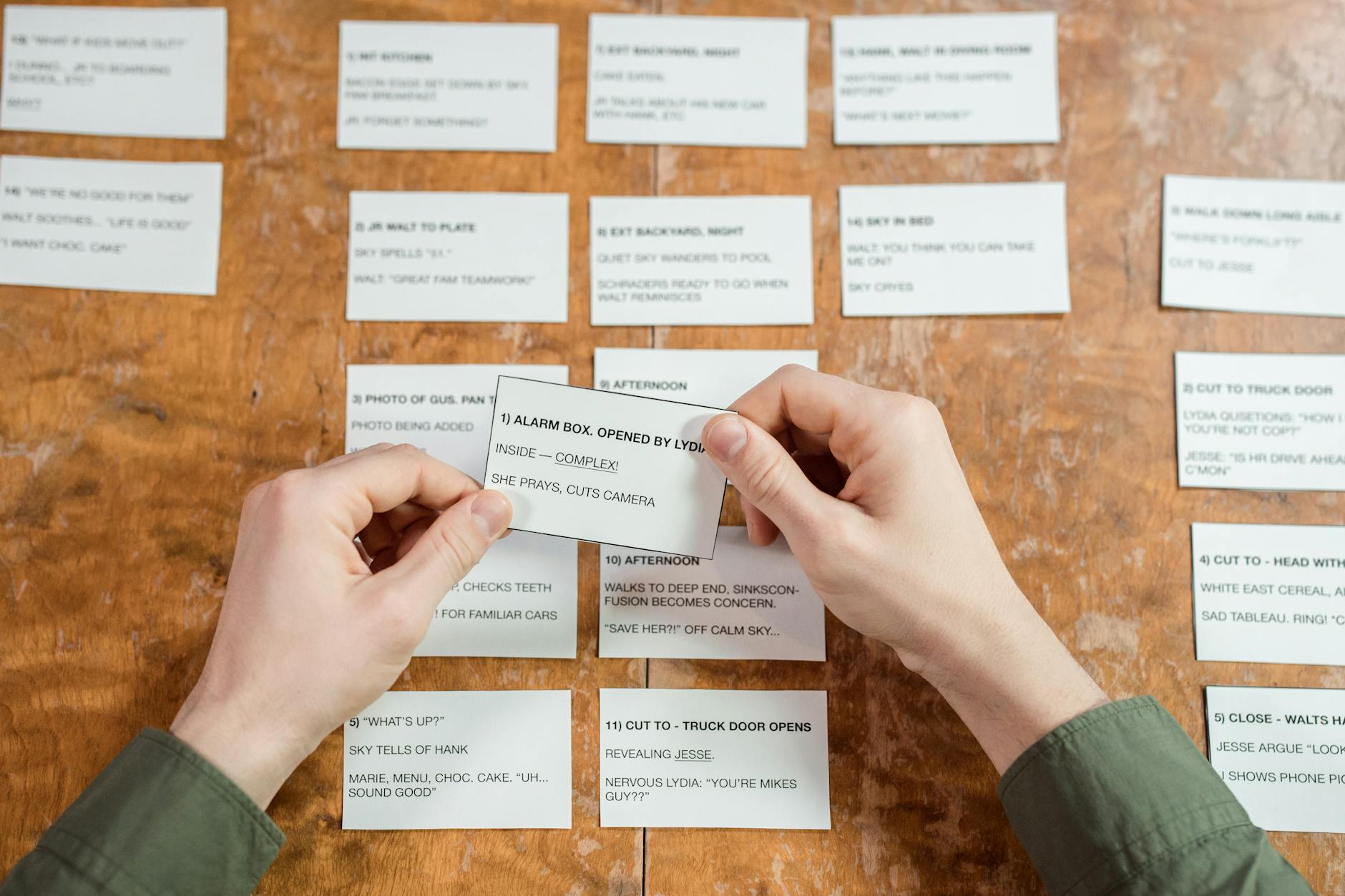
The Novel Smithy Lewis Jorstad explains that puzzling works by bringing elements of plotting and pantsing together.  For example, perhaps you have a brilliant story concept and can visualize several scenes in your mind, have a rough idea of characters and an inkling of how it will end. Using index cards or post-it notes, jot down each individual scene – one idea per card. You may not think of every scene right off the bat. You may only have three or four scenes to start. But that’s okay. What you are doing is creating a puzzle with various pieces that will eventually fit together. This is the discovery part.

Once you have a collection of scenes on index cards (or post-it notes), spread them all out on a table or tape to the wall so you can see them all at a glance. Then rearrange them in the order you think they should go. This is the plotting aspect.

Once the cards are in some story order, review them again. Note if there are any gaps in the sequence. Wherever there is a gap, insert a card indicating a scene to come.

The advantage to puzzling is that it allows you to generate scenes on the go. You don’t have to think of every scene before writing. You can write the scenes you do know, knowing the rest will come eventually. You don’t have to follow any structural rules.

Even while drafting, you may still come up with new scenes. When that happens, jot them down on a card and insert them where you think they might fit in the story. You can add or delete scenes and change the order of them as you go along. It gives you more control and flexibility than a straight plotting structure, which can be limiting to those who want to give their imagination free rein.

Another benefit is the ability to review your story at a glance scene-by-scene and make adjustments to the timeline. You can also identify which scenes are the key plot points of your novel.  I suspect this approach results in fewer rewrites.

Are there any downsides? So far, I haven’t found any, though I just started working with it for my current work in progress. In the short time I’ve been using this puzzler approach, I’ve learned a few things:

  1. It has helped me maintain my interest in the story. With previous approaches, I’ve invariably lost interest in my manuscript and given up on it, or got lost in the muddling middle.
  2. It allows me to assess my scene sequence and rearrange them as I see fit, without  having to rewrite anything.
  3. It helps me stay focused on one scene at a time. With one scene per card, I know what I’m writing next and I’m not left staring at a blank screen. The cards give me a clue and keep me on track.

    If you’ve tried plotting or pantsing, and they haven’t provided the results you want, give puzzling a try. You may find that being a puzzler makes you a more productive writer.  

Dictate Your Way to Publishing Success

Photo by PhotoMIX Company on Pexels.com

Writers are always looking for ways to work smarter and get more done in less time.

Enter dictation.

When I think of dictation, I think of the old-school way of recording correspondence back in the 1980s. Managers would dictate letters and other correspondence in a recorder with a tiny cassette, then their secretaries would play it back to transcribe them.

Fortunately, as technology evolved, so did dictation and transcription tools, making it easier for writers to draft larger projects, like full-length novels. Several well-known authors routinely used dictation to help them draft their novel, including Dan Brown, Henry James, Barbara Cartland, and Agatha Christie. TV executive Sidney Sheldon reportedly dictated novels for several hours in the morning and then had his secretary transcribe them later.

I must confess I have never used dictation to draft any of my own stories, but I know that option is available. You can’t overlook its value to authors. While writing 1200 words can take a couple of hours, with dictation, it takes roughly 30 minutes.

Sarah Elizabeth Sawyer of FictionCourses.com who writes Native American historical fiction, also teaches courses about dictation. Of her 19 published books, at least 10 have been created by dictation.

Sawyer cites several benefits:

* Improved health – With dictions, there’s less strain on the eyes, back and shoulder.
* Better time management – You can dictate while waiting for appointments or walking the dog.
* Improved speaking skills – With practice, you speak more confidently which helps prepare you for author readings.
* Experiment with character voices – You can test out character voices with accents and dialects, and inject personality into their voices.

Users have noted several blocks to getting started with dictation. Some said the practice just didn’t work for them or they felt their brain didn’t operate that way. Others cited the cost of dictation software, although there are plenty of free options available, or the software was difficult to use. Still others said they drew a blank when they pressed the record button.

There are other downsides, such as messy punctuation. That only means you have to be prepared to review and edit the drafted material more carefully afterwards. The software may not recognize unusual spellings and pronunciations of character and location names, especially those you might find in science fiction and fantasy novels. Like any new skills, there’s a learning curve before you’re able to do it well.

Still if you have the patience and determination to try to produce creative work in less time, dictation might be worth a try. But which software and apps work best? Do you need any special equipment?

Jason Hamilton at Kindlepreneur shared the best dictation tools, giving the pros and cons of each.

  • Dragon – By far, Dragon software performed the best though the cost may put off many potential users. The Professional Individual version cost $500 while the Home version is $200.  
  • Windows Speech Recognition – free option that comes with most Windows computers
  • Apple Dictation – a free option for Mac users
  • Google Docs Voice – a free option with the power of Google
  • Otter.ai – a free trial is available for new users. I’ve heard mixed reviews on whether this works for long form documents like novels. That said, I have used it for transcribing notes from interviews.

No matter where you are in your writing process or what kind of projects you work on, any tool that can help you produce more words in less time is worth checking out.

Story Starter Scenes Can Spark Creative Storytelling

Photo by Tairon Fernandez on Pexels.com

Ever have a scene idea strike you from out of the blue and get stuck in your head, but you’re not sure what to do with it? You’re sure that it’s a brilliant idea because you’ve never seen it in any book before. No matter how hard you try, the idea sits with you, often for days, weeks or even months. Yet you can’t seem to settle on a story around it. Nor does it fit any of your current works-in-progress.

What you’ve got is a story starter. Some say a story starter is a type of writing prompt, something to get your imagination “started.” In a recent post at Writer’s Digest, author Andrew Welsh-Huggins describes a story starter as a “lightning bolt of inspiration.”  

“The fun thing about a story starter scene is the freshness it brings to the creative process; so much more invigorating than staring at a blank page yearning for inspiration. The challenge is following up on that novelty,” Welsh-Huggins says.

I know what he’s talking about. I’ve had a story starter scene stuck in my mind since at least 2018. The scene features a woman who wakes on the morning of her birthday and sees the face of her deceased mother in the bathroom mirror.

I know there’s a story behind this scene somewhere, but for months I couldn’t figure out what it was. Since that image began haunting me (pun somewhat intended), I’ve played with different plot lines. The first novel I tried to write with that scene changed so much after several revisions that the scene no longer seemed appropriate. I set the scene aside, but never dismissed it.

Lesson learned: Never, ever dismiss a story starter idea. When a new plot idea inspired me last fall, I knew I had found the right place for my story starter scene.   

What Welsh-Huggins shared and what I’ve learned shows that these random scenes from out of the blue can serve as the impetus for creative story telling in ways you can’t imagine.

Here are a few of my tips for using these random story starter scenes especially when the right novel concept is nowhere in sight.  

* Keep a notebook of writing ideas. You should be doing this anyway for all of your novel and short story concepts. When you get that image of a particular scene and you can’t get it out of your head, write it down in that notebook. Write out the scene as you see it in your mind, describing every detail and nuance and emotion. Even if you do nothing more with the written scene at that moment, getting it down on paper will help you remember the details later when you need them. You can always refer back to your written scene later when you begin a new project to see if there’s a place for it.

* Review current works of your own or any manuscripts that are tucked away in a desk drawer to see if the story starter scene might work in any of them.

* Draft a short story around that story starter scene. Starting with a smaller writing project might spark other scenes or evolve into a larger, full-length novel.

* Brainstorm possible scenarios and actions that could be happening in your story starter scene. For example, let’s say you keep imagining a man sitting down to play the piano in an auditorium, but realizes suddenly that he cannot play. Create a bullet point list for each of the following details:

  • Who is the man? A musician? A piano tuner? A building custodian with a hidden talent?
  • Why is the man on the stage? Is he supposed to perform? Is he fixing the piano? Is he pretending to be a prolific musician?
  • Why can’t he play? Maybe he doesn’t know how. Perhaps he has amnesia or some other illness or has a physical ailment, like arthritis. Let your imagination fly.  

    The next time a story starter scene strikes you from out of the blue, don’t dismiss it. It can be the start of something fresh and unique.

Helpful Websites and Resources for Writers

Photo by Negative Space on Pexels.com

If you read my blog, you’re likely embarking on a writing journey, whether it’s toward publishing success or simply trying to finish your first draft. Wherever you are on your journey, there’s plenty of help and advice from writing and publishing professionals. We’re all here to learn from one another.

Over the years I’ve followed numerous writers and editors to understand how to navigate the publishing world. Even though I’ve learned a lot since my own journey began, I still turn to the experts for guidance whenever I feel stuck.

I’ve compiled a list of my favorite experts which I follow regularly on social media or subscribe to their newsletters. No doubt you’ve heard of most of them or even already follow them. If you haven’t, feel free to check them out to see what they offer. Every little bit of advice helps, and reminds us that in our solo writing journeys, we’re never completely alone.

Jane Friedman (www.janefriedman.com). Jane is a former editor at Writer’s Digest, so she is well connected in the publishing industry and has a good, strong handle on the latest trends and news. While she writes some of the posts on her blog, most posts are provided by regular contributors such as Tiffany Yates Martin and Allison K. Williams. Best of all, she hosts numerous online workshops at reasonable prices, some as low at $25.

Janice Hardy (www.janicehardy.com). Janice is another writer I follow regularly. She’s an award-winning author of teen fantasy books as well as the Grace Harper urban fantasy series for adults. She has also published several non-fiction books about writing, revising and plotting. Sign up for her newsletter, and you’ll get something in your inbox every day, from writing tips to guest posts. 

K.M. Weiland (https://www.helpingwritersbecomeauthors.com/). If you want a deep dive into plotting, story structure and character arcs, Weiland’s website and newsletter is the place to go. Her specialty is archetypal characters, which may be more detailed that you might need for your own writing projects, but they might be worth a look to see if her insights work for you.

C. Hope Clark (https://chopeclark.com/). Clark is a veteran mystery writer and speaker with a weekly newsletter that is chock full of helpful insights about the writing life. The newsletter also includes resources, such as writing contests, fellowships, freelance opportunities, and publishers. While I have not directly benefited from any of the listings, I do find her insights and support inspirational and uplifting for those times when I feel discouraged.

Kat Boogaard (https://katboogaard.com/). If you’re serious about starting a freelancing business, check out Kat Boggaard, a veteran freelancer who has earned six-figures most of her career. She is incredibly down-to-earth and practical about the business. In her  newsletter, (now distributed monthly) , she is very open about the ups and downs of a freelancing career as well as work-life balance issues while raising a family, which makes her relatable. Check out her website, where she offers numerous forms and checklists that she uses in her own business. Sign up for her newsletter or follow her on LinkedIn.

Brooke Adams Law (https://www.wearewritingbrave.com). Author and host of Writing Brave, Law occasionally hosts a free online summit focused on the emotional aspect of writing, working through fear and self-doubt. It’s a topic that’s rarely touched upon and one that most writers I know deal with frequently. If you’re looking to Write Brave, check out Law’s site.        

Writer Unboxed (https://writerunboxed.com/). This community of writers offers an array of perspectives about the writing business. I especially enjoy the insights of Kathryn Craft and Donald Maass, who are masters of storytelling. Check out the weekly Flog a Pro feature, which highlights the opening page of a current bestseller and asks readers if they would read the book based on the those opening paragraphs. (More often than not, it’s a resounding “no.”) If you’re serious about writing fiction, this is the place to go for valuable tips and motivation.

The Brevity Blog (https://brevity.wordpress.com/). So you say fiction isn’t your thing, but narrative non-fiction is? You should feel right at home at The Brevity Blog. Similar to Writer Unboxed, it’s a community of writers that specialize in writing memoir and narrative non-fiction. Many of the articles, submitted by members of their community, deal with the challenges and triumphs of the writing life. Even if you don’t write literary non-fiction, this site is worth checking out.  

Writer’s Digest (https://www.writersdigest.com/).  WD is the go-to resource for any kind of writing you care to pursue. While they offer numerous online classes and webinars, they can be a bit pricey, and if you sign up for their newsletter, you’ll get a lot of promotional ads for their products. Still, the magazine is top notch and their weekly Monday Motivation is well worth reading.

Reedsy (https://reedsy.com/)  You don’t have to use Reedsy’s online writing app to take advantage of its various publishing resources, such as a weekly writing prompt. Check out their YouTube channel for their backlist of webinars and online discussions about the publishing business. They also lead live write-in sessions, editing sessions and first-line critiques, so even as they assist other writers, you can learn too.   

Writing and Wellness (https://writingandwellness.com/). Writing isn’t just about getting published. Sometimes, it’s also part of a wellness plan, to deal with emotional and mental health. Activities like journaling, writing poetry or personal essays are outlets to deal with anger, grief or sadness. Writing can also help you deal with physical pain, backaches and burnout. Freelance writer and author Colleen Story hosts this site to help writers deal with these issues, and put fear and self-doubt in the rearview mirror.

Hope you find these sites helpful in your own writing journey.