The Path from Journalist to Fiction Writer

Photo by Andrea Piacquadio on Pexels.com

Writers come from all walks of life. Many have had previous careers, such as lawyers, doctors and journalists. No matter our background, we have one thing in common: a desire to tell stories. However, the journey to get published isn’t the same. In fact, it’s a struggle for most. That shouldn’t stop us from trying however.

I came from a professional background in association publishing. I knew how to string together complete sentences to present clear ideas. But how that would translate into a fiction writing career remained to be seen.

For me, writing an 85,000-word novel was a huge challenge. But did I have the patience and determination to see it through? That was the question. One I was itching to find out.

I started on this writing journey for several reasons.

* To determine the next chapter in my career. I was at a crossroads and wasn’t sure what was next for me. I had just left a full-time job after eight years and I wanted to take time out to consider other options. One thing I knew for sure was that writing was the core of my being, and it would play a significant role in my career in some shape or form.

* To fulfill a fantasy. I had toyed with the idea of writing a novel earlier in my life, but did nothing with it, likely because I didn’t know what I was doing. I knew nothing about story structure or scene development back then, nor were there the amazing number of sources available to help a newbie like me to learn the ropes.  

* To meet my accountant’s challenge. While getting my taxes done about 10 years ago, I updated my accountant on my job search woes. I confided that I wasn’t sure what to do next in my career. Her response? “I think you should write a book.” The challenge was on. My dear accountant has since retired, but I still hear her words of encouragement in my head.

* To sow the creative seeds that were sprouting in my brain. I don’t know if it was all the free time I had after I left my job or the writing classes I took, but my creative muse started working in earnest, spitting out story ideas like a factory. I had no choice but to work with them. I started to see story ideas everywhere, and there were too many to ignore. I saw them as a sign to take my dabbling to the next level.

Even though I wanted to take my writing to the next level and explore different genres, I knew there was plenty of work I needed to do. How did I move from corporate writer to aspiring novelist?

* I signed up for writing workshops and classes. It was at a local writing studio that I was able to unleash my creative writing juices. Being around other writers and getting their feedback helped me to hone my craft. 

* I subscribed to Writer’s Digest. Each issue is chock full of articles about the writing process, author interviews, agent profiles, news about the publishing industry, and tips for new writers. It also explores different genres, and gives a clear-eyed view of the writing life. There are other similar publications, like The Writer, Poets & Writers, Publishers Weekly (about the publishing industry) and Script Magazine (about script writing).

* I ramped up my novel reading. Since I had more time on my hands, I dove into my favorite hobby in earnest. I had forgotten how much I enjoyed reading. The more I learned about the writing process, the more I started paying attention to how the stories played out in the books I read. Reading was part of the self-education process.

* I started reading books about writing. The two best I’ve come across are by Stephen King (On Writing) and Anne Lamott (Bird by Bird). Though there were two very different approaches to writing, both provided the inspiration and motivation to support my writing goals.

* I started following authors, editors and publishing pros via newsletters and social media. I especially enjoy the insights shared by Jane Friedman, a former editor of Writer’s Digest, and book coach Janice Hardy. There are plenty of blogs and writing communities online covering the publishing business too.

* I joined a writer’s group. Though our group is small, only three people, we meet monthly to share best practices and motivate each other. The group is more about accountability and socializing than anything else. Still, it’s fun to talk shop with people who share my interests.

Though I started this journey in 2014, I’m still learning and growing. The more I have learned about writing fiction, the more I realize I need to learn and the more it feeds my determination to succeed. I hope one day to become published, and while I have accomplished a lot, that first completed novel to show editors and agents remains elusive.

For my readers and fellow writers who are in the midst of their own transitions or are considering one, here are a few tips based on my experience:

* Learn about creative writing and story structure as much as you can. No matter how much you think you know, there will always be something new to learn.

* Read as much as you can in your preferred genre. Notice how those authors crafted their stories and learn from their writing styles. It also helps you see what people are reading in that genre.

* Be patient with yourself. Learning about the writing process takes time and you will certainly make missteps along the way. Don’t beat yourself up when that happens. Instead, take a deep breath and start over. But don’t give up.

* Ask for help and support when you need it. Find a support group, not necessarily a writer’s group, but one or two people who will listen to your writing woes and be your biggest cheerleaders.

* Be consistent with your writing practice. That way you won’t lose momentum. Take breaks when you need it or when you feel stuck. Most importantly, have fun.

For more about this topic, check out these articles:

Navigating the Road from Journalist to Novelist
From Astrophysicist to Author: Tips for Making the Transition to Career Author
15 Tips for Starting Your Writing Career Later in Life

I’ll leave you with this wonderful tidbit of wisdom from science fiction author Mark Alpert: “Don’t worry about how long it takes to reach your dream. The long road just gives you more life experiences to enrich your fiction.”

Finding Your Creative Writing Niche

Photo by Suzy Hazelwood on Pexels.com

Editor’s note: I’m tied up with assignments this week, so please enjoy this reposted article from 2021.

When I first embarked on my writing journey, it was a challenge to shift from writing magazine features and website content to creative writing. It was a far cry from the business world, where the criteria was set by employers and clients. I had to shift from writing for business to creating whole new worlds in fiction.

Part of the challenge of being a creative writer is finding a niche. It’s deciding what kind of creative writing I wanted to do and what I was best suited for. Did I want to focus only on novels, or were short stories more my thing? Maybe I was drawn to the soul-baring essence of creative non-fiction, or the challenge of tackling a 100,000-word novel. Or would I be better suited for flash fiction where stories rarely exceed 1000 words? When I first dove into the creative writing pool, I thought I knew what I was doing. After all, I’d already had magazine features published and had received positive feedback about my writing from teachers and editors.

But I quickly realized there was a lot I didn’t understand. It was necessary for me to start from the beginning – to take classes, read up on story telling technique, and most important, to practice, practice, practice. I experimented with different writing styles. I attempted several novels as well as short stories and, more recently, novellas. I’ve submitted essays to competitions and sought feedback from writer’s groups. It’s all been part of a learning, growing process.

I’m still working toward finishing my current novel in the hopes it will one day be published. But I also understand that it takes more than talent to get there. It takes grit and determination and perseverance. It takes a consistent writing practice.

Here’s how you can find your own creative writing niche.

1. It’s important to read a lot, and to read a variety. In his book, On Writing, Stephen King says the best way to learn about writing is to read and to read widely. That’s how you learn how to craft stories, develop plot and character, create suspense and satisfy readers. By reading, you naturally absorb authors’ writing styles and adapt to your own. By reading, you also notice what works well in storytelling, and what doesn’t. Reading other authors’ works is a must to advance your own writing aspirations.

2. Know who you are as a writer and what you stand for. Julie Anne England of the Self-Publishing School says it’s important to assess yourself – your interests, your strengths and weaknesses, and your writing goals. That means understanding what you can tolerate in the world at large and what you can’t. Maybe writing critique groups aren’t your thing. Not everyone is cut out for them. Maybe you feel more inspired by writing in a semi-public place where there are other people nearby so you don’t feel so alone while you write. Or maybe you prefer to write at home alone. England advises writers to “be true to who you are. Trying to be someone you’re not will only impede your progress.”

3. Pay attention to the feedback you receive. Whether you get feedback from a writing buddy, a coach, a boss, or your website audience, pay attention to what they tell you. Do they like the way you describe a scene or the way you draw your characters? Conversely, are they confused by your plot structure or is your protagonist flat, lacking in emotion and personality? Then use their feedback to improve your work.

4. Learn as much as you can about the writing craft. Whether you’re just beginning your writing journey or you’ve traveled this road for some time, it’s important to keep learning. Readers’ tastes and publishers’ needs constantly change, so what was popular a year ago may be obsolete in another year or two. You need to stay on top of the publishing trends. Further, by keeping up with your professional development, you keep your skills fresh and learn new story telling techniques. You show agents and editors that you are willing to do whatever it takes to produce the best story possible.

5. Don’t be afraid to experiment with different genres and writing styles. Maybe you’ve been writing narrative non-fiction, but you’d like to experiment with writing short stories. Don’t be shy about taking a workshop about short story writing. You may decide after completing one or two stories that it just isn’t right for you. That’s okay. At least you tried, and there may be some things you learned about the writing process that can be carried over to your essays. Don’t be afraid to experiment to see what works best for you.

6. Be flexible and open-minded. Don’t get locked into your niche or specialty because it will likely change over time, writes Shaunta Grimes at The Write Brain blog. For example, when I started my blog in 2016, I wrote about a variety of writing and communications topics because that was my professional background. As time went on and I gravitated toward more personal writing and less business communications, my blog reflected that shift. Now I focus almost exclusively on essays about the writing life with some posts about fiction writing thrown in. Allow your personal interests to dictate your path.

If you want to know more about what kind of writer archetype you are, check out this quiz at The Write Brain blog. (Note: You will need to create an account to read the article on Medium.) Find out if you are a Hesitater, a Skipper, a Spiller, a Teacher or an Artist. It will help you learn what you write and why. (Btw, I’m a teacher, which should be obvious from my blog.)

The beauty of creative writing is that there are multiple paths to choose from, and it’s not uncommon for writers to specialize in more than one genre or writing style. Finding that niche, however, depends on knowing who you are and what you have to offer readers. 

How Reading a Variety of Books Can Improve Your Writing

Photo by Mikhail Nilov on Pexels.com

When I first began my writing journey nearly about five years ago, I was inspired by Stephen King’s book On Writing, in which he encouraged writers to read often and read a variety of book titles. Around that same time, I had started volunteering for a non-profit group that provided books to incarcerated women, and I became familiar with the books they often requested from our library (most of which were donations). So I was reading everything from true crime, prison life and re-entry to African-American and Hispanic fiction.  

Adding fuel to the fire was a blog post I came across about a reading challenge—reading books under certain categories, themes, genres or book titles—no matter how crazy those titles might be. The list included everything from reading a non-fiction book, a book about motherhood, a book turned into a movie or TV series, or a book with a color/number/person’s name in the title. You get the idea. The challenge wasn’t about how many books you could read, but the variety. It simply added another layer of fun to the activity of reading.

Put altogether, reading a variety of books became ingrained in me. So what that I rarely read the current bestseller? I learned as much by reading a classic John Steinbeck novel as anything else on the current bestseller list. I learned that every book you read can teach you something about writing.

More important, reading a variety exposed me to authors I probably would never have read (Toni Morrison, for example) and about different cultures and perspectives (Indian culture through the work of Jhumpa Lahiri, for example). It showed different uses of language and unique and interesting characters and settings (fantasy, for example).

Reading a variety has also shown me the things that don’t always work in storytelling and what does and does not appeal to readers. That knowledge is helping me craft better stories, stronger plots and more interesting characters. (At least I hope it does.}

Reading a variety can nudge you out of your comfort zone and challenge your brain to see things differently. If all you ever read is the same genre, boredom can settle in and you’ll likely see the same plot lines and the same types of characters over and over again. When that happens, it may be time to mix things up a bit. After reading a couple of historical fiction novels, switch it up by reading a memoir or a classic. You can always return to your favorite genre.

Here’s what you can learn about writing by reading outside your favorite genre:

  • Sci Fi/Fantasy – Learn about world building with its own unique population and language. This challenges you to think outside the box.
  • Mystery/thriller – Learn techniques for pacing and creating suspense.
  • Literary – Learn about character-driven plots, character motivation and story arcs.
  • Memoir – Learn about a person’s history, emotions and experiences. What makes them tick? How did they become the person they are now?
  • Non-fiction – Learn to explain technical or complex subjects. Get background information about a subject.
  • Commercial fiction or current bestseller – ask yourself why they are so popular with readers. What is their appeal? Why are people buying this book?
  • The classics – Learn about the use of language from years ago. Important if you’re writing historical fiction.
  • Plays/drama – Pay attention to dialogue. How do the characters speak and relate to one another?
  • Read Latino, African-American, Native-American, Middle Eastern, Asian-American authors – Notice how their culture influences their story telling.

The way I see it, reading is the flip side of writing. Without reading, we would never experience the fine art of storytelling. So read a lot, and read a variety. Your creative writing self will thank you for it.

Tips for Mastering Multiple Genres


Stephen King has done it. So has Margaret Atwood and J.K. Rowling. Neil Gaiman, Joyce Carol Oates, Jacqueline Woodson and Isabel Allende have also done it.

These famous authors might be best known for their work in fiction, but did you know they’ve also published works outside of their chosen genre? King might be known for his horror novels, but has also written mysteries and a fantasy novel. Allende has written memoir and Rowling has published non-fiction. You can find more examples at Bustle.

But writing in multiple genres isn’t easy. Experts suggest having some writing experience behind you before tackling a new style of writing.

Why would any writer want to publish in different genres? Naturally, it can help you scratch that creative itch. If all you write is magazine feature articles or press releases, sometimes you get that itch to try something new. Or maybe you get this brilliant idea for a mystery novel and you just have to try to write it.

Other times you don’t want to limit yourself to one style of writing. No one wants to be a one-trick pony. Your writing can get stale and boring that way. Experimenting with a different genre can help you break out of that creative rut.

But how do you begin? Here are a few tips to mastering multiple genres:

  • Read beyond your selected genre. Most writers I know read a variety of books, everything from mystery and science fiction to non-fiction and memoir. Reading different genres exposes you to different writing styles and different ways to tell stories. You have to understand your chosen genre well before you can begin to write it. How can you write a good mystery if you’ve never read one?
  • Focus on one genre at a time. Start by focusing your time and energy on mastering one particular genre before you tackle another one. Stephen King became a master in the horror genre before tackling different genres later in his career.
  • Practice, practice, practice. It can take time and lots of crumpled pieces of paper before you figure out the nuances of your newly selected genre. You might be a strong fiction writer, but writing memoir or a biography requires a different writing skillset.

One of the challenges of writing in multiple genres is managing your time and workload, especially if you’re working on different projects at the same time. Not everyone has the time or inclination to work on several projects at once.

Unless your name is Simon Van Booy, who has published several novels for adults and children, as well as a screenplay and non-fiction. He usually has several projects going at one time. He shares his tips for managing his time and workload with Writer’s Digest.

Booy starts by setting monthly goals for each project. He then breaks down his workload in chunks of time. For example, he writes adult fiction from 8 a.m. to 11 a.m. on Mondays, then edits and adds material to it on Wednesday and Friday mornings. Booy also sets aside time on Tuesday afternoon for reading adult fiction and Thursday afternoon for reading children’s fiction.

With that structure, he says he’s able to meet his monthly writing goals on all three projects. By splitting his time between writing, research and reading, he has built in enough variation of work to avoid boredom.

However, there are some downsides to writing in multiple genres. According to The Author Wheel blog, it can be difficult to market your work because you have more reader groups to appeal to. It can also cause readers to be confused if you use your name for the different genres. Readers may see your name on the shelf and expect it to be one style of book, only to be disappointed that it’s something else entirely.

In these instances, you might consider using a pen name for at least one of the other genres, or a variation of your name or an abbreviation. For example, if you are known for writing non-fiction but want to publish science fiction, it might be beneficial to use a pseudonym to find the right audience for your project.

For every new pen name, however, you may have to create an entirely new author platform, including a separate website, mailing list and social media. That can be rather labor intensive to manage all those channels, and you may not have time for that. Only you can decide if a secondary platform is necessary for your work.  

That said, many famous authors stick with their own name when they publish in a different genre. Their name has the cache to attract readers.

Even with all these considerations, writing in multiple genres can be challenging and fun. It can broaden your writing experience and help you find new fans for your work.   

Nine Lessons I’ve Learned on My Writing Journey

Image courtesy of the Regal Writer

After a brief hiatus, I’m back to writing for The Regal Writer. The time away has cleared my head. I’ve been writing this blog since 2016, and I found that I was running out of story ideas. I’ve had a lot of time to think about my writing journey, and I wanted to share what I’ve learned with you. Hopefully, my lessons will resonate with you.

Lesson 1: It’s never too late to begin your writing journey.

I’ve dreamed of writing a novel since I was in my 20s when I dabbled with a few story ideas. But nothing concrete ever took shape. Once I got to my 50s, well, it seemed all the more pressing to begin the process. So I took a few classes to learn about the writing process and experimented with different storytelling techniques. I realized early in this journey that I was not alone. I’ve met several new writing friends along the way with similar goals. I also learned that numerous other authors were late bloomers. Laura Ingalls Wilder wrote Little House on the Prairie and its series at age 65, Bram Stoker wrote Dracula at 50 and Raymond Chandler penned his first novel The Big Sleep at 51. I figured if they could find success, so could I.

Lesson 2: Read widely in different genres.

One of the first books I read about the writing life was On Writing by Stephen King, which I highly recommend. The book freed me to start this writing journey and to take chances with my writing. One piece of wisdom he shared was to read and to read widely, not just my chosen genre but others, because reading is the best way to learn about crafting stories. My library is stocked with everything from non-fiction, romance, literary and the classics. There is something to learn from each one.

Lesson 3: Keep learning – and growing.

Much like reading books of different genres, it’s important to keep up with your education about writing. It seemed that the more classes I took and the more articles I read, the more there was to know and understand about writing. I’m still learning and growing, and I expect I will continue for as long as I call myself a writer. I have also learned that the best education was the actual process of writing. The more I experiment with ideas and characters and plot lines, the more I’m learning about the craft of storytelling. You learn best by doing.

Lesson 4:  Fiction writing is very different than writing for the business world.

I’ve enjoyed a successful career as an editor and communications professional. I’ve seen my work published in association publications and earned a byline. But I quickly learned on this journey that writing fiction is a very different animal. Like other newbies, I had to start at the bottom and learn how to craft a story, how to create the plot, develop characters with depth, and how to create suspense that will satisfy readers. It’s been a long, arduous process, and I’m still working on it. That said, writing fiction is more fun.

Lesson 5: Don’t be afraid to experiment with different writing styles.

When I began this journey, I had yet to settle on novel writing. The first classes I took focused on essays of about 1,000 words. The hardest part of this experience was revealing personal details of myself, which made me uncomfortable at times. I wondered if essays were the best avenue for me. I experimented with other styles – short stories, novellas, and eventually worked my way up to a full novel. I’ve dabbled with writing suspense, romance and women’s fiction, because I enjoy reading all those types of books. Experimenting with the different genres and lengths helped me determine that women’s fiction is probably the best outlet for my talents.

Lesson 6: Don’t be afraid to fail.

I once heard those words of advice from someone interviewing me for a job some years ago, and they’ve stuck with me ever since. In writing, it’s easy to fall into the mind trap that I’ve failed just because I never finished a manuscript or an editor rejected your latest piece. But no writing effort is ever a true failure. There’s always something to be salvaged from the manuscript – a piece of dialogue or a character with a unique perspective – that you can adapt to another piece of work. In writing, the only true sign of failure is giving up. Which leads to lesson 7.

Lesson 7: Never give up on your writing dreams.

I’ve had this dream of being a writer since I was in my teens. I’ve had teachers who encouraged me along the way. While I didn’t write a word for a couple of decades while I focused on my career, built a home life and enjoyed a social life, I was still compiling life experience. When I was ready to write again, I had plenty of fodder to draw from. So if you’re grappling with how to fit writing into your life, all I can say is there are ways to make it happen if you want it badly enough.

Lesson 8: Finishing the first draft is easy; it’s the revision process that is most challenging.

With several manuscripts in various stages of completion, I can honestly say that drafting stories is so much fun. I may sketch out the first few chapters, then begin writing. That’s when my imagination takes over. Characters show up that I never envisioned and plots develop in unexpected ways. It’s when I get to revising, shaping it into a marketable piece, that the hard work begins. That’s when I need to arm myself with patience to get through the often slow, painstaking revision process.

Lesson 9: It’s not the destination; it’s the journey. Enjoy the ride.

As I mentioned above, once I begin writing, I allow my creative muse to take over. My hands on the pen or keyboard are only the conduit for the words that come. It’s that part of the process that I enjoy most. I rarely think about what the end goal is. Maybe I’ll get my work published, more likely I won’t. But I relax and enjoy the process all the same. Don’t worry about what the end looks like, just enjoy the ride. Hope these lessons inspire you to keep writing.

Find Your Niche as a Creative Writer


Check out my new white paper, Find Motivation to Start Writing — and Keep Writing, which you can download here.

Also check out this week’s writing prompt: “What is your writing superpower? What can you do that no one else can do?


When I first embarked on my writing journey, it was a challenge to shift from writing magazine features and website content to creative writing. It was a far cry from the business world, where the criteria was set by employers and clients. I had to shift from writing for business to creating whole new worlds in fiction.

Part of the challenge of being a creative writer is finding a niche. What kind of creative writer do you want to be? Do you want to focus only on novels, or are short stories more your thing? Maybe you enjoy baring your soul in creative non-fiction essays, or the challenge of rhyming words in poetry while still expressing a heartfelt emotion. I thought I knew what I was doing as a creative writer. After all, I’d already had magazine features published and had received positive feedback about my writing from teachers and editors.

But I quickly realized there was a lot I didn’t understand. It was necessary to start from the beginning – to take classes, read up on technique from writing blogs and magazines. And to practice, practice, practice. Further, I experimented with different writing styles. I attempted several novels before moving on to short stories and, more recently, novellas. I submitted essays to competitions, and sought feedback from writer’s groups. It’s all been part of a learning, growing process.

I still hope to get published one day. It takes more than talent though; it takes grit and determination. It takes a consistent writing practice.

Here’s what I’ve learned about finding a creative writing niche.

1. It’s important to read a lot, and to read a variety. Stephen King says the best way to learn about writing is to read and to read widely. You learn how to craft stories, develop plot and character, create suspense and satisfy readers. I read an average of 30 books per year, and I try to read a variety of genres and authors. By reading, you naturally absorb their writing styles and adapt to develop your own style. By reading, you also notice what works well and what doesn’t. Reading other authors’ works is a must to advance your own writing aspirations.

2. Know who you are and what you stand for. Julie Anne England of the Self-Publishing School says it’s important to assess yourself – your interests, your strengths and weaknesses as a writer, and your writing goals. It also means knowing what you can tolerate and what you can’t. Maybe writing critique groups aren’t your thing. Not everyone is cut out for them. Maybe you feel more inspired by writing in a semi-public place were other people are nearby rather than alone in your home. England advises writers to “be true to who you are. Trying to be someone you’re not will only impede your progress.”

3. Pay attention to the feedback you receive. Whether you get feedback from a writing buddy, a coach, a boss, or your website audience, pay attention to what they tell you. Do they like the way you describe a scene or the way you draw your characters? Conversely, are they confused by your plot structure or is your protagonist flat, lacking in emotion and personality. You know from their feedback that you have to rework the plot and create a stronger protagonist that readers will root for.

4. Learn as much as you can about the writing craft. Whether you are just beginning your creative writing journey or you’ve traveled this road for some time, it’s important to keep learning the craft. Publishers’ needs and tastes change so what was in demand one year may be passé a couple of years later. You need to stay on top of the publishing trends. Further, by keeping up with your professional development, you keep your skills fresh and learn new story telling techniques. You show agents and editors that you are willing to do whatever it takes to produce the best story possible.

5. Don’t be afraid to experiment with different genres and writing styles. You may not have any experience writing magazine features but you think it might be worthwhile to learn how to write them, even though you specialize as an essayist. Don’t be shy about taking a workshop about magazine writing. You may decide after completing one or two stories that it just isn’t right for you. That’s okay. At least you tried, and there may be some things you learned about the research and writing process that can be carried over to your other projects. Don’t be afraid to experiment to see what works best for you.

6. Be flexible and open-minded. Don’t get locked into your niche or specialty because it will likely change over time, writes Shaunta Grimes at The Write Brain blog. You may start out with an interest in writing essays, but over time, you find yourself writing more short stories. For example, when I started my blog in 2016, I wrote about a variety of writing and communications topics because that was my professional background. As time went on and I gravitated toward more personal writing and less business communications, my blog reflected that shift. Now I focus almost exclusively on the writing life. Allow your personal interests to dictate your path.

If you want to know more about what kind of writer archetype you are, check out this quiz at The Write Brain blog. Find out if you are a Hesitater, a Skipper, a Spiller, a Teacher or an Artist. It will help you learn what you write and why. (Btw, I’m a teacher, which should be obvious from my blog.)

The beauty of creative writing is that there are multiple paths to choose from, and it’s not uncommon for writers to specialize in more than one genre or writing style. Finding that niche depends on knowing who you are and what you have to offer readers.  

Update Your Reference Library With These Writing and Creativity Books

As writers, it’s important to keep up with our reading, especially when that reading pertains to the writing craft. Sometimes you need to read about writing to motivate you to keep writing, experiment with a different writing style or improve your skills. There’s always something new to learn by reading about other writers’ experiences of their writing journey that you can adapt to your own situation.

The three most important books I keep on my shelf is a dictionary, a thesaurus and the classic The Elements of Editing by Strunk and White. In addition, I have the AP Stylebook for when I write magazine articles.

If you want to add to your library, or you’re just starting one, there are numerous other books that are worthy of adding to your collection.

Below is my list of recommended reading. Admittedly, I’ve only read half of them. The other half are either currently on my bookshelf waiting to be read or on my “to be acquired” list because they were recommended by other writers.

What about you? Do you have a favorite book about writing that you like to refer to over and over?

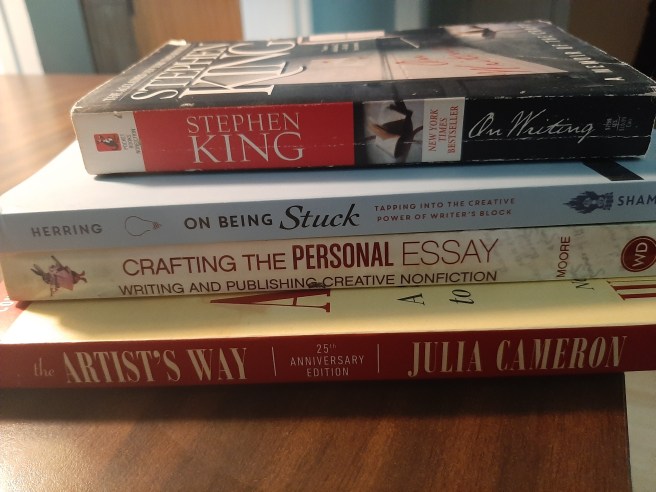
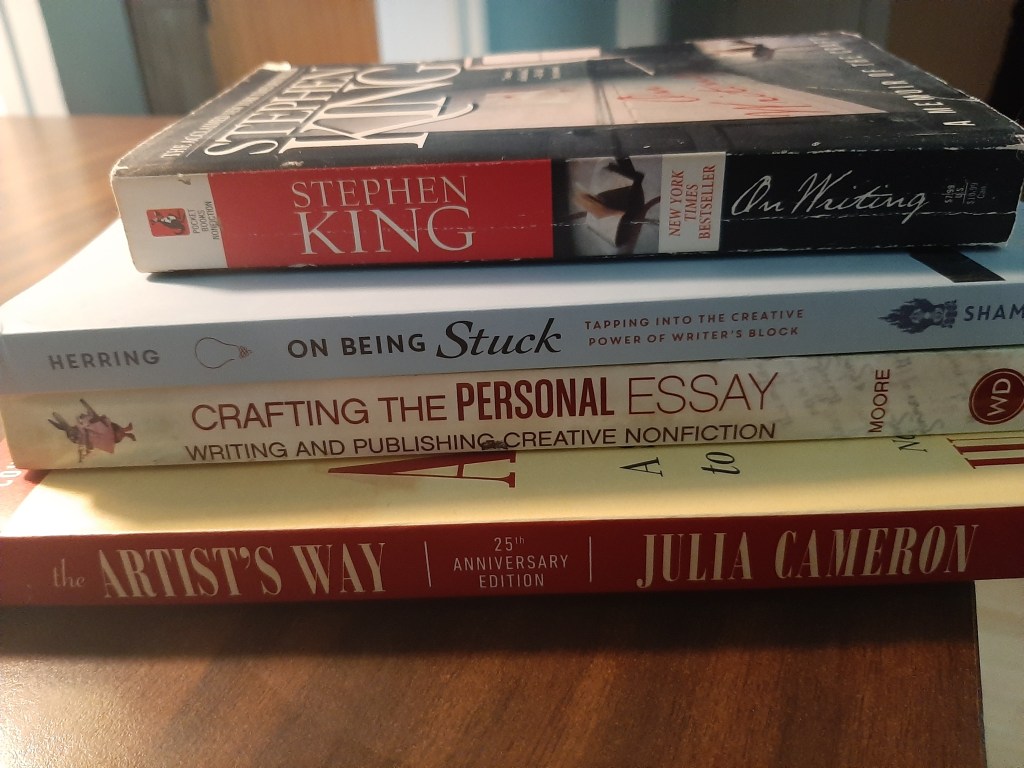
1. On Writing by Stephen King. You’ll find King’s book on numerous recommended lists, and it’s easy to see why. Part memoir and part writing toolbox, there are so many practical tips that makes it easy to jump into a regular writing practice. I appreciated his honesty about the writing life – it’s not always easy and you’ll find bumps along the way.

2. Crafting the Personal Essay by Dinty W. Moore. If you want to start writing personal essays, this is a must-read book. Moore breaks down the art and craft of essay writing in simple, easy-to-understand ways. He covers different types of essay writing too – food, travel, childhood experiences, etc. Moore, by the way, is editor of Brevity’s Journal of Concise Literary Nonfiction.

3. Bird by Bird by Anne Lamott. If you prefer a little humor with your writing advice, you’ll enjoy Lamott’s personal odyssey in writing. She covers everything from getting started to joining writer’s groups and attending conferences. You’ll learn a thing or two as you laugh.

4. Zen and the Art of Writing by Ray Bradbury. The best part of Bradbury’s book is his description of how he comes up with story ideas, which is by word associations. If you’re tired of doing writing prompts, Bradbury’s approach might be worth a try.

5. Writing from the Heart by Nancy Aronie. While this title is not as well-known as others on this list, it is a worthwhile read. Her goal is to create a safe environment for people to write. Not everyone finds the writing process easy, and Aronie takes you through the process step by step so you don’t feel so intimidated.

6. Callings: Finding and Following an Authentic Life by Gregg Levoy. While not a book about writing, it is about finding your calling. If you believe that writing is your calling, then this is a must-read to help you get over any fears and self-esteem issues that may be holding you back from accomplishing your goals. Levoy is not only a terrific story teller, he relies on his personal experience and the experiences of other people to show how it is possible to live an authentic life. I read Levoy’s book twenty years ago, and I still go back to read sections that resonate with me.

7. The Artist’s Way by Julia Cameron. Many writers point to Cameron’s book as the one that got them started writing. She is most known for her freewriting exercise: writing three pages non-stop first thing in the morning. The exercise is intended to help you remove the toxic thoughts and emotions that build up in your mind and body. Once you release those thoughts, your mind is free to create. If you’ve already read The Artist’s Way, check out Cameron’s follow up, The Right to Write.

8. Writing Down the Bones by Natalie Goldberg. This book has appeared on numerous reading lists and it’s been on my to-read list for a couple of decades. According to the book summary, Goldberg believes that “writing is a practice that helps writers comprehend the value of their lives.” Included are chapters about using verbs, listening, writing first thoughts (writing nonstop, keeping your pen on the page and not crossing anything out), and overcoming self-doubt.

9. The Creative Habit: Learn It and Use It for Life by Twyla Tharp. Tharp may have been a famous dancer and choreographer, but she also knew a thing or two about tapping into one’s own creativity. She describes the empty space of the dance floor (or the blank page) as the starting point for creativity. If you’re looking to start writing or creating on a regular basis, Tharp’s book may help you get past “writer’s block.”

10. On Being Stuck: Tapping into the Creative Power of Writer’s Block by Laraine Herring. Speaking of writer’s block and getting stuck, Herring’s book explores the possibilities that writer’s block holds. She speaks about using these sticking points to your advantage rather than getting stymied by the creative process. Herring has written another book worth checking out, Writing Begins with the Breath.

11. The Successful Author Mindset: A Handbook for Surviving the Writer’s Journey by Joanna Penn. I always thought Penn had the perfect name for a writer. While I have not read this book, I have read her The Creative Penn blog on occasion, which is chock full of helpful tools and advice for developing a successful mindset for your writing career.

12. The Writing Life: Writers on How They Think and Work by Marie Arana. I only recently came across this title. I’ve always found it intriguing how other writers begin their writing journey. We all can learn something from their experiences.

I hope you find these titles helpful. As you continue your writing journey, it helps to pause to read about the experiences of other writers, if only to inspire you to keep writing.

Three Questions Every Writer Should Ask Before Starting a Writing Routine

Novice writers often ask, “How often should I write? And should I write every day?”

Browse the internet and you’ll likely find a variety of responses to these questions. Some responses suggest making time goals, such as one hour a day, while others suggest word goals, such as 500 words. For example, Stephen King in his book “On Writing,” advises new writers to aim for a lofty 1,000 words a day.

To add to the confusion, novice scribes are advised to write every day to achieve consistency with your writing. If you don’t write every day, experts argue, you might lose momentum and motivation. After missing several days, you may never get back to writing.

While their arguments are valid, they may not be practical. Not everyone has time to write every single day because of demanding schedules. Further, the thought of writing every day can be daunting, especially for novice writers who haven’t a clue how to get started. You might say to yourself, “Write every day? I can’t possibly do that! That will take up too much of my day!”

That kind of reasoning assumes that writing is time consuming. But the truth is, writing isn’t nearly as time consuming as we imagine it is. That’s because many of us have built up scenarios in our brain in which we imagine sitting in front of our computer for several hours a day. That scenario might be accurate for well-known authors and professional writers, but not for beginning writers like you and me.

How much time you devote to writing depends on several factors: what you’re schedule allows, whether you’re new to writing, and what you want to achieve with your writing. No two writers will have the same answers. Below are several questions you need to ask yourself before establishing a writing routine.

Question 1: Are you new to writing?

If you’re new to writing, it might be helpful to start with a small goal and work your way up into larger goals as you gain more confidence in your abilities. Set a word goal of 100 words, for example. If after a few days, 100 words is too easy, you can raise the goal to 250 words.

For other writers, a time goal may be a better option, say 15 minutes or 30 minutes. Even five minutes is better than none at all. As you gain more confidence, you can add more time to your sessions, moving from 15 minutes to 30 minutes, for example.

Shannon Ashley at the Post-Grad Survival Guide blog writes that it’s important to achieve consistency with your writing. But how much time and energy you put into it is up to individual writers and what they want to achieve. But it’s not necessary to write every day to achieve that success. It is important if you want to achieve consistency, especially for newer writers.

I recommend setting a small goal of 100 words per session. That is the equivalent of three or four paragraphs, something that is easy to achieve if you write every day. However, if you don’t have time to write every day, you can choose to write two or three times a week or even just weekends. You can still achieve consistency with your writing by committing to writing three days a week.

As you gain more experience, you will learn to write faster and get more writing done in less time. That’s when you can set higher goals for yourself and create more flexible writing schedules.

Question 2: Do you prefer a structured routine or write when you can?

Some writers prefer having a set schedule because they enjoy the structure that it gives them.  Writing every day for a set amount of time or specific word count provides a sense of accomplishment. Just sitting down and writing at the same time every day is an accomplishment in and of itself.

The reality is, there is no set rule that says you have to write every day, writes Ali Luke at WritetoDone blog. It’s simply a goal to work toward. Only you know what is best for you considering your schedule.

On the other hand, some writers with more demanding work schedules may not have a lot of spare time for writing. Or they may simply thrive in unstructured work environments. Sometimes it’s necessary to find time to write wherever you can squeeze it in. For example, you may jot down notes while riding on the bus to work, or cram in a half hour of writing before bedtime. Further, it may not be possible to commit to writing every day. It may be that you are weekend warriors, writing in chunks on Saturday and Sunday.

Knowing which type of person you are – structured or unstructured – can help you decide how to set up your writing routine or whether you should have one at all.

Question 3: What do you want to accomplish with your writing?

If writing is a hobby, then you can be more flexible with your schedule since you are not tied to any deadlines. You can write whenever and wherever you want, and you can make your sessions as short or as long as you want – as your schedule allows. It might be easier to squeeze in writing time before doctor’s appointments and work breaks.

But if your goals are more serious – such as writing an essay or article that you want to have published – then you might need to devote a longer work session to complete it. That’s quiet, uninterrupted time to research, contemplate and prepare your finished piece for an editor. Since it requires greater care, then you will need longer stretches of time to work on it.

The bottom line is this: the more you want to accomplish with your writing, the more time you will devote to your craft. If you love to write, the more time you will make for it. That’s the difference between those who see writing as a casual leisurely pursuit and those who view it as their life’s work.

Writing Critiques: Who Are The Best People to Review Your Writing?

blur business close up college
Photo by Pixabay on Pexels.com

It’s one thing to show off your latest work to your family and closest friends. After all they are the ones who know you best. They know how ambitious and creative you are and how hard you work at your craft. But can they be truly objective about your work? Can they provide more helpful comments other than “it’s a great story.” If you want more than a pat on the back, then you have to look elsewhere to get your writing critiqued.

There are writing groups, of course. Many new writers swear by them, claiming they have gained valuable feedback from fellow group members. But most members are as new as you are to writing, so they may not have the best perspective of your skill or a solid grasp of your story. Members will likely tell you that the work is good as is, simply because they either don’t want to offend you or because they want to be seen as a valued contributor to the group or because they may not understand the difference between good writing and great writing. Personally, I’m skeptical of writers groups for critiques.

So who are the best people to critique your writing? Depending on where you are in your writing process, any one of the following people can provide meaningful and practical feedback.

1. Close friend or spouse
In his book On Writing, Stephen King suggests completing a first draft before having your work reviewed, and then showing it to only one or two people who are closest to you and who you trust, usually a spouse, partner or best friend. King’s wife reviews his first drafts, and she provides valuable input that helps him during the revision phase.

Your significant other knows you best, understands your love of writing, and supports your need to spend countless hours pouring your heart and soul onto a blank page (or computer screen). They may be in the best position to tell you if there’s a better way to phrase something or if a character seems one-dimensional or if a plot twist seems contrived. They may be close to you personally, but they are not close to your work, so they can give you an objective review of your work without killing your enthusiasm for it.

2. Writing instructor or coach
If you’ve ever taken a writing class, you know how valuable the instructor’s knowledge can be. Not only do they become familiar with you as a writer over time, they can help you become aware of your own creative thought process. In that way, you refine your self-editing skills. As they become more knowledgeable of your writing, they can identify weak spots you need to improve on as well as strengths you can maximize to the fullest.

A coach not only provides technical guidance but will also help you be accountable for your writing and help you stay on track to meet your goals. They may be published authors themselves, so they can give you insights about the path to publishing. Many instructors also serve as coaches, offering instruction on a one-on-one basis. Instructors and coaches help you learn to help yourself, but their services may come at a price — the price of a writing class or a coaching session. But the cost may be worth it.

3. Beta readers or reading groups
Other helpful sources of feedback are beta readers and reading groups. Beta readers are individuals in your personal network who are avid readers, while reading groups are groups of avid fans. They may be fans of certain genres, such as mystery or science fiction. If you’re writing a science fiction novel for young adults, reach out to the avid readers in your network and ask for their input. Because they are familiar with the genre and have likely read tons of stories in that genre, beta readers can tell you how your story compares with others they’ve read. Is it on par with them, or does it need improvement? Beta readers and reading groups understand what works and what doesn’t, what will appeal to readers and what won’t.

Mind you, reading groups have a different focus than writing groups. While writers groups focus on writing technique and performance, readers’ groups focus on the storytelling aspect. They understand what makes readers read certain books and not others. And that information can help you craft your story better.

4. An editor
After you’ve revised your story enough times to make it believable and readable, it’s time to submit it to an editor for review. That thought might make you weak in the knees, but don’t fret. Remember, editors are your friends. They’re there to help you hone your story further. They’ve reviewed and edited hundreds of other stories, so they know that many of them are decent enough stories, but aren’t publishable. The editor can tell you how to make your story more publish-worthy.

There are two types of editors. One works for a publication and routinely reviews submitted stories. They know what writing style they’re looking for and the types of stories they want to publish. If your work does not meet the publication’s criteria, it will be rejected.

The second type of editor may work on their own, offering their services to aspiring writers before they formally submit it to an agent or publisher. They will likely charge you for their expertise, but it may be worth it to have someone review your work with a fresh pair of eyes. If you’ve worked on it a long time, you may be too close to your work to see it objectively.

To find a freelance editor, ask fellow writers for referrals. Or check out organizations such as Editorial Freelancers Association or the National Association of Independent Writers and Editors, which post directories of editors.

5. An already published writer
If you’re fortunate enough to count a published writer among your acquaintances, take advantage of their expertise. Ask if they are willing to review a few pages or a chapter or two. If they don’t have time to review it, ask if they’re willing to discuss your project. You might get enough meaningful advice just through the discussion alone. Since they’ve been through the publishing process already, they can tell you what worked for them and what they would do differently.

6. An agent
If you aspire to be published, at some point, you will want to show your completed work to a literary agent. Agents tend to work in specific genres, so do your homework and find an agent that works in the same genre as your story. A good place to start is Writer’s Market, which is updated and published every year, and Writer’s Digest magazine, which profiles a literary agent in each issue. Each agent is different, so be sure you review their submission criteria.

Agents will review your work with an eye on its marketability. Will it sell? Is it publishable? Agents have relationships with multiple publishers and can determine if your story is a good fit at one of them. Most important, they’ll review your work to determine if you are worthy of being represented by them.

Depending on where you are in your writing journey, you will no doubt have a connection to one or several of these individuals at some point. No matter which of these people you choose to review your work, their insights can help you become the best writer you can be.

Want to Improve Your Own Writing? Read Poorly Written Books

blur book girl hands
Photo by Leah Kelley on Pexels.com

In his book On Writing, (which I highly recommend), author Stephen King suggests that if you want to be a better writer, all you have to do is read. Read a lot. And read a variety of stories.

Of course, that might mean exposing yourself to less than stellar writing. But that’s okay.  Even the less-than-stellar samples can show writers a thing or two about crafting stories – the right way.

Perhaps I should begin by defining what I mean by ‘bad writing.’ It isn’t just about a lack of proper grammar and punctuation, although that’s part of it. It has more to do with the development of the story. Think stilted dialogue, implausible plot lines and poorly drawn characters. It isn’t the writing that’s poorly done as much as the storytelling.

As British author Toby Litt writes in The Guardian, bad writing is boring writing. Bad writing are stories you can’t wait to finish because they are dreadfully boring, or one that you don’t finish at all. On the other hand, a well-crafted, well-written book is one that keeps your attention all the way through. It makes you want to turn the page, and the next page and the next page, and so on.

In my opinion, a good book may not be the highest quality writing. It may not even be a best-seller. But what it does well is keep the reader involved in the story and with the characters, especially the protagonist. If you have a hard time putting a book down, it means the author has successfully designed the story to satisfy your interest. You want to read more to find out what’s going to happen next.

After you’ve read enough stories of different genres, your brain begins to notice differences in the way authors develop their plots and characters, or the way dialogue and narration are presented. When you’ve read enough books, you recognize contrived plot lines and inconsistent behavior from characters. You can decide, as the reader, what is believable and what isn’t. By reading bad writing, you are, hopefully, aware enough of your own skill not to commit the same mistakes.

I recently finished reading a romance novel by an author whose work I had read before and enjoyed. I looked forward to a light, easy read. It was anything but. The plot was not believable, the female protagonist behaved in ways that was not consistent with her character, and the overall experience of reading the book was unpleasant. I felt disappointed and cheated.

You don’t want to do that to your readers.

I doubt I will read anything else by this particular author ever again, although I will pick up another romance novel. They can be fun reads on their own — when they’re written well.

Lesson learned from that reading experience: Make sure the plot is plausible and believable and your protagonist behaves in ways that are true to their personality.

Bad writing can appear in any genre, and sometimes in best-sellers. If in doubt about what ‘bad writing’ is, check out Goodreads’ list of ‘poorly written’ books. Among the Fifty Shades of Gray and Twilight collections is The Da Vinci Code. I once tried to read it many years ago and couldn’t get through it. The language was overly descriptive and heavy, moving the narrative along at a snail’s pace. I kept wanting the author to pick up the pace. Naturally, I never made it to the end.

Lesson from that reading experience: Don’t get so bogged down in details that the story slows to a crawl. Keep moving the story along and you will maintain your readers’ interest. Keep that in mind when you do your own writing.

On the upside, reading bad writing can put your own writing into perspective. You can say to yourself, “Hey, I can write better than this. If this trash is being published, maybe there’s hope for me yet in this business.”

The more you read, the more you can learn from the mistakes other writers have made. So even if you have to trudge through a few bad apples along the way, you can still gain from the experience and improve your writing at the same time.

Related Reading about ‘Bad Writing’:
https://bookriot.com/2013/06/27/the-case-for-reading-bad-books/

https://joshcraigwrites.wordpress.com/2012/08/16/about-reading-poorly-written-books/