The Most Memorable Books of 2025

Looking back over the past year, 2025 was a banner year for reading. Not only had I finally gotten around to reading several authors I’ve wanted to read, but several books were true surprises.

My choices cover a range of genres from historical fiction to contemporary romance, from literary fiction to mystery and magical realism. I selected these books based on the following criteria:

* A compelling premise. Did the story hook me from the start?
* Strong main character (and not necessarily likeable either)
* Engaging storytelling that kept me turning the pages
* A satisfying conclusion that actually made sense for the story

Below are my top seven picks of the year followed by honorable mentions. How many of these stories have you read and enjoyed?

The Best:

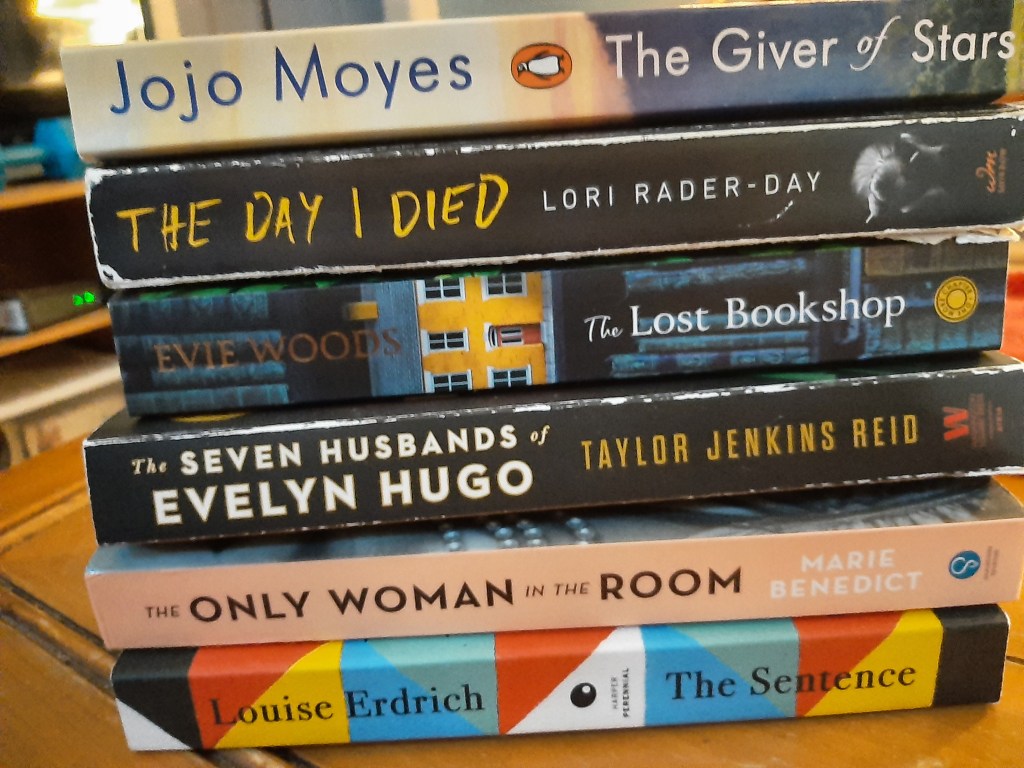
The Giver of Stars by Jojo Moyes

This book had been on my Want-to-Read list for ages, and it did not disappoint. Based on a true event and set during the Depression era, the story highlights a group of women who volunteer to deliver books to poor residents in rural Kentucky as part of Eleanor Roosevelt’s traveling library. According to the marketing blurb on the back cover, it’s a “captivating tale of friendship, true love and reaching for what’s possible.” I’m looking forward to reading more of Moyes’ books.

The Sentence by Louise Erdich

Here’s another author I’ve wanted to read for a while. The Sentence takes place in Minneapolis over the course of one year from November 2019 to November 2020, taking readers through the narrator’s experience during the Covid pandemic and the George Floyd murder and ensuing riots. All the while, she deals with a capricious ghost haunting the book shop  where she works as well as her conflicted feelings about her marriage and her efforts to reconcile her own dark past. An intriguing character study of one woman’s life in turbulent times, and Erdich’s Native-American heritage brings an added narrative layer. I’m sure I’ll be reading more of her works.

The Seven Husbands of Evelyn Hugo by Taylor Jenkins Reid

Evelyn Hugo, a retired film star of the 1950s and 1960s, hires a novice magazine writer to help her draft her memoir. Over several ensuing weeks, the actress shares her life story, though she does so at her own pace and is determined to control the narrative. The hired writer wonders why she was chosen for the job because the two women have nothing in common. Hugo, by her own admission, is not the kindest person in the world and her relationships are fraught with tension. This was another fascinating character study, and the story stayed with me longer have I closed the book.

The Lost Bookshop by Evie Woods

Fans of magic realism will enjoy this novel by Woods, set in Dublin where a vanishing bookshop casts its spell over three unsuspecting characters who have played minor side roles in their own lives. Told through two timelines and three characters’ point of views, readers follow them on their journey to self-discovery and self-empowerment. What I enjoyed most is the way Woods weaved and intertwined the characters’ lives despite the different timelines and how she created a magical bookshop that only a few could see.

The Only Woman in the Room by Marie Benedict

In her novels, Benedict often features bright, talented young women whose career achievements are suppressed by the strong, dominating men in their lives. This story is no exception. Most people knew Hedy Lamarr as a stunningly beautiful Hollywood film star of the 1950s. What they don’t know is that she was also a scientist. She grew up in an aristocratic family in Austria, and through her marriage to an Austrian arms dealer, she often overheard conversations detailing the Third Reich’s  plans. After escaping to the United States and becoming a screen star, she used her scientific knowledge to design a communications system that would help the U.S. fight the Nazis. Except as a woman, no one would listen to her idea.

Murder Under the Tuscan Sun by Rachel Rhys

File this one under gothic romantic suspense. In some ways, the tone and storytelling of this novel reminds me of Daphne DuMaurier’s Rebecca. When a recently widowed woman responds to an ad for a companion to an ill aristocrat at his estate in rural Italy, she has no idea what to expect. While there is no actual murder, there is plenty of suspense as the widow experiences strange dreams, ghost sightings while she cares for her charge who doesn’t seem to want her help. Over time, the two grow closer even as he seems close to death. This was a surprising read that kept me turning the page.

The Day I Died by Lori Rader-Day

After reading two earlier works by Rader-Day (Little Pretty Things and The Black Hour), I fully expected another stellar novel. I was not disappointed.  From the opening pages, I was taken on a wild journey through the eyes of the story’s protagonist Anna, who has a unique talent of analyzing people’s handwriting. The local sheriff isn’t convinced of Anna’s abilities, but hires her anyway to help in his search for a missing boy. But to solve this mystery, Anna has to face her own fears about her past and her relationship with her own teenaged son.

Honorable Mentions:

The following didn’t make my best list but are all worthy of your time.

Mexican Gothic by Silvia Moreno-Garcia
I don’t usually read horror novels–I get too easily creeped out–but Garcia’s writing helped create a dark and suspenseful story. I just didn’t buy into the romantic relationship.

Book Lovers by Emily Henry
After hearing so much about Emily Henry, I had to check out one of her books. This was a solid, engaging story, but the more compelling story line was the relationship between the two sisters.

The Midnight Library by Matt Haig
I was fascinated by the premise of this novel. Imagine what your life would be like if you made different choices.

The Memory of Lemon by Judith Fertig
A mix of magical realism and contemporary romance, this story is about a young baker who has a knack for tasting people’s emotions and has the ability to sense which ingredients will touch her customers’ hearts.

The Ten Thousand Doors of January by Alix Harrow
A young woman unwittingly uncovers a network of secret doorways to other worlds and explores many of them to find her father who had disappeared long ago. I don’t read many fantasy novels, but this was a surprising and entertaining read.

What about you? What books did you read this past year that impressed you most? Which books would you recommend?

Design Your Own Reading Challenge for 2026

Photo by Bryan Schneider on Pexels.com

Mention the term reading challenge and some people will roll their eyes. Not me. I’m a big fan of them, so much so that I’ve created my own challenge the past few years.

For those not familiar with them, reading challenges are a test of sorts to coax you to read different types of books, explore new genres or new authors. It can be done either alone or as a small group, and for any length of time, whether it’s for three months or one year.. Reading challenges can spice up your reading life and even help you tackle those books in your TBR pile. It’s one of the reasons I look forward to the start of the new year, so I can begin a new challenge.

If you decide to participate in a challenge, or want to create your own, here are a few things to keep in mind:

* It’s not about how many books you read, but the quality and nature of those books. Some people aim to read as many books as they can, but do you really want to rush through the reading experience? Books are meant to be consumed at a slow, steady pace to absorb the plot, characters, theme and emotions.

* Set a goal for yourself. What do you want to accomplish during the challenge? Is there a certain genre you want to explore that you haven’t read before? Perhaps you want to return to the classics? Or an author you’d like to read more of, say Stephen King or Agatha Christie.

* Set a time allotment. Most challenges I know usually take place over the course of one year. But maybe you prefer a shorter challenge, like three or six months where you can focus on a particular genre or author.

* Have fun with the challenge. Be imaginative. Come up with unique categories, such as a book you found in the garbage or dumpster. (Hey, you never know what you might find there.) Check your TBR shelf for inspiration.

With these tips in mind, you’re ready to start 2026 with a brand new approach to reading. If you’re not sure where to start, I’ve come up with several challenge options that you can adapt for your own use.

Reading Challenge #1: By Prompt

Challenge #1 is the traditional version you’ve likely heard of with a never-ending list of prompts. Do a search online and you can find all sorts of challenges of this nature. There are roughly 40 prompts in the list below, but you don’t have to follow all of them. You can add or alter the list as you see fit. Most importantly, have fun.

1. A favorite author
2. An author from your hometown
3. An author you’ve never read
4. A book you read when you were in high school
5. A genre you don’t normally read
6. A book that’s been sitting on your TBR shelf for more than 2 years.
7. A book with more than 400 pages
8. A book with less than 200 pages
9. A book published in the year you were born
10. A book with a one-word title
11. A book you bought second-hand or at a discount store
12. A book you bought new
13. A book you borrowed from the library
14. A book recommended to you by a fellow reader
15. A book set in a foreign country, not Paris or London
16. A book with a color in the title
17. A book with a number in the title
18. A book with a place in the title
19. A book made into a movie or TV series
20. A book by a debut author
21. A banned book
22. A fairytale retelling
23. A workplace romance
24. A memoir by a non-celebrity
25. A book with an job/occupation in the title
26. A book published in the past year (2025)
27. A book published more than 100 years ago.
28. A book published by a small or indie publisher
29. A book with a lengthy subtitle
30. A book written by two authors or one author with a pseudonym
31. A book with a character with a unique name
32. A book you found in the garbage or dumpster
33. A book with a picture of food on the cover
34. A book with a body of water on the cover
35. A book you heard about on social media
36. A book by a minority author
37. A current bestseller
38. A book with a person’s name in the title
39. A book set in Hawaii or Alaska
40. A young adult mystery or romance

Reading Challenge #2: By genre

Each month is dedicated to a different genre. For example, January might be ideal for curling up by the fire with a lengthy fantasy or science fiction series. Another month might be dedicated to current bestsellers or indulging in one of the classics. I always find October to be the perfect time for a good mystery or horror novel, while February is always reserved for romance because of Valentine’s Day.

I’ve listed the most common genres below. How you want to assign one to each month is up to you.

Mystery/suspense
Romance
True crime
Science Fiction
Fantasy/Romantasy
Memoir or Biography
Non-fiction
Literary fiction
Young adult
Classic literature
Current bestseller
Horror
Spy thriller
Paranormal
Historical fiction

Reading Challenge #3: By theme or topic

If genre is too basic and you wish to take your reading challenge to the next level, try making reading choices based on theme. You probably notice from your TBR collection that you’ve acquired books with similar themes. For example, I tend to read books about libraries, bookshops and struggling writers. Perhaps you read stories set on a university campus or feature students as the main characters. Or your favorite memoir is about sports celebrities. You get the idea.

Themes can be fun to read because they’re broad enough to cover different genres and authors, so you don’t have to think about that aspect of the challenge. Here are some common themes, or come up with one of your own.

Money or finance
Love/romance
History
Family
Faith
Pets or animals
Books or libraries
Bodies of water
Sports
The arts (dancing, music, painting, etc.)
Sports
Food/Cooking
Earth/environment
Science or technology
Health or medical theme

Reading Challenge #4: By Setting or Location

If none of the aforementioned categories rocks your boat, there’s another option: by location. Whether you love to travel or prefer to stay close to home, reading a book set in a specific location can transport you to any place in the world. Think of these possible locations for your next reading challenge:

Parts of the U.S.:
Washington, D.C.
California
Texas
Florida
New York City
A farm in the Midwest
Pacific Northwest
Boston or Northeast
New Orleans
Southern states
Hawaii
Alaska
On a cruise ship

Outside the U.S.:
Mexico
Canada
Paris, France
London, England
Italy
Greece
India
Germany
The Caribbean
Japan
China
Russia

Reading Challenge #5: By Time Period or Decade

I came across this challenge by The Book Girls Guide and thought I would add it to our challenge options. The ladies at Book Girls Guide do a great job of compiling and summarizing books for their readers. Every year for the past six years, they’ve presented a reading challenge based on decades. If you love historical fiction, this might be the challenge for you. Sure, it’s one single genre, but with the focus on the time frame of history, no two stories are alike and you can learn so much about events and people who shaped history.

My challenge to you is to choose one challenge and have fun with it.

Create a Reading Challenge That Truly Challenges You

It’s usually at the start of every New Year that I look forward to my annual reading challenge. While I aim to read on average 30-34 books, I really try to focus on diversifying my reading interests. I like to challenge myself by reading new authors, different genres that I don’t normally read. By mixing things up, I expose myself to different writing styles which can only make my own writing better.

This year I decided to switch things up by creating a challenge based on monthly themes. I considered each month’s holidays and seasons for potential book themes, then browsed my TBR shelf for books that matched that theme. For example, January is the start of a new year. It has a wintry theme, with cold, snow and wind. It’s hockey season too.

Photo by Mikhail Nilov on Pexels.co

Selecting books from my TBR shelf that fit these themes was fairly easy. I wound up reading The Ice Queen by Alice Hoffman and The Snow Child by Eowyn Ivey. I’m already looking ahead to February with two more novels based on the month’s themes (Valentine’s Day, President’s Day, Mardi Gras and African-American Heritage month), and I only have to look at my TBR shelf to find those selections. Other options are the local library and the Little Free Library in your neighborhood.

This is one way to complete a reading challenge. The beautiful thing about them is that you can create your own challenge based on your own goals and interests and start it at any time. They can last three months, six months or a full year. They can either be focused on diversifying your reading selections or increasing your reading time. It all depends on what goals you set for your reading challenge.

Since there are so many ways to go about completing a reading challenge, it may be difficult to decide the best one for you. If you’re not sure what type of reading challenge you want to do, check out this nifty quiz at MindJoggle.com. The site also has some cool resources you can use to get the most out of your challenge, such as reading journals and book lists.

The first step for any reading challenge is to set a goal. If your reading goal is to squeeze more reading time into your life, there are several ways to approach this:

* Increase the number of pages you want to read every day. For example, if you usually only read 10 pages, see if you can increase that total to 20 or 25.

* Increase the amount of time you spend reading. If you currently read 15 minutes a day, see if you can increase that reading time to 30 minutes a day.

* Set a goal for the number of books you want to read in a given month. If you’re used to reading only one book, challenge yourself to increase it to two.

On the other hand, if your focus is to expand and diversify the types of books you read, there are ways to accomplish that too.

* Focus on monthly themes. For example, during the month of February, you might read a romance novel (Valentine’s Day), a political thriller or presidential biography (President’s Day) or a novel written by an African-American author (African-American Heritage month). Pick one or two to fulfill the February theme, then do the same for March (St. Patrick’s Day, Women’s History month and the start of spring) and the other months that follow.

* Focus on one genre for a short time period. For example, if you’re used to reading the latest bestsellers, you might do a three-month challenge featuring classic novels that you’ve never read before.   

* Using the monthly system, you can select a book for a different genre each month. For example, in January, you might read a fantasy novel, in February a biography, in March a historical fiction novel, etc.

These are just ideas to get you started thinking about your own reading challenge. When you create a  challenge that fits your interests and schedule, you’re more likely to stick with it.

Here are a few other tips to maximize your reading experience:

1. Start by determining your reading goal. Do you want to increase the amount of time you spend reading in a given week? Or would you rather experiment by reading books in different genres?

2. Think short-term mini-challenges. Sometimes all you need is a three-month challenge to kickstart a reading habit or improve the one you already have. With shorter challenges you can do a deeper dive into specific genres, like mysteries or historical fiction that you probably didn’t read before.

3. Create a reading calendar. Whether you commit to a full one-year challenge or a mini-challenge of three months or six months, use a calendar to choose the books you want to read. Create a mix of longer and shorter books so you don’t get bored with books of the same length. When you see the calendar at a glance and know what books you’ll read and when, it will be easier to stick with the schedule and with the challenge.

4. Join a reading community. To keep yourself motivated, it might help to join a reading community where you can share book reviews and reading experiences with other like-minded book lovers. Check the internet for possible online communities, or visit your local library to see if they have a reading community. (Note: Don’t confuse a reading community with a book club. Reading communities focus on the reading experience, no matter what you’re reading, while book clubs read the same book for the purpose of discussion.)

5. Be consistent with your reading. A little bit each day builds a new habit and will keep you motivated to keep reading. Also be flexible with your challenge. If a book isn’t working out for you, skip it and come back to it later. Switch to something you will stick with. It’s okay to change the schedule as you go along.

6. Beat reading slumps by mixing up formats. It never fails that by late autumn, my reading interest lags and I just don’t feel like reading. Experts suggest changing up book formats with shorter pieces that don’t require as much time or energy. Think short stories, an essay collection or a novella.

Remember, reading challenges are meant to help you stretch yourself, learn new things and get out of reading ruts. Most important, have fun with them. That’s what makes them worthwhile.

Rediscovering the Local Library for Lifelong Learning

books-4

It’s been a busy week and I haven’t had time to write a fresh post. So in light of my focus on education and training, here’s a repost of a story I did back in 2016. Enjoy. I’ll be back next week with a fresh new post and a new writing prompt. As always, thanks for reading. RL

Have you visited your local library lately? When was the last time you did?

It had been a long time since I visited a library, but a few weeks ago I decided to go to the one in my neighborhood to escape the heat. Once inside the glass doors, I was quickly reminded how much I loved the hushed atmosphere. People spoke is low voices amidst the rustling of newspapers and the hum of laptops as people worked. I love that low-level noise, just enough to know that other people are around, but not loud enough to interfere with a person’s studying or reading activity.

As I wander the aisles, I imagine myself getting smarter just being there in the presence of so many books. I feel like my body absorbs their creative energy, the ideas, the discussions, and the desire for learning. No wonder there is a hushed reverence as soon as I walk through its doors. Knowledge is at work among those who visit.

In an era where Google rules the Internet, local public libraries have been a mainstay in many communities. New research by Pew Research Center finds that libraries still play a vital role in our local communities. Where would we be without these places of learning? Like print books, they’re not going away any time soon. And that’s great news for self-described lifelong learners like me.

But like many people, I tend to forget that the library is there, ready to welcome readers and students of all ages and education levels to browse its shelves and delve into subjects to expand their understanding of the world. Most Americans believe that libraries do a good job of providing a safe place to hang out, according to a study by the Pew Research Center. Consider these additional statistics:

* 77 percent say public libraries provide them with the resources they need.

* 58 percent of respondents believe libraries help open up educational opportunities for people of all ages.

* 49 percent think libraries contribute “a lot” to their communities in terms of helping spark creativity among young people.

* 47 percent said libraries provide a trusted place for people to learn about new technologies.

We may occasionally forget that the library exists, but thank goodness they still play a vital role in our communities. While most people may prefer to use the Internet initially for learning new things, it’s nice to know that libraries are still a viable place for reading, research and studying.

Nine Easy Ways to Expand Your Vocabulary

CAM00674This is a repost from a couple of years ago. The content is as pertinent today as it was then. Enjoy!

Whether you are a budding writer or a working professional in a non-communications role, your ability to communicate depends on an expansive vocabulary. As children and young adults, we learn new words at a fairly high rate. By the time kids reach age six, they know close to 13,000 words, according to Scholastic.com. Most native English-speaking adults have mastered 20,000 to 35,000 words, according to TestYourVocab.com. Sadly, vocabulary growth tends to slow down for most adults by the time they reach mid life.

When it comes to reading and writing, learning new words and broadening our scope of language and understanding can only serve to make our story telling skills even better. With each new word we learn, it’s only natural that we want to implement it right way into our everyday conversation, to display our newfound knowledge.

Whether you want to become a better writer or just want to impress your friends with your growing lexicon of language, here are a few easy tricks to expand your vocabulary.

1. Read, read, read. This is obvious. The more you read, the more you will absorb the writer’s meaning through language. And the more diverse your reading materials – from historical fiction novels and celebrity memoirs to newspapers and medical journals – the more expansive your vocabulary will become.

2. Play games and puzzles. Crosswords and other word puzzles are not only fun, but they help build your understanding of words. A site like TestYourVocab.com offers several self-tests and exercises to help you determine how expansive your vocabulary is.

3. Keep a dictionary and thesaurus at your side. These valuable tomes are your best friends whenever you read or write. When you come across an unfamiliar word when you read, take a moment to look up its meaning. When you write, you tend to use the same words over and over. Try looking up a word you commonly use to see if there’s another word you can use instead.

4. Read the dictionary. Yes, you read that right. Read the dictionary front to back as if you were reading a novel. A grade-school classmate of mine did that in seventh grade. While other kids in the class were throwing spit balls, my classmate sat quietly at his desk studying the dictionary. It did not surprise me to learn several years later that he earned a perfect high score on his ACT test.

Take a page or two a day and study each word on the page. Note how many of them are unfamiliar to you. Little by little, your vocabulary will grow.

5. Take a class on a topic unfamiliar to you. If you don’t have the time or patience to read a text book, taking a class might be the next best thing to help you build your vocabulary. For example, when I took a personal training certification class a few years ago, I was exposed to terms and phrases related to exercise physiology, nutrition and physical fitness, not part of my everyday language, but it did give me some additional exposure to words I never would have learned otherwise. If medical science isn’t your forte, try other topics, such as gardening, carpentry or cooking.

6. Keep a vocabulary log. Each time you come across a word that is unfamiliar to you, write it down in a journal. In the space next to it, look up the word in a dictionary and write down the definition. The practice of writing it down will help commit the information to your memory.

7. Talk to people. Every now and then, it helps to take your nose out of a book, laptop or iPhone and look around you. The next time you visit a coffee shop, strike up a conversation with people in line or sitting at a table by themselves. Listen to the way they speak. What words do they use? This practice is helpful for creating dialogue in your fiction writing.

8. Visit sites like Vocabulary.com, a free online learning platform that helps students, teachers and communicators build their vocabulary. The site offers online games and exercises as well as tools to help you build vocabulary lists. There are other online platforms and apps available for the same purpose. No matter which you decide to choose, they are designed to help you build your vocabulary in fun, interesting ways.

9. Start writing, and keep writing. The more you write, the better you become at writing and the more words you will learn to use along the way.

When you engage in any one, two or three of these techniques on a regular basis, you’ll see your vocabulary grow exponentially in a short matter of time.

A Writer’s Guide to Self-Care

Photo by Cedric Lim on Pexels.com

Happy New Year! I’m pleased to announce the debut of my white paper “Find Motivation to Start Writing — and Keep Writing” which you can find on my website.

Also check out this week’s writing prompt: Why do you write? Challenge yourself to come up with at least 40 reasons why you write.

If you’re like me, you probably don’t give much thought to caring for your mental and physical well-being when you’re caught up in your writing projects. You spend hours at your desk planning blog posts or your novel while you forget to eat right or get the exercise you need. But without a strong foundation of health, you may not have the strength and stamina to withstand the twists and turns, ups and downs of your writing life.

Some writers describe writing as more like a marathon than a sprint. You have to prepare yourself mentally and physically for the long haul. Writing is more demanding than most people think it would be. It can take a lot out of you day in and day out. Further, if you run a writing business where you must meet the demands of clients and work on deadlines, that adds more stress to your day.

It’s important for writers to manage their self-care. There are several simple things you can do every day to make sure you are healthy and strong. Below are my tips for practicing self-care.

1. Get plenty of rest. Sleep is key to restoring your energy levels and mood. I can always tell the difference in my energy levels and motivation when I sleep seven hours compared to only four or five. Sleep really does make a difference. I wrote about sleep and creativity here. But sometimes sleep can be difficult to come by. Experts suggest cutting back on caffeine, shutting off electronic devices a few hours before bedtime and avoid heavy meals before bedtime. If you find yourself routinely waking up at three or four in the morning, rather than fight the sleeplessness, try reading for an hour before trying to go back to sleep.

2. Eat healthy meals and snacks. To maintain your energy throughout the day, make sure you’re eating healthy foods with plenty of fruits and vegetables, and protein and fiber to keep you feeling fuller longer. Drink plenty of water – at least eight glasses a day – and don’t skip meals. If you feel your energy lagging mid-day, eat healthy snacks to tide you over until dinner time. Try an apple with a handful of nuts or nut butter, veggies and hummus, or cheese and crackers.

3. Get plenty of exercise. Health experts suggest getting at least 30 minutes of physical activity every day. The activity doesn’t have to make you sweat, but you should feel your heart beat faster. Go for a walk, do yoga poses or ride a bike. If you don’t have 30 minutes at one time, break it down into two or three 10-minute breaks during the day. During these mini-workouts, you can dance, jog up the stairs or follow a YouTube fitness video. The fitness breaks will not only help you stay fit and strong, they will give you the energy boost you need to get through the rest of the day.

4. Talk to a friend when you struggle. Sometimes you may feel stuck or lonely during your writing practice. When those situations occur, make sure you call a friend to talk things over, especially if you’re feeling particularly sad about something. Find an outlet for your feelings, and talking with a friend can get you through those rough periods.

5. Curl up with a good book. Sometimes when I’m feeling blue, all I want to do is curl up with a good book. Reading just makes me feel better. Most books end on a positive, happy note, and that makes me believe that happy endings are possible in real life too.

6. Take a long, hot bath. Sometimes just soaking in the tub can ease the tension of the day. There’s something about immersing yourself in warm water that alters your mood. Research shows that warm baths diminish feelings of pessimism and depression because they give bathers a feeling of solitude, comfort and peace. Add scented soap to the water, like lavender which is also soothing and relaxing. Candles are optional.

7. Practice meditation. Sometimes the pace of life moves too fast, faster than we can keep up with. At those times, it helps to practice meditation. Or if you don’t have the patience for meditation, just try to sit alone with your thoughts. Turn off the TV and electronic devices for at least 10 minutes, longer if your schedule allows. Just enjoy the quiet. Sitting quietly helps slow down your breathing and the pace of your life will also seem to slow down.

8. Keep a personal journal. When things get especially emotional and intense, grab a notebook and begin writing. Those thoughts that plague you can interrupt the flow of your work, so you want to find an outlet for them. It helps you make sense of the curve balls that life occasionally throws at you. Once you find an outlet for your personal feelings, you can focus on the tasks at hand.

9. Spend some time with a favorite pet. Most writers I know seem to have a dog or cat as their companion. Many psychologists believe pets are good for your mental health because they help lower blood pressure and reduce stress and anxiety. Pets also make you laugh, and laughing is good for your mental health too. If you’re not convinced, try spending a few minutes a day watching animal videos; they’re sure to put a smile on your face.

10. Get a massage. If you’re like me, you feel most of your tension in the neck and shoulders. A good massage can ease muscle tension and relieve anxiety. But massages can be pricey, so have a friend or significant other give you a good back and shoulder rub.

Self-care is important for your well-being. A healthy mind and body can prepare you to work longer stretches of time. With good health, you can finally finish writing that novel or meet your writing goals.

What do you do to take care of yourself?

What Makes a Story Memorable?

book-2170910_1280

Have you ever read a book that stayed with you long after you finished reading the final page? Or watched a movie that kept you awake all night as scenes replayed over and over in your mind?

There are few stories that are so memorable that they grab you by the throat and throttle your senses, or grip your heart so tightly that you want to cry or scream. Most reactions to stories are more subtle, of course, but still effective. Sometimes, a film or book drains you instead, so all you want to do is clutch a warm, soothing cup of tea and sit huddled on the sofa staring into space trying to relive the story in your mind or erase it because it was too horrible to experience again.

Recently I re-discovered one of my favorite all-time films on cable and again, I experienced that “stickiness” of a good story. I grew up watching Fiddler on the Roof enchanted by the music and the romance in a time and place far away from the here and now. The story is about a Jewish peasant in prerevolutionary Russia contending with the marriage of three of his daughters. It wasn’t until I was older and watched it as an adult that I understood the historical and religious undertones of the story. Still, as I lay in bed that night a few weeks ago, the story, the characters and the music continued to play in my head, delaying sleep.

What stories have you read or watched that made you feel sad, angry, joyous, surprised, frightened or ecstatic? What films have made you take notice of an issue, a person or a piece of history that you had not noticed before? What stories or characters made you want to take some sort of action — to dance and sing, to hug your children to make sure they were safe and felt loved, or hop on an airplane to a place you had never been before, just because you saw it on the movie screen or read such a vivid description that you had to see it in person?

In the business world, the term “stickiness” refers to a website’s ability to keep eyeballs browsing its pages. I suppose the same “stickiness” can be applied to a story’s ability to stay on in your memory long after you closed the book. The story gives us so much pleasure that we want to experience that pleasure again.

So what makes a story memorable? What elements do memorable stories have in common that make them worth seeing or reading over and over again? Here are a few common elements, based on my own observations.

Fully developed characters. If fictional characters were real human beings, they wouldn’t be flat, emotionless people. Characters need depth, flaws, and qualities that makes them more like one of us. Strong characters don’t necessarily have to be good characters and they certainly shouldn’t be perfect or we wouldn’t be able to relate to them. Complex, multi-dimensional characters make the most memorable characters, and they aren’t always the most likable. Think Ebinezer Scrooge or Harry Potter’s Lord Voldemort.

Sense of time and place. We might remember a story for its unique setting or its place in history. For example, the yellow brick road in The Wizard of Oz is memorable because its unusual color transcends what we believe to be true of traditional paths that are made of other materials and other colors. It makes us realize that this is not part of our world.

Emotional connection. A story can be memorable by the emotional connection it creates between the characters and their readers or viewers. We can sympathize with Topol’s father figure in Fiddler on the Roof because of the emotional conflicts he faces. We feel the love he has for his family and his community, and we witness the pain and confusion in his eyes as he sees his old comfortable world falling apart, and he feels helpless to do anything to stop it.

Suspense. Without suspense, there isn’t much of a story, just a bunch of scenes with no connection to one another. Suspense creates tension, which is the engine that drives the action forward. As each chapter unfolds, another clue, character, or plot twist keeps our interest. If we want to know what’s going to happen next, we have to keep reading.

A satisfactory conclusion. There is nothing more disappointing than reading a page-turner only to get to an ending that makes you wonder, “What happened?”  The ending may not be what you or I have in mind, but it makes sense from the author’s or director’s perspective. We are so conditioned to believe in “happily ever after” that we expect happy outcomes in movies and books. So when a story ends differently, like Thelma and Louise driving their convertible off a cliff, or two young lovers split up at the end of La La Land, it can be a bit startling. The satisfaction comes with understanding that there is a resolution to the conflict in the story; it just may not be the one we wish it to be.

Granted most of these examples are films, but these tips work just as well for books, TV shows, even song lyrics. They tell stories too. Whether you write stories, or just enjoy reading them or watching them on film, remember that stories aren’t worth experiencing unless you can make them memorable.

Rediscovering the Local Library for Lifelong Learning

books-4

Have you visited your local library lately? When was the last time you did?

It had been a long time since I visited a library, but a few weeks ago I decided to go to the one in my neighborhood to escape the heat. Once inside the glass doors, I was quickly reminded how much I loved the hushed atmosphere. People spoke is low voices amidst the rustling of newspapers and the hum of laptops as people worked. I love that low-level noise, just enough to know that other people are around, but not loud enough to interfere with a person’s studying or reading activity.

As I wander the aisles, I imagine myself getting smarter just being there in the presence of so many books. I feel like my body absorbs their creative energy, the ideas, the discussions, and the desire for learning. No wonder there is a hushed reverence as soon as I walk through its doors. Knowledge is at work among those who visit.

In an era where Google rules the Internet, local public libraries have been a mainstay in many communities. New research by Pew Research Center finds that libraries still play a vital role in our local communities. Where would we be without these places of learning? Like print books, they’re not going away any time soon. And that’s great news for self-described lifelong learners like me.

But like many people, I tend to forget that the library is there, ready to welcome readers and students of all ages and education levels to browse its shelves and delve into subjects to expand their understanding of the world. Most Americans believe that libraries do a good job of providing a safe place to hang out, according to a study by the Pew Research Center. Consider these additional statistics:

* 77 percent say public libraries provide them with the resources they need.

* 58 percent of respondents believe libraries help open up educational opportunities for people of all ages.

* 49 percent think libraries contribute “a lot” to their communities in terms of helping spark creativity among young people.

* 47 percent said libraries provide a trusted place for people to learn about new technologies.

We may occasionally forget that the library exists, but thank goodness they still play a vital role in our communities. While most people may prefer to use the Internet initially for learning new things, it’s nice to know that libraries are still a viable place for reading, research and studying.


Nine Easy Ways to Expand Your Vocabulary

CAM00674
Whether you are a budding writer or a working professional in a non-communications role, your ability to communicate depends on an expansive vocabulary. As children and young adults, we learn new words at a fairly high rate. By the time kids reach age six, they know close to 13,000 words, according to Scholastic.com. Most native English-speaking adults have mastered 20,000 to 35,000 words, according to TestYourVocab.com. Sadly, vocabulary growth tends to slow down for most adults by the time they reach mid life.

When it comes to reading and writing, learning new words and broadening our scope of language and understanding can only serve to make our story telling skills even better. With each new word we learn, it’s only natural that we want to implement it right way into our everyday conversation, to display our newfound knowledge.

Whether you want to become a better writer or just want to impress your friends with your growing lexicon of language, here are a few easy tricks to expand your vocabulary.

1. Read, read, read. This is obvious. The more you read, the more you will absorb the writer’s meaning through language. And the more diverse your reading materials – from historical fiction novels and celebrity memoirs to newspapers and medical journals – the more expansive your vocabulary will become.

2. Play games and puzzles. Crosswords and other word puzzles are not only fun, but they help build your understanding of words. A site like TestYourVocab.com offers several self-tests and exercises to help you determine how expansive your vocabulary is.

3. Keep a dictionary and thesaurus at your side when you read. This is a no-brainer. These valuable tomes are your best friends whenever you read or write.

4. Read the dictionary. Yes, you read that right. Read the dictionary front to back as if you were reading a novel. A grade-school classmate of mine did that in seventh grade. While other kids in the class were throwing spit balls, my classmate sat quietly at his desk studying the dictionary. It did not surprise me to learn several years later that he earned a perfect high score on his ACT test.

Take a page or two a day and study each word on the page. Note how many of them are unfamiliar to you. Little by little, your vocabulary will grow.

5. Take a class on a topic unfamiliar to you. If you don’t have the time or patience to read a text book, taking a class might be the next best thing to help you build your vocabulary. For example, when I took a personal training certification class a few years ago, I was exposed to terms and phrases related to exercise physiology, nutrition and physical fitness, not part of my everyday language, but it did give me some additional exposure to words I never would have learned otherwise. If medical science isn’t your forte, try other topics, such as gardening, carpentry or cooking.

6. Keep a vocabulary log. Each time you come across a word that is unfamiliar to you, write it down in a journal. In the space next to it, look up the word in a dictionary and write down the definition. The practice of writing it down will help commit the information to your memory.

I just started doing this with the book I’m currently reading, where I have easily written down up to three or four new words per page. Now I wish I had started doing this practice a long time ago. I can only imagine how much more comprehensive my vocabulary would be now.

7. Talk to people. Have conversations. Every now and then, take your nose out of a book, laptop or iPhone and look around you. The next time you visit a coffee shop, strike up a conversation with people in line or sitting at a table by themselves. Listen to the way they speak. What words do they use?

8. Visit sites like Vocabulary.com, a free online learning platform that helps students, teachers and communicators build their vocabulary. The site offers online games and exercises as well as tools to help you build vocabulary lists. There are other online platforms and apps available for the same purpose. No matter which you decide to choose, they are designed to help you build your vocabulary in fun, interesting ways.

9. Start writing, and keep writing. The more you write, the better you become at writing and the more words you will learn to use along the way.

When you engage in any one, two or three of these techniques on a regular basis, you’ll see your vocabulary grow exponentially in a short matter of time.