Overcoming Rewriting Paralysis

Photo by Andrea Piacquadio on Pexels.com

Whenever I get to the end of my first draft of whatever novel I’m working on, I’m filled with a range of emotions: joy, relief, satisfaction and pride. After spending weeks and months crafting a story I hope readers will love and creating characters I care about, I’m ready to celebrate.

The celebration is short-lived, however. Because I know there’s more work to do. A LOT more work. Being an intuitive writer, I don’t do much planning beforehand except sketching out the initial scenes. By the end of the drafting phase, my manuscript is a mess. That’s when I come face to face with the monster in the room – the rewrite.

For me, revision and rewriting is a daunting process, much like getting my wisdom teeth pulled. I usually spend hours staring at my pages wondering what to do next.

Recently, I came across a term for this. It’s called rewriting paralysis, defined by a state of being stuck and unable to move forward with a writing project because you’re frozen by the daunting task of revision.

For more information, check out this excellent piece by creativity coach Anne Carley who explains what rewriting paralysis is all about. There are several signs that you’re experiencing rewriting paralysis (sometimes called analysis paralysis because you’re over-analyzing a writing problem).

* You experience brain freeze. Or what others might call writer’s block. After looking at so many scenes, your mind goes numb. You wonder if you’ve covered every aspect of your story. Even if you do sense you’re missing a scene or two, your brain stops working. When you try to finish your story, the words won’t come.

* You feel emotionally spent. You’ve poured so much of your emotional energy into writing the first draft that you have nothing left for the rewrite.

* Your inner critic takes over the creative process. Maybe it berates you for sloppy work or keeps reminding you that you’re wasting your time. The critic’s non-stop chatter discourages you from finishing the rewrite.

* Self-doubt creeps in. Now that you’ve finished the draft, you’ve given the manuscript time and space to breathe. But in that space, the critic’s cousin Self-Doubt makes its presence known.  The more you doubt yourself, the more you wonder if you’re doing the right thing or if you should start over.

* You feel overwhelmed by the task ahead. Paralysis sets in because the project suddenly seems too big and overwhelming to tackle on your own. You’ve created a monster, but now you wonder how to turn it into Cinderella. You’re not sure how or where to begin the rewrite process, so you set aside the manuscript and hope for inspiration.

Fortunately, there are remedies to re-energize your project and push through the rewriting phase. I’ve experimented with some of these with some success. They might help you too.

Strategy 1: If the project seems too big and overwhelming, it might help to attack the rewrite by breaking it down into smaller sections, working through each Act or several scenes at a time. Author and book coach Janice Hardy suggests creating an editorial map that lets you see how your story is progressing. She also recommends creating a revision plan to organize each edit and check them off as you finish them.

Strategy 2: Draft a synopsis of your current work-in-progress. The end of the first draft may be the perfect time to draft a synopsis to make sure the story is progressing the way you imagined. The synopsis can reveal problem areas that need to be fixed. For example, when I drafted a synopsis for my current project, it revealed part of my protagonist’s backstory that explained why she felt so conflicted toward her deceased mother. Up to that point, that backstory had been a mystery to me.

Strategy 3: Review story structure. Paralysis might occur because you haven’t worked out the plot of your story, or it might be missing certain elements. The end of the drafting phase might be a good time to review story structure. There are multiple structure types, and it’s not always easy to choose the best one that fits your story. For information about story structure, check out this guide from Reedsy or this blog series and book, Structuring Your Novel by author K. M. Weiland.

Strategy 4: Study the revision process or take a course in revision. Author and book coach Jessica Brody teaches an online self-study course The Complete Novel Revision course which breaks down the process into three levels: story edits, scene edits and page edits. Whether you follow Brody’s process or use someone else’s, it takes time to review, reassess and rewrite your story to whip it into shape. Be patient with yourself and with the process.

Of course, before starting any rewriting or revising, it’s helpful to set aside the draft for a few weeks or months. Then print out the manuscript and read through it as a reader would. The time away from your story will clear your head and you’ll see the story with fresh eyes.

Armed with these strategies, you can easily overcome rewriting paralysis and create the novel of your dreams.

How to Hook Readers into Your Story

Photo by Mu00fccahit inci on Pexels.com

If you’ve ever gone fishing (I admit I have not), you usually need something to lure your catch, such as a worm. You need to do the same for readers (minus the worm). Author K.M. Weiland describes it best:

“Unless you hook readers into your story from the very first chapter, they won’t swim in deep enough to experience the rest of your rousing adventure, no matter how amazing it is.”

Hooks are used to get reactions from readers and entice them to ask questions about what’s happening on the page. There’s some suspense connected with hooks too because they hint at the action to come, prompting readers to keep reading.  

A recent webinar by Contemporary Romance Writers outlined the most common types of hooks. I’ve described a few of them below.

1. Show some action – The easiest way to hook readers is by engaging characters in some type of action. That doesn’t mean it has to be violent or mysterious, like a car chase. But something should be happening on the page. Maybe someone is cleaning out the attic and finds an old diary. Or the character is baking a cake to prepare for a wedding. Or someone else is in the middle of a presentation to their work colleagues. Avoid cliches such as waking up from a dream or a description of the weather because frankly, they’re overused and boring, and do nothing to engage readers. And that’s the ultimate goal of a hook.

2. Introduce a unique character – Introduce a character with unique characteristics. It typically is the protagonist but not always. Show how that person is different. Do they have a unique job or hobby, or unique skills, like seeing dead people? Do they have an odd habit, like being perpetually late for appointments. Or maybe your character is like John Singer, the deaf-mute man featured in The Heart is a Lonely Hunter by Carson McCullers, who befriends the lonely people in a small town while struggling with his own feelings of loneliness.

3. Form an emotional connection – Try reading the opening pages from several of your favorite books. Do they make you feel any specific emotion, such as sadness, anger or guilt? Does the action make you feel anxious for the character because they might be in danger? Establishing an emotional connection with readers will ensure that readers stay engaged and will follow along on the character’s journey.

4. Pose a question – Sometimes the hook may come in the form of a formally asked question: “Why did I think I could get away from this?” (That’s not a real opening hook; I just made that one up.) Readers will want to know who the narrator is and what they were trying to get away with. The most important question readers will have though is something they ask themselves:  “What happens next?” As long as they keep asking that question, they’ll keep reading to get the answer.

5. Share a surprising or shocking dialogue – Opening scenes may feature a conversation between people, but the subject or tone may be shocking. For example, in Nutshell by Ian McEwan, a married pregnant woman and her lover discuss plans to murder her husband, and every word is overheard by the woman’s unborn child, who narrates the story. Who wouldn’t want to keep reading to know more about what happens next?

6. Include humor – Making readers laugh from your opening scene is another great way to hook them into your story. Humor can be found in the way a character behaves or in a witty exchange. In the opening scene of The Love of My Afterlife by Kristy Greenwood, the young protagonist chokes on a piece of bread and is convinced she is about to die. Her mind goes into overdrive with assorted worries and fears, some quite irrational, but Greenwood does it in such a way that makes you laugh out loud. When done well, adding humor can suffuse any tension. 

7. Foreshadowing – The hook may hint at some sort of conflict or action that will take place  later. For example, in the opening prologue in The Diamond Eye by Kate Quinn, a mysterious stranger looks on from a distance as Eleanor Roosevelt welcomes a Russian sniper to the White House. The stranger is clearly angry, and readers sense that a confrontation will occur at some point between him and the sniper, which entices them to keep reading.

8. Describe a surprising situation – One thing all these hooks I’ve discussed have in common is the element of surprise. Something surprising or unexpected occurs in the opening scene from the overheard dialogue to someone choking on a cheap hamburger. Its impact is to jolt readers to attention, and ask the question, “What happens next?”

I’ll add one more hook to this list, courtesy of the experts at Master Class. The title of your story serves is the earliest opportunity to grab readers’ attention. It serves as a “mini-hook” using “emotionally loaded language or surprising combinations of words to hint at the story within its pages.” Harry Potter and the Chamber of Secrets offers a clear hook. You know right away from the title who the story is about and what they’ll be looking for. 

Hooking readers doesn’t end with the opening scene. You need to keep hooking them throughout the novel. Thriller authors are adept at doing this. One technique often used is to introduce a new question every time the previous one is answered. Also try opening each chapter with a teaser – some action, dialogue, an intriguing new character – much like you do to start your story. That keeps readers engaged until the end. 

Your story and its genre will dictate what kind of hook will work best. Experiment and see what works. As long as you keep the action moving, readers will ride along on the journey until they get to The End.

Neither a Plotter Nor a Pantser? Try Becoming a Puzzler

Photo by Ron Lach on Pexels.com

Writers usually fall into one of two categories: the plotter or the pantser.

Plotters prefer to plan out every aspect of their stories ahead of time, from the setting, character, theme, structure. They will plot out every scene from the opening paragraph to the final resolution. They have to know every detail in advance before starting to write. Plotting allows writers to view their story from all detailed angles. They know exactly what they want to write before writing it.

I’ve tried this plotting approach once before early in my fiction writing. It was the first story I attempted to write. I quickly gave up on it because I found it limiting. My plotting didn’t allow for new characters to show up, and I struggled to find the right place in the story for new scenes as I thought of them.

Still there are plenty of authors who have plotted their way to success. Fantasy author K.M. Weiland is a big proponent of outlining and story structure, and goes into a deep dive on these subjects on her blog. She’s also written several books about plotting if you want to learn more.

One disadvantage I see is the extra time it takes to get the details “just right.” It can take the wind out of your creative sails too. By the time you’re done plotting, you could lose interest in your story because you feel you’ve already written it in plotting form.

But not every writer works that way.

Then there are the pantsers . . .
I always believed I was a pantser, also known as a discovery writer, because I enjoyed discovering my story as I wrote. With only a vague sense of main characters and a few scene ideas, pantsers tend to begin writing if only to see where the story takes them, or whether there’s a story at all.

The advantage of writing by the “seat of your pants” is that it gives the imagination free rein. The story, without the limits of plotting, can go in a multitude of directions, and it can be fun to discover new characters and settings that you didn’t think of initially. Writers feel free to explore their story world without the limitations of a set of rules or structure.

The downside, however, is that by the end of the drafting phase, what writers have is a ton of material with no cohesiveness between scenes, characters or plot. That only makes the editing phase much harder because there’s so much material to dig through, and much of it will land on the cutting room floor anyway. As I quickly learned, pantsers usually have to do several rewrites to get the story to where you want it to be, which can be a drain on time and energy, not to mention patience.

What if you’re neither a pantser nor a plotter – or you’re a little of both?
While I’ve experimented with both of these approaches, I realized that I don’t fit neatly in either one. While I love exploring plots and characters organically, I also recognize that I need to plot my story to some extent so I know where it’s going. Otherwise, I’m only spinning my wheels, editing and rewriting sections until they feel right.

Enter Puzzling.

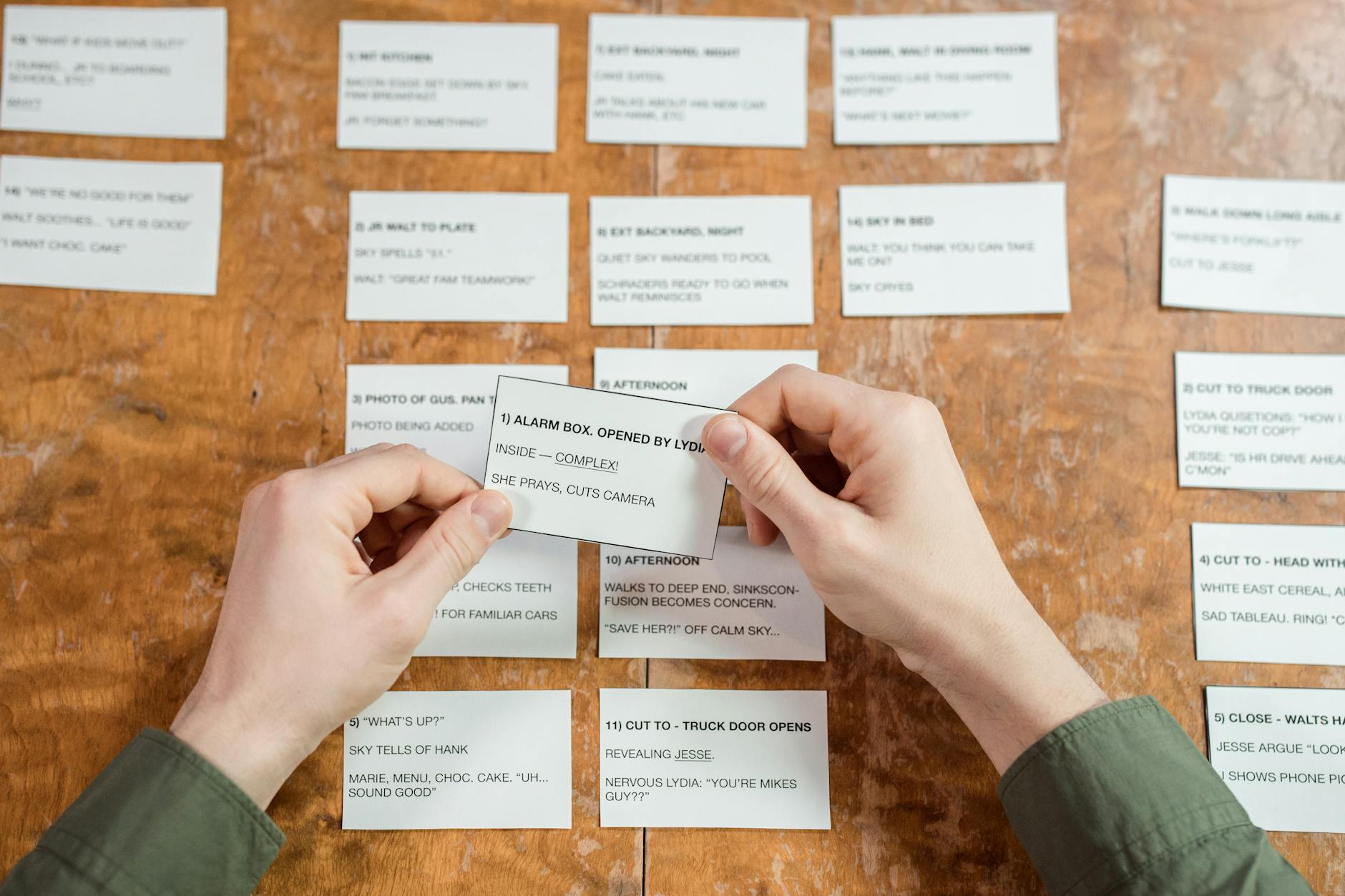
The Novel Smithy Lewis Jorstad explains that puzzling works by bringing elements of plotting and pantsing together.  For example, perhaps you have a brilliant story concept and can visualize several scenes in your mind, have a rough idea of characters and an inkling of how it will end. Using index cards or post-it notes, jot down each individual scene – one idea per card. You may not think of every scene right off the bat. You may only have three or four scenes to start. But that’s okay. What you are doing is creating a puzzle with various pieces that will eventually fit together. This is the discovery part.

Once you have a collection of scenes on index cards (or post-it notes), spread them all out on a table or tape to the wall so you can see them all at a glance. Then rearrange them in the order you think they should go. This is the plotting aspect.

Once the cards are in some story order, review them again. Note if there are any gaps in the sequence. Wherever there is a gap, insert a card indicating a scene to come.

The advantage to puzzling is that it allows you to generate scenes on the go. You don’t have to think of every scene before writing. You can write the scenes you do know, knowing the rest will come eventually. You don’t have to follow any structural rules.

Even while drafting, you may still come up with new scenes. When that happens, jot them down on a card and insert them where you think they might fit in the story. You can add or delete scenes and change the order of them as you go along. It gives you more control and flexibility than a straight plotting structure, which can be limiting to those who want to give their imagination free rein.

Another benefit is the ability to review your story at a glance scene-by-scene and make adjustments to the timeline. You can also identify which scenes are the key plot points of your novel.  I suspect this approach results in fewer rewrites.

Are there any downsides? So far, I haven’t found any, though I just started working with it for my current work in progress. In the short time I’ve been using this puzzler approach, I’ve learned a few things:

  1. It has helped me maintain my interest in the story. With previous approaches, I’ve invariably lost interest in my manuscript and given up on it, or got lost in the muddling middle.
  2. It allows me to assess my scene sequence and rearrange them as I see fit, without  having to rewrite anything.
  3. It helps me stay focused on one scene at a time. With one scene per card, I know what I’m writing next and I’m not left staring at a blank screen. The cards give me a clue and keep me on track.

    If you’ve tried plotting or pantsing, and they haven’t provided the results you want, give puzzling a try. You may find that being a puzzler makes you a more productive writer.  

Helpful Websites and Resources for Writers

Photo by Negative Space on Pexels.com

If you read my blog, you’re likely embarking on a writing journey, whether it’s toward publishing success or simply trying to finish your first draft. Wherever you are on your journey, there’s plenty of help and advice from writing and publishing professionals. We’re all here to learn from one another.

Over the years I’ve followed numerous writers and editors to understand how to navigate the publishing world. Even though I’ve learned a lot since my own journey began, I still turn to the experts for guidance whenever I feel stuck.

I’ve compiled a list of my favorite experts which I follow regularly on social media or subscribe to their newsletters. No doubt you’ve heard of most of them or even already follow them. If you haven’t, feel free to check them out to see what they offer. Every little bit of advice helps, and reminds us that in our solo writing journeys, we’re never completely alone.

Jane Friedman (www.janefriedman.com). Jane is a former editor at Writer’s Digest, so she is well connected in the publishing industry and has a good, strong handle on the latest trends and news. While she writes some of the posts on her blog, most posts are provided by regular contributors such as Tiffany Yates Martin and Allison K. Williams. Best of all, she hosts numerous online workshops at reasonable prices, some as low at $25.

Janice Hardy (www.janicehardy.com). Janice is another writer I follow regularly. She’s an award-winning author of teen fantasy books as well as the Grace Harper urban fantasy series for adults. She has also published several non-fiction books about writing, revising and plotting. Sign up for her newsletter, and you’ll get something in your inbox every day, from writing tips to guest posts. 

K.M. Weiland (https://www.helpingwritersbecomeauthors.com/). If you want a deep dive into plotting, story structure and character arcs, Weiland’s website and newsletter is the place to go. Her specialty is archetypal characters, which may be more detailed that you might need for your own writing projects, but they might be worth a look to see if her insights work for you.

C. Hope Clark (https://chopeclark.com/). Clark is a veteran mystery writer and speaker with a weekly newsletter that is chock full of helpful insights about the writing life. The newsletter also includes resources, such as writing contests, fellowships, freelance opportunities, and publishers. While I have not directly benefited from any of the listings, I do find her insights and support inspirational and uplifting for those times when I feel discouraged.

Kat Boogaard (https://katboogaard.com/). If you’re serious about starting a freelancing business, check out Kat Boggaard, a veteran freelancer who has earned six-figures most of her career. She is incredibly down-to-earth and practical about the business. In her  newsletter, (now distributed monthly) , she is very open about the ups and downs of a freelancing career as well as work-life balance issues while raising a family, which makes her relatable. Check out her website, where she offers numerous forms and checklists that she uses in her own business. Sign up for her newsletter or follow her on LinkedIn.

Brooke Adams Law (https://www.wearewritingbrave.com). Author and host of Writing Brave, Law occasionally hosts a free online summit focused on the emotional aspect of writing, working through fear and self-doubt. It’s a topic that’s rarely touched upon and one that most writers I know deal with frequently. If you’re looking to Write Brave, check out Law’s site.        

Writer Unboxed (https://writerunboxed.com/). This community of writers offers an array of perspectives about the writing business. I especially enjoy the insights of Kathryn Craft and Donald Maass, who are masters of storytelling. Check out the weekly Flog a Pro feature, which highlights the opening page of a current bestseller and asks readers if they would read the book based on the those opening paragraphs. (More often than not, it’s a resounding “no.”) If you’re serious about writing fiction, this is the place to go for valuable tips and motivation.

The Brevity Blog (https://brevity.wordpress.com/). So you say fiction isn’t your thing, but narrative non-fiction is? You should feel right at home at The Brevity Blog. Similar to Writer Unboxed, it’s a community of writers that specialize in writing memoir and narrative non-fiction. Many of the articles, submitted by members of their community, deal with the challenges and triumphs of the writing life. Even if you don’t write literary non-fiction, this site is worth checking out.  

Writer’s Digest (https://www.writersdigest.com/).  WD is the go-to resource for any kind of writing you care to pursue. While they offer numerous online classes and webinars, they can be a bit pricey, and if you sign up for their newsletter, you’ll get a lot of promotional ads for their products. Still, the magazine is top notch and their weekly Monday Motivation is well worth reading.

Reedsy (https://reedsy.com/)  You don’t have to use Reedsy’s online writing app to take advantage of its various publishing resources, such as a weekly writing prompt. Check out their YouTube channel for their backlist of webinars and online discussions about the publishing business. They also lead live write-in sessions, editing sessions and first-line critiques, so even as they assist other writers, you can learn too.   

Writing and Wellness (https://writingandwellness.com/). Writing isn’t just about getting published. Sometimes, it’s also part of a wellness plan, to deal with emotional and mental health. Activities like journaling, writing poetry or personal essays are outlets to deal with anger, grief or sadness. Writing can also help you deal with physical pain, backaches and burnout. Freelance writer and author Colleen Story hosts this site to help writers deal with these issues, and put fear and self-doubt in the rearview mirror.

Hope you find these sites helpful in your own writing journey.

How to Avoid Becoming a Self-Indulgent Writer


We all enjoy a little self-indulgence now and then—a long soaking bath, a couple of glasses of wine, dinner at an expensive restaurant, lots of chocolate, etc..

But when it comes to writing, self-indulgence can confuse your readers and, worse, kill your story.

Merriam-Webster dictionary defines self-indulgence as “excessive or unrestrained gratification of one’s own appetites, desires or whims.” As it pertains to writing, self-indulgent writing is writing that fulfills an author’s desires rather than the audience.

“It’s writing that doesn’t serve the story,” writes author K.M. Weiland. “It’s made up of ‘darlings’ you’re always being told you’re supposed to kill. It’s stuff you might love as a writer, but if you were an objective reader of your own stuff, you probably would not.” 

In a recent post on her blog Helping Writers Become Authors, Weiland describes the different ways that you might see self-indulgent writing in the books you read. For example:

  • A story that seems to never end as if the author is reluctant to finish it. The story itself might be over by page 325, but it continues to page 389. Or the writing comes across as rushed and needs editing. This is particularly true for books that are the last in a series.
  • The author spends too much time world-building as if they’ve gotten lost in a world of their own creation.
  • Scenes or dialogue that stretch out too long because the author seemed reluctant to end it. Or scenes or details that seemed to repeat as if the author forgot their place in the story while writing it.
  • Characters that have no purpose in the story because the author seemed to love the character’s personality
  • Giving a character a platform and voice to spout your own opinions about a current issue. Often called grandstanding, and it can come across as preachy.

So how can you recognize self-indulgence in your own writing? Here are a few questions to ask yourself.

  1. Who is your audience? Are you writing for yourself or for readers? Weiland says you write the first draft for yourself; the second draft is for the reader. It’s in that second draft that you weed out the little self-indulgences that detract from your story.
  2. Why are you writing this story? Is it to slay your personal demons? Or is it to entertain readers and take them on a journey to a world you’ve created?  Always keep the reader in mind as you write. Ask: what do readers need to know to help them understand this story?
  3. Have you fallen in love with certain characters? Do those characters have a purpose in your story? If you love them but they don’t have a meaningful purpose, it’s time to “kill your darlings” or at least, save them for another story.
  4. How much of yourself is in the story? Did you inadvertently portray yourself as the protagonist or the victim? Naturally, there will always be aspects of ourselves in our characters, but when you have become that character, it’s time to rethink who you want that character to be.
  5. Is there a character who is grandstanding—spouting opinions that you hold dear? Unfocused and personal musings or pontificating about current issues can turn off readers.
  6. Have you fallen in love with a setting or have you provided too much backstory and detail about the world you’ve created? Too many setting details can slow down your story.
  7. Are there any poorly-devised plot twists? They can create unnecessary scenes and push the story into dead ends. I’ve seen this happen when a plot twist added 50 pages that didn’t need to be there, pushing the total page count to more than 500 for a women’s fiction.
  8. How much time do you spend inside a character’s head and provide self-talk. Especially if you’re writing in first person, it can be easy to get inside your protagonist’s head—and stay there. It’s important to provide just enough inside thoughts to provide important details and back story without grounding the story to a halt.

    Self-editing is a crucial skill to learn so you can assess your own work as objectively as possible. If you haven’t mastered the art of self-editing, recruit a friend or fellow writer to review your work. They may notice areas of self-indulgent writing.

Just as in real life, a little self-indulgence is fine. But when self-indulgent writing interferes with the story’s progress or confuses the reader, it’s time to make adjustments. You don’t want too much self-indulgence to kill your story.

For more insights about self-indulgent writing, check out this article at Flocksy.

Eight Strategies for Returning to Writing after a Hiatus

Photo by Lisa Fotios on Pexels.com

Imagine my surprise when I checked my calendar this morning and realized it was February. Where did the time go? It seemed like yesterday I was watching Hallmark Christmas movies and making plans for the New Year. I realize now how little progress I’ve made in my writing.

That’s because since November, I’ve had numerous distractions, from demanding job assignments and household responsibilities to holiday celebrations and catching up on sleep. With everything that was on my plate, creative writing wasn’t a priority. I’m barely making my weekly deadline for posting to my blog.

Contributing to this scheduling mess was the fact I had completed writing a sports romance, but was having second thoughts about its viability. I knew I had to re-read it and edit it further, but my eyes just weren’t seeing the solutions to my storytelling problems. I began to doubt the story – and by extension, my writing. Was I producing anything worthwhile, or was I wasting my time?

So I set aside the novel until I felt ready to edit it again. I was feeling so overwhelmed by the task that I took a break from it. I needed the time to regroup to figure out my next steps.

So now it’s February, and though I have dabbled writing a Christmas novella through the holidays, I have nothing concrete to show for my efforts. It’s time to get serious about writing again. But where do I begin?

I’m not alone. After reading this recent post by author K.M. Weiland, I realized I’m not alone in taking a sabbatical from writing. Weiland shared her own struggles with writing again after taking a lengthy break, and she shared the steps she’s taking to get back to writing again. Sometimes you have to step away from it to gain perspective about how far you’ve come and where to go next.

So how does one begin to get back on track? The experts at Masterclass suggest having a plan for building up your writing practice and getting those creative juices flowing again. Here are a few possible ways to get started writing again.

  • Start small. You can’t always just dive into the swimming pool. Sometimes you need to get your feet wet first. That might mean sitting at poolside with your feet dangling into the water. Or maybe you start further by wading in the shallow end for a few minutes before getting back out. The truth is you don’t have to spend hours on Day 1 playing catch up with your writing. Start writing shorter pieces, such as an essay, a poem or flash fiction. It might be easier to get your creative juices flowing this way, and you might feel more accomplished finishing that first short piece.
  • Limit your writing time. Using a timer or clock, set it for a specified time, say 30 minutes. When the timer rings, stop writing, no matter where you are on the page. OR…give yourself a word limit or page limit, such as 300 words or one page. In smaller chunks, you may not feel as overwhelmed by the writing process.

  • Don’t be hard on yourself. If you get too busy or feel overwhelmed, it’s okay to skip a day of writing. Some people feel pressure to write every day like the so-called writing experts suggest. Sometimes it’s not feasible. Although, I must admit, having a regular schedule helps me stick to my writing practice.

  • Schedule your writing time. If you’re the type of person who routinely plans your day and keeps doctor appointments, try scheduling your writing time. On your calendar or appointment book, block out a chunk of time for writing. As mentioned before, start small, say 15 minutes or a half hour.

  • Comb through old writing projects. You probably have a file or desk drawer filled with unfinished stories. Pull them out, read through them and see if they spark your imagination. By reviewing old material, you might get ideas for new projects or ways to rewrite what you’ve already written.

  • Try writing prompts. This might jumpstart those creative juices that you haven’t used in a while, and the exercises are short enough that they don’t require a huge time commitment.

  • Take a writing class or attend a workshop. Immersing yourself into the world of writing can inspire you to begin writing more. There might be in-session exercises to get those creative ideas going again. Reading a book about writing might also do the trick.

  • Remember that nothing is perfect. Whatever we put on the page is never pretty. Focus on getting ideas down, then go back and edit later. That’s when the real writing begins.

    With these strategies in your pocket, you’ll be back to writing regularly in no time, and with greater motivation and inspiration. It’s never too late to start or (restart) a writing practice.