Honor Your Inner Writer During November National Writing Challenge

Photo by Suzy Hazelwood on Pexels.com

Whether you’ve been a writer for some time or you’re just starting out on your writing journey, you likely have heard about National Novel Writing Month, which takes place every November. While the organization that started this event has shut down, the mission still holds true: to encourage writers of all levels of experience to amp up their productivity. The aim is to write 50,000 words during the month, or approximately 1,666 words per day.

That’s a hefty load for any writer. It’s much like aiming to walk 10,000 steps that doctors recommend (or about five miles). Who has time to do that? Both activities require more time than most people have available to them. 

The way I see it, the November Writing Challenge can be about any goal you want to achieve. It doesn’t have to be about 50,000 words if that goal is too steep. The Challenge is about finding new ways to fit writing into your life, whether that’s writing for one hour per day or writing only 500 words per week. It’s about stretching yourself beyond what you’re used to doing in your writing life. Plus it just feels better knowing other people are going through the challenge too. There’s power in numbers, and it’s empowering when you know you’ve got other writers beside you. Remember, the November Writing Challenge is whatever you want it to be.

Several writing communities offer their own writing challenges and support systems for writers. For example, Story Forge’s challenge is 30,000 words, or about 1000 words per day. That’s a more accessible goal for many people. You can find quite a few others like Reedsy, ProWriting Aid and AutoCrit. 

No matter which challenge you follow or if you make up your own like I’m doing, the key point to remember is to stretch yourself. Aim for more words. Longer writing periods. Or do something different. Consider these other possibilities:

* Draft one flash fiction story (about 1500 words) or a short story (up to 15,000 words) per week
* Commit to writing 500 words per day, the equivalent of two pages.
* Write for 30 minutes per day, especially if you’re used to writing sporadically.
* Write your current work-in-progress from a different character’s point of view.
* Write in a different genre than you’re used to. If you’re used to writing fiction, try writing essays.

You might consider some non-writing activities too.

* Read the first draft of your current work-in-progress, noting changes you want to make in the margins. But don’t make the changes just yet.

* Read about the writing craft. If you’re new to writing, this might be a good time to become familiar with the tools you need to craft your story. Learn about plotting, story structure, character development, conflict, etc.

* Got a story dancing in your head? Sketch out several scenes to get your creative juices flowing.

* Do background research. Is there a subject you know nothing about but is imperative to your current project? Spend a few minutes each day researching that topic.

* Spend some time world-building. What do the settings in your story look like? Whether you’re writing a fantasy in a make-believe world or a mystery set in a small town, take time to convert the setting from your imagination to the paper or screen.

* Work on character development. Get to know your characters by writing profiles of the main ones. Describe more than their appearance, but their desires, their personality quirks, their strengths and weaknesses.

The beauty of the November Writing Challenge is to make it whatever you want it to be depending on your goals and what you’re working on. You set the goals and how you’ll measure your success. Just remember to ramp up the activity so you’re challenging yourself to do something different or to improve your productivity.

For example, I plan on using November to draft a holiday romance novella. I’m already prepping by sketching out scenes I plan to write later. My goal is to draft five pages per day, or roughly 1000-1,2000 words. If all goes well, my rough draft should be complete by the end of the month.

If you’re creating your own challenge, it might be helpful to follow these basic rules:

* Establish your goal for November. What do you want to accomplish by month’s end?

* Make sure your goal is measurable. How do you know you’ve achieved success? Set a specific time limit or number. For example, aiming to write 1000 words per day or writing for 15 minutes before bedtime.

* Track your progress. Using a calendar, mark a symbol or star on the days you write or jot down how many words/pages you finished.

* Be sure to ramp up the difficulty. If you’re used to writing three days a week, what can you do to increase that output to five days?

* Reward yourself. When November ends and you can see the progress you’ve made, celebrate your accomplishments. Perhaps treat yourself to a low-cost writing webinar or a book about the writing craft.

You don’t have to target 50,000 words to be successful during November Writing Month. Whether you commit to writing one page per day or 1000 words per day, simply by sitting down to write, you’ve already achieved success.


What Is The Best Format for Your Story Idea: Novel, Novella or Short Story?

Photo by Pixabay on Pexels.com

Imagine that you’ve come up with a great idea for a story. You haven’t seen it published anywhere else, and you’re sure that people would read it. Only question is: should you write it as a short story, a novella or a novel?

“What’s the difference?” you might ask. 

Word counts is the short and easy answer. Depending on the length of your story, it may fall into one of several story categories:

* Novel–70,000 to 100,000 words (although some novels have been less than 70,000 words and others have exceeded the upper limit, depending on genre.)

* Novella–17,500 words to 40,000 words

* Novelette–7,500 words to 17,500 words

* Short story–Less than 7,500 words

With short stories, there’s an economy of words and action. Since you don’t have a lot of space, descriptions, backstory and exposition are limited, and there are no subplots. Full-length novels allow more time and space for exposition and backstory, setting and character development. Short stories are like a weekend getaway while novels are a month-long retreat at a luxury spa. Novellas, which fall in between, are more like your typical one-week vacation.

To learn more about these differences, check out this helpful resource from Reedsy about word counts for different genres.

How do you know where your story idea fits? Should it be a short story, a novella or a novel?.

To answer this question, I recommend fleshing out your story idea as much as you can. Jot down scene ideas, characters, plot points using post-it notes or index cards. The more details you have about your story will determine what type of format you’ll need. 


Once you’ve plotted your scenes and made your character list, consider these questions:

1. What is the main problem the characters are trying to resolve? Is it a complex problem with layers of complications? Or is it fairly simple and straightforward?

2. Are there any subplots? A full-length novel might have one or two subplots while a short story and novella won’t have any.

3. How many characters are featured in your story? If there are a few characters, it’ll most likely be a short story. Longer sagas like historical fiction or science fiction/fantasy will likely have a cast of several dozen, while a short story will be limited to a handful of people. Romance novels are roughly a dozen or less.

4. Are you writing this story in multiple POVs? More likely, it’ll fall into the novel category. You won’t see multiple POVs in a short story. You might find one other POV in a novella.

5. What is your story’s genre? Historical fiction and fantasy tend to run longer, around 100,000 words. Romance novels tend to be between 70,000 to 90,000 words. Understanding your genre will help you determine whether your story should be a novel, novella or short story.

If after answering these questions, you’re still not sure what format your story should take, try this exercise. Write the story first as a short story with one point of view, a few essential characters and limited backstory. Keep to the necessary action. Then set it aside for a few weeks. Come back to it later with a fresh eye or have a friend or writing colleague review it with you. Decide what works and what doesn’t. 

If the story seems complete as is, then it probably works best as a short story. But if you feel there’s more to the story than what you wrote, rewrite your story, this time as a novella (up to 40,000 words). This time add the elements you think are missing, whether that’s world building, setting or characters. Maybe present a second point of view. 

When you’re finished, review it again. Does the story work better? If in doubt, ask a couple of beta readers to review the manuscript and give you feedback. If, based on their feedback, you still want to expand the story, perhaps add a subplot, then you can rewrite it as a full-length novel. 

The point is to start small and work your way up, testing out your story idea at each phase to see which format works best.  

Here’s another exercise to try: Visit your local bookstore or library, or browse your own collection. Note the size and length of certain genres. Some genres simply work better as shorter pieces. Historical fiction and fantasy tend to be longer while romance works well as a novella. .

Throughout this creative process, trust your instinct. More often than not, your gut will tell you what format will work best for your story idea. When you close your eyes and visualize what the story looks like, sometimes you just know what format your story should be. 

Deciding what format your story should be isn’t as difficult as you might think. The magic comes when you begin to see your story come to life on the page.

How to Hook Readers into Your Story

Photo by Mu00fccahit inci on Pexels.com

If you’ve ever gone fishing (I admit I have not), you usually need something to lure your catch, such as a worm. You need to do the same for readers (minus the worm). Author K.M. Weiland describes it best:

“Unless you hook readers into your story from the very first chapter, they won’t swim in deep enough to experience the rest of your rousing adventure, no matter how amazing it is.”

Hooks are used to get reactions from readers and entice them to ask questions about what’s happening on the page. There’s some suspense connected with hooks too because they hint at the action to come, prompting readers to keep reading.  

A recent webinar by Contemporary Romance Writers outlined the most common types of hooks. I’ve described a few of them below.

1. Show some action – The easiest way to hook readers is by engaging characters in some type of action. That doesn’t mean it has to be violent or mysterious, like a car chase. But something should be happening on the page. Maybe someone is cleaning out the attic and finds an old diary. Or the character is baking a cake to prepare for a wedding. Or someone else is in the middle of a presentation to their work colleagues. Avoid cliches such as waking up from a dream or a description of the weather because frankly, they’re overused and boring, and do nothing to engage readers. And that’s the ultimate goal of a hook.

2. Introduce a unique character – Introduce a character with unique characteristics. It typically is the protagonist but not always. Show how that person is different. Do they have a unique job or hobby, or unique skills, like seeing dead people? Do they have an odd habit, like being perpetually late for appointments. Or maybe your character is like John Singer, the deaf-mute man featured in The Heart is a Lonely Hunter by Carson McCullers, who befriends the lonely people in a small town while struggling with his own feelings of loneliness.

3. Form an emotional connection – Try reading the opening pages from several of your favorite books. Do they make you feel any specific emotion, such as sadness, anger or guilt? Does the action make you feel anxious for the character because they might be in danger? Establishing an emotional connection with readers will ensure that readers stay engaged and will follow along on the character’s journey.

4. Pose a question – Sometimes the hook may come in the form of a formally asked question: “Why did I think I could get away from this?” (That’s not a real opening hook; I just made that one up.) Readers will want to know who the narrator is and what they were trying to get away with. The most important question readers will have though is something they ask themselves:  “What happens next?” As long as they keep asking that question, they’ll keep reading to get the answer.

5. Share a surprising or shocking dialogue – Opening scenes may feature a conversation between people, but the subject or tone may be shocking. For example, in Nutshell by Ian McEwan, a married pregnant woman and her lover discuss plans to murder her husband, and every word is overheard by the woman’s unborn child, who narrates the story. Who wouldn’t want to keep reading to know more about what happens next?

6. Include humor – Making readers laugh from your opening scene is another great way to hook them into your story. Humor can be found in the way a character behaves or in a witty exchange. In the opening scene of The Love of My Afterlife by Kristy Greenwood, the young protagonist chokes on a piece of bread and is convinced she is about to die. Her mind goes into overdrive with assorted worries and fears, some quite irrational, but Greenwood does it in such a way that makes you laugh out loud. When done well, adding humor can suffuse any tension. 

7. Foreshadowing – The hook may hint at some sort of conflict or action that will take place  later. For example, in the opening prologue in The Diamond Eye by Kate Quinn, a mysterious stranger looks on from a distance as Eleanor Roosevelt welcomes a Russian sniper to the White House. The stranger is clearly angry, and readers sense that a confrontation will occur at some point between him and the sniper, which entices them to keep reading.

8. Describe a surprising situation – One thing all these hooks I’ve discussed have in common is the element of surprise. Something surprising or unexpected occurs in the opening scene from the overheard dialogue to someone choking on a cheap hamburger. Its impact is to jolt readers to attention, and ask the question, “What happens next?”

I’ll add one more hook to this list, courtesy of the experts at Master Class. The title of your story serves is the earliest opportunity to grab readers’ attention. It serves as a “mini-hook” using “emotionally loaded language or surprising combinations of words to hint at the story within its pages.” Harry Potter and the Chamber of Secrets offers a clear hook. You know right away from the title who the story is about and what they’ll be looking for. 

Hooking readers doesn’t end with the opening scene. You need to keep hooking them throughout the novel. Thriller authors are adept at doing this. One technique often used is to introduce a new question every time the previous one is answered. Also try opening each chapter with a teaser – some action, dialogue, an intriguing new character – much like you do to start your story. That keeps readers engaged until the end. 

Your story and its genre will dictate what kind of hook will work best. Experiment and see what works. As long as you keep the action moving, readers will ride along on the journey until they get to The End.

Building Your Story From First Line to First Draft

Photo by Magda Ehlers on Pexels.com

No doubt you’ve heard about the importance of the firsts in writing—the first line, the first paragraph, the first page, the first scene, the first draft. Each “first” has its own role to perform. It must contain certain elements for the story to work, just like pieces of a giant puzzle. Every element must fit together.

Why are they important? How can you make them as compelling as possible so your manuscript doesn’t end up in the editor’s slush pile? Here’s what you need to know about each of these “firsts” to readers, agents and editors won’t stop reading.

The first line

There is some debate about the importance of the opening sentence. Some say it has to grab the reader from the get-go and hint at the conflict to come. Others say it’s more important to focus on the first paragraph which gives readers more information about what’s to come.  

“The first sentence alone doesn’t give readers enough information or the writer enough room. The paragraph gives enough room and direction to write your book,” says John Matthew Fox in a guest post on JaneFriedman.com.

I’m inclined to agree with Fox. I’ve read a few doozies of opening lines for some wonderful stories, but most of the time, opening lines are rather lackluster. I still kept reading anyway, and the stories were just as readable.

I see the first sentence as the first blow of a balloon. You won’t see much result from your effort of blowing, but with sustained effort, that first line serves as the starting point for something bigger.

The first paragraph

The first paragraph should make a strong first impression, stronger even than the first line. It should give readers enough information about the story to decide if they want to keep reading.

John Matthew Fox says opening paragraphs contain four critical elements:

  • Characterization – Readers need to learn something about the main character. It could be a dilemma they’re grappling with, some deep emotion they’re feeling or some puzzle they’re trying to solve. Readers need to know something about them that makes them relate to the character, or makes them want to root for them in the story.
  • Energy/tone – The first paragraph should bring a certain energy to the story. A rom-com, for example, will be written with a light-hearted tone, while a horror story might have a darker, creepier tone
  • Mystery or conflict – The opening paragraph should hint at some question or conflict that needs to be resolved. For example, why a complete stranger is watching someone else from a distance.
  • Emotion – Finally, the first paragraph should exude some emotion to hook the reader, whether that’s fear, grief or disappointment.  


The first page

At an average length of 250 to 300 words, the opening page has to do a lot of things in a short amount of time to kick the story into high gear. It’s the heavy lifter of all the firsts.

In a recent weekly newsletter, Karyn Fischer of Story & Prose outlines the common elements of the first page.

* Character and desire – What does the character want? The first paragraph might have hinted at this, but the opening page goes into more depth.
* Conflict and stakes – What or who opposes the main character in getting what they want?  * Voice – Fischer says it’s often difficult to pinpoint voice, but you might detect it through the way they speak or think. Does their voice sound true to life?
*Setting and world-building – The first page should give readers a sense of where they are in the story. Perhaps it’s a birthday party in someone’s home, the site of a car accident or a courtroom. Don’t overload the story with setting details, but sprinkle them throughout to give a sense of time and place.
* Action – Make sure the character is doing something, whether it’s baking a cake or being chased by thieves.
* Genre – Depending on the genre, the opening page should hint at the type of story people are reading. In historical fiction, for example, the first page might have visual cues that show time and place.

First scene/first chapter

I’ve combined the first scene and chapter into one section for a couple of reasons. First, they consist of the same elements and strive to accomplish the same goals. Second, a chapter may consist of a single scene, or several.

While the first page does a lot of work to prepare readers for what’s next in the story, the first scene or chapter ramps up the effort. In addition to doing what the first page does, the first scene or chapter does more, such as:

* Introduce other compelling characters that will either support or antagonize the main character.
* It grounds the reader into the story, providing more details about what the protagonist is dealing with.
* It continues to build on the tone established in the first page.
* It provides the hook that will keep readers turning the page.
* Depending on the story, the first chapter (not necessarily the first scene) should contain the inciting incident, the situation that gets the story moving.

By the end of the first scene or chapter, readers should know enough about the main character and their plight to determine if they like the character and empathize with their situation. If readers don’t find anything to like about the character, it’s likely they’ll give up on the story.

First 50 pages

The first 50 pages are important because it’s those pages that many editors and agents will review to determine if it’s worth reading—and publishing. It’s also a litmus test for readers. If the story loses its steam, readers will lose interest before they get to that 50-page mark. More specifically, the first 50 pages:

* Give readers, agents and editors an impression of your writing style.
* Includes the inciting incident and shows the raising of the stakes
* Shows the initial progress in the protagonist’s character arc. How will they grow or progress as the story moves forward?

First draft

When you finish writing your first draft, you might think your work is done. But it’s only just starting. The editing and rewriting process is where the real creativity begins, experts suggest.

The first draft, in all its messy glory, should contain the spine of the story—namely the who, what, when, where, why and how. It has three main goals:

* Helps you get all your ideas down on paper, from characters and their backstory to setting and dialogue.
* It helps you lay out the major plot points.
* It provides a road map for how to proceed during the revision process.  

If all goes well at each of these “first” elements, then it’s only a matter of time before you enjoy the next first in your professional writing life—publishing your first book.

Alternative Pre-Writing Methods to Kickstart Your Novel

Photo by Pixabay on Pexels.com

Last week, I wrote about becoming a puzzler, which combines elements of plotting and discovery writing (pantser). It’s a happy medium for those who need some structure in the way they plan their novels, but still want the flexibility of organic story development.

One of the tools puzzlers may use is storyboarding, which helps them visualize key plot points. In fact, there are numerous other methods writers can use to help them structure and visualize their stories before they begin writing, such as mind mapping, collages, tarot cards and Enneagram personality types. I’ll describe each of these below (plus a couple others). Granted, they may not be for everyone, but they might be worth exploring to see how they might work for you.

  • Collages – Collages are a collection of photos that help writers “see” the details of their story. By cutting out images from magazines and pasting them on poster board, or using a digital platform like Canva or Pinterest, you can compile images representing the characters and settings.  You can add other elements, such as a car that a character might drive, a restaurant where two characters meet, or a school where a particular event takes place. Add swatches of fabric to represent a dress a character wears, as well as sketches, drawings, symbols or anything else that might inspire a key plot point. Collages not only provide a visual cue, they can be fun to put together and provide inspiration for those times when you feel stuck.

  • Mind mapping – Also known as clustering, this method helps writers see the connections between unrelated ideas. It can also help them understand theme, conflict, and character development. Start with your main concept in the center captured with some central image such as a cloud. From that image are branches that represent the main themes of your story. Each branch comprises a key word that’s printed on its associated line. Topics of lesser importance are represented as twigs. Viewed together, the twigs and branches form a structure of interconnectedness. For more information about mind mapping, visit Mindmapping.com.

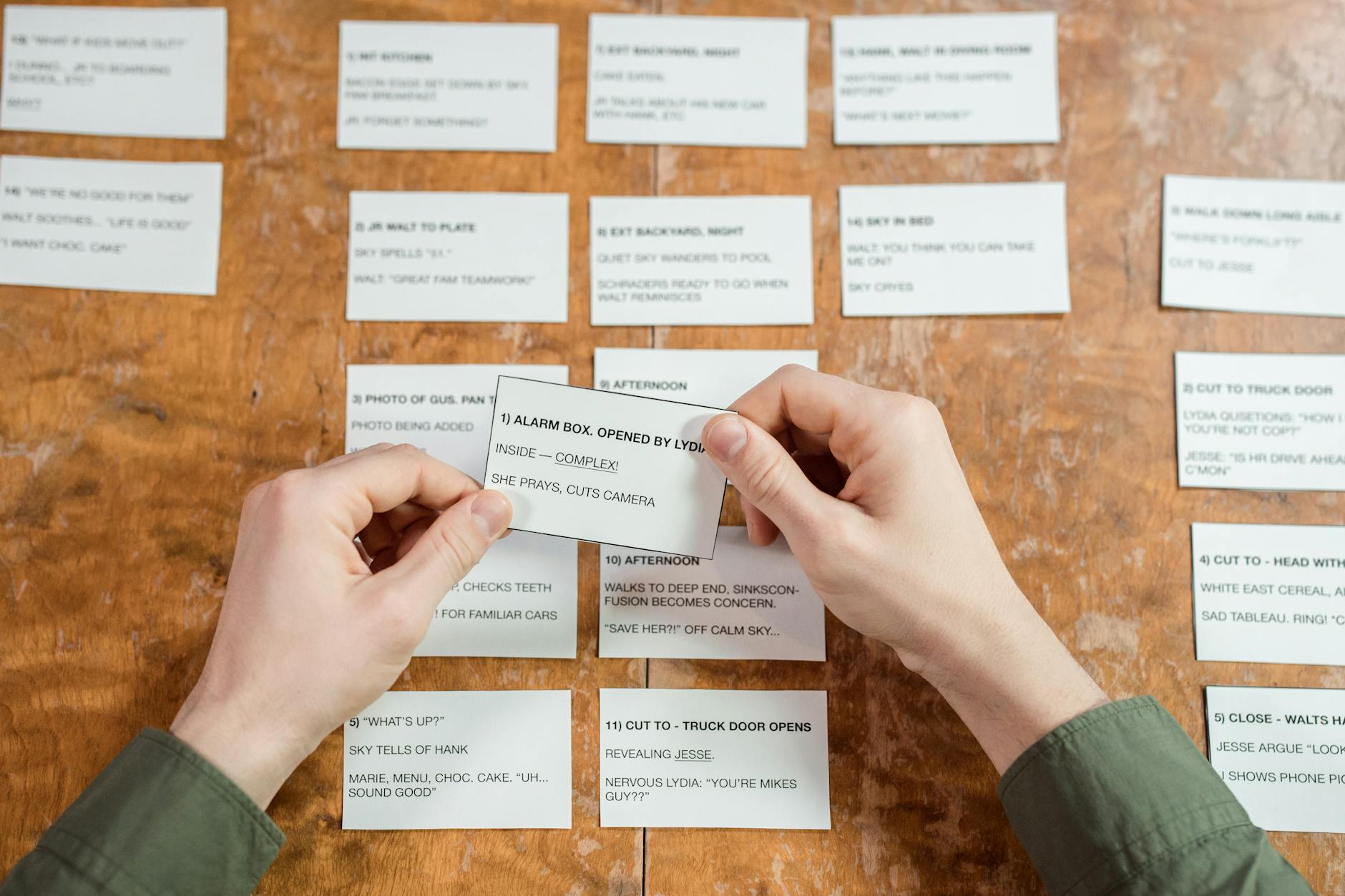
  • Storyboarding – Using index cards or post-it notes, or even sketches, jot down each scene as you think of them. One scene per card. Then rearrange them in the order that seems to make the most sense for your narrative. By looking at the cards, you can see whether the sequence of scenes makes logical sense and if there are any scenes that need to be added or changed. It provides a tool for planning your story before you begin writing it so you’re not wasting time on writing scenes that will only be cut later.  Learn more about story boarding at Gilliam Writers Group.

  • Tarot Cards – Tarot cards provide a range of meanings whether they appear upright or reversed. Cards representing the king, queen, prince and page can represent individual characters while the four main elements each have their own meaning: Swords for intellect, Cups for love and emotion, Wands for work and physical activities, and Discs for wealth and resources. Some writers, like Quinn Diacon-Furtado, turn to tarot cards when they feel stuck in their story and seek clarity about their characters, settings or plot.

    “As a writer, I’ve learned to use the tarot to explore my characters, intuit plot, and to reflect on my creative process,” she explains in a Writer’s Digest article.  “Unlike conventional writing guides, I’ve found that tarot cards offer a dynamic landscape of symbols and archetypes that help me work through the nuances of character development, the intricacies of plot dynamics, and the richness of world-building.”

  • Enneagram – The Enneagram is a geometric diagram with nine points, each representing a personality type. It shows the interconnectedness of the personalities. Writers have used the Enneagram to understand characters’ personalities, their strengths and weaknesses, and how they might relate to characters of other Enneagram personalities. Some personalities will get along better with other types while other combinations may become rife with conflict.  You can find out more about the Enneagram diagram here.

  • Timelining – This tool is especially helpful if you’re writing a story with multiple timelines. How do you keep those timelines straight so readers don’t get confused? Timelining can be as simple as a straight line across the page with each major plot point marked. Or it can be more complex as a spreadsheet with multiple timelines for multiple plots. Doing a timeline before writing helps writers organize their thoughts and ensure a logical progression of events as well as the character’s arc of development over time.

  • Zero drafting – Only recently did I learn about zero drafting, which falls somewhere between a basic outline and the first draft of a novel. It can sometimes be used as a brainstorming session. Writers use this method to work out key details of their story, using phrases, slap-dash prose, or bullet points without any consideration for word count, quality of writing or formatting.  Zero drafting allows writers to get to the spine of the story without expending time and energy on a first draft. It’s ideal for writers who are still working out the basic framework until they feel ready to start writing.

    Though I have never used this zero drafting myself, I can see how it can be useful, not just for creating your story framework, but also for drafting your synopsis.

No matter where you are in your project, these pre-writing methods can help you explore your stories before you begin to put pen to paper.

Neither a Plotter Nor a Pantser? Try Becoming a Puzzler

Photo by Ron Lach on Pexels.com

Writers usually fall into one of two categories: the plotter or the pantser.

Plotters prefer to plan out every aspect of their stories ahead of time, from the setting, character, theme, structure. They will plot out every scene from the opening paragraph to the final resolution. They have to know every detail in advance before starting to write. Plotting allows writers to view their story from all detailed angles. They know exactly what they want to write before writing it.

I’ve tried this plotting approach once before early in my fiction writing. It was the first story I attempted to write. I quickly gave up on it because I found it limiting. My plotting didn’t allow for new characters to show up, and I struggled to find the right place in the story for new scenes as I thought of them.

Still there are plenty of authors who have plotted their way to success. Fantasy author K.M. Weiland is a big proponent of outlining and story structure, and goes into a deep dive on these subjects on her blog. She’s also written several books about plotting if you want to learn more.

One disadvantage I see is the extra time it takes to get the details “just right.” It can take the wind out of your creative sails too. By the time you’re done plotting, you could lose interest in your story because you feel you’ve already written it in plotting form.

But not every writer works that way.

Then there are the pantsers . . .
I always believed I was a pantser, also known as a discovery writer, because I enjoyed discovering my story as I wrote. With only a vague sense of main characters and a few scene ideas, pantsers tend to begin writing if only to see where the story takes them, or whether there’s a story at all.

The advantage of writing by the “seat of your pants” is that it gives the imagination free rein. The story, without the limits of plotting, can go in a multitude of directions, and it can be fun to discover new characters and settings that you didn’t think of initially. Writers feel free to explore their story world without the limitations of a set of rules or structure.

The downside, however, is that by the end of the drafting phase, what writers have is a ton of material with no cohesiveness between scenes, characters or plot. That only makes the editing phase much harder because there’s so much material to dig through, and much of it will land on the cutting room floor anyway. As I quickly learned, pantsers usually have to do several rewrites to get the story to where you want it to be, which can be a drain on time and energy, not to mention patience.

What if you’re neither a pantser nor a plotter – or you’re a little of both?
While I’ve experimented with both of these approaches, I realized that I don’t fit neatly in either one. While I love exploring plots and characters organically, I also recognize that I need to plot my story to some extent so I know where it’s going. Otherwise, I’m only spinning my wheels, editing and rewriting sections until they feel right.

Enter Puzzling.

The Novel Smithy Lewis Jorstad explains that puzzling works by bringing elements of plotting and pantsing together.  For example, perhaps you have a brilliant story concept and can visualize several scenes in your mind, have a rough idea of characters and an inkling of how it will end. Using index cards or post-it notes, jot down each individual scene – one idea per card. You may not think of every scene right off the bat. You may only have three or four scenes to start. But that’s okay. What you are doing is creating a puzzle with various pieces that will eventually fit together. This is the discovery part.

Once you have a collection of scenes on index cards (or post-it notes), spread them all out on a table or tape to the wall so you can see them all at a glance. Then rearrange them in the order you think they should go. This is the plotting aspect.

Once the cards are in some story order, review them again. Note if there are any gaps in the sequence. Wherever there is a gap, insert a card indicating a scene to come.

The advantage to puzzling is that it allows you to generate scenes on the go. You don’t have to think of every scene before writing. You can write the scenes you do know, knowing the rest will come eventually. You don’t have to follow any structural rules.

Even while drafting, you may still come up with new scenes. When that happens, jot them down on a card and insert them where you think they might fit in the story. You can add or delete scenes and change the order of them as you go along. It gives you more control and flexibility than a straight plotting structure, which can be limiting to those who want to give their imagination free rein.

Another benefit is the ability to review your story at a glance scene-by-scene and make adjustments to the timeline. You can also identify which scenes are the key plot points of your novel.  I suspect this approach results in fewer rewrites.

Are there any downsides? So far, I haven’t found any, though I just started working with it for my current work in progress. In the short time I’ve been using this puzzler approach, I’ve learned a few things:

  1. It has helped me maintain my interest in the story. With previous approaches, I’ve invariably lost interest in my manuscript and given up on it, or got lost in the muddling middle.
  2. It allows me to assess my scene sequence and rearrange them as I see fit, without  having to rewrite anything.
  3. It helps me stay focused on one scene at a time. With one scene per card, I know what I’m writing next and I’m not left staring at a blank screen. The cards give me a clue and keep me on track.

    If you’ve tried plotting or pantsing, and they haven’t provided the results you want, give puzzling a try. You may find that being a puzzler makes you a more productive writer.  

Dictate Your Way to Publishing Success

Photo by PhotoMIX Company on Pexels.com

Writers are always looking for ways to work smarter and get more done in less time.

Enter dictation.

When I think of dictation, I think of the old-school way of recording correspondence back in the 1980s. Managers would dictate letters and other correspondence in a recorder with a tiny cassette, then their secretaries would play it back to transcribe them.

Fortunately, as technology evolved, so did dictation and transcription tools, making it easier for writers to draft larger projects, like full-length novels. Several well-known authors routinely used dictation to help them draft their novel, including Dan Brown, Henry James, Barbara Cartland, and Agatha Christie. TV executive Sidney Sheldon reportedly dictated novels for several hours in the morning and then had his secretary transcribe them later.

I must confess I have never used dictation to draft any of my own stories, but I know that option is available. You can’t overlook its value to authors. While writing 1200 words can take a couple of hours, with dictation, it takes roughly 30 minutes.

Sarah Elizabeth Sawyer of FictionCourses.com who writes Native American historical fiction, also teaches courses about dictation. Of her 19 published books, at least 10 have been created by dictation.

Sawyer cites several benefits:

* Improved health – With dictions, there’s less strain on the eyes, back and shoulder.
* Better time management – You can dictate while waiting for appointments or walking the dog.
* Improved speaking skills – With practice, you speak more confidently which helps prepare you for author readings.
* Experiment with character voices – You can test out character voices with accents and dialects, and inject personality into their voices.

Users have noted several blocks to getting started with dictation. Some said the practice just didn’t work for them or they felt their brain didn’t operate that way. Others cited the cost of dictation software, although there are plenty of free options available, or the software was difficult to use. Still others said they drew a blank when they pressed the record button.

There are other downsides, such as messy punctuation. That only means you have to be prepared to review and edit the drafted material more carefully afterwards. The software may not recognize unusual spellings and pronunciations of character and location names, especially those you might find in science fiction and fantasy novels. Like any new skills, there’s a learning curve before you’re able to do it well.

Still if you have the patience and determination to try to produce creative work in less time, dictation might be worth a try. But which software and apps work best? Do you need any special equipment?

Jason Hamilton at Kindlepreneur shared the best dictation tools, giving the pros and cons of each.

  • Dragon – By far, Dragon software performed the best though the cost may put off many potential users. The Professional Individual version cost $500 while the Home version is $200.  
  • Windows Speech Recognition – free option that comes with most Windows computers
  • Apple Dictation – a free option for Mac users
  • Google Docs Voice – a free option with the power of Google
  • Otter.ai – a free trial is available for new users. I’ve heard mixed reviews on whether this works for long form documents like novels. That said, I have used it for transcribing notes from interviews.

No matter where you are in your writing process or what kind of projects you work on, any tool that can help you produce more words in less time is worth checking out.

The Ties That Bind: Writing about Families

Photo by Nicole Michalou on Pexels.com

If you ever feel stuck with your writing and need inspiration for your next story, you don’t have to look much further than your own family. Whether you’re an only child or grew up in a family with eight kids, whether you’re the oldest, youngest or somewhere in between, there’s plenty of family drama to draw from. Even the closest-knit families can be hiding a few skeletons in their familial closet.

The holidays seem to intensify these interactions. Some gatherings are fraught with more tension and conflict than a best-selling mystery novel while others will be happy occasions. There are sibling rivalries, miscommunications and misunderstandings, and estrangements. So much fodder for storytelling.

That’s what makes family dramas so fun and interesting to write.

But experiencing these family dramas is one thing; writing about them is quite another. Writing about families isn’t easy. First you have to conquer your own emotional connection to the story, build in some time and space between the present time and the past so you can write about them objectively. You may have to tiptoe around people’s feelings. Family members may not be pleased that you’re writing about them. Or they see events differently than you do. They might feel betrayed or feel they’ve been wronged.

How you present the family stories is up to you, of course. Either write family stories as a memoir or narrative non-fiction, recording the people and events as accurately as possible. Or write a fictionalized version, changing people’s names to protect their identity or leaving out non-essential events and characters.  

Whichever genre you choose, here are a few things to think about:

For fiction:

1. Inject a little humor into the story. To lighten the mood during the most tension-filled moments, pair it with a little humor, writes author Sierra Godfrey at Writer’s Digest. The humor can either come through a character’s personality or in things that the characters say. A good example of this is Buffy the Vampire Slayer who manages to defuse the tension of her fight scenes with snappy comebacks to her demon opponents.

2. Use character imperfection. Everybody’s different so they respond to stressful situations in their own unique way. Under duress, they may make snap decisions that turn out poorly. Understand each character’s flaws, their goals, their mistakes. When you understand the goal of each family member featured in the story, you can use those goals to push family members against each other, Godfrey says.

3. Allow room for each character to grow. If a family member in your story has done something terribly wrong, can they be forgiven? Can they forgive themselves? That can be part of their character arc—from committing their mistake to owning up to it and making amends. In the young adult novel Forgive Me Not by Jennifer Baker, a teen girl is involved in an accident that kills her younger sister. As she goes through a series of trials as punishment for her crime, she grows in self-awareness and learns to forgive herself and eventually earns her family’s forgiveness.

4. Have empathy for your characters. This is the most important element in fiction, writes Godfrey. “Everyone hurts in some deep, emotional way, but most people don’t know how to fix their pain.”  Perhaps one of the best examples of empathy in fiction that I’ve read is The Book of Ruth by Jane Hamilton. In separate chapters, Hamilton describes the backstory for Ruth’s mother and husband so readers understand what leads up to their brutal and violent confrontation. Ruth, for all her issues, shows incredible grace and insight about what has happened. That shows true empathy, both from the main character and from the author.

For memoir:

The following tips from Sharon Harrigan (via JaneFriedman.com) are geared toward memoir or narrative non-fiction, but some might apply to fiction as well.

* As you write your first draft, don’t worry about what your family will think. Imagine yourself on a deserted island so no family members are looking over your shoulder. Just focus on getting your story down on paper.

* Be aware of your motives. Why do you want to write this particular story, and why do you want to write it NOW? Be careful that you’re not writing out of revenge. Distance yourself from negative experiences long enough so you gain some perspective.

* Write down your own memories before you ask other people to fact-check. Remember your memoir is based on your memory of events, which may or may not be accurate, but they are still yours.

* Treat some people extra carefully, such as children. They’re usually innocent bystanders. Unless they are critical to the story, it might be wise to cut them out of your story

* Family members will react to what you write. Be prepared for criticism, even jealousy. If someone reacts negatively to your piece, go through the manuscript addressing each of their objections. Harrigan also advises having one person to be a trusted reader, someone who knows all the characters in real life but who can also remain objective. It could be a close friend or a sibling. Having that third eye can help you create a truthful story that won’t burn any bridges.

As long as there are families, there will be stories. As writers, we can document the ups and downs and twists and turns that characterize our family life and turn them into entertaining works that readers will enjoy.

Best Tips from the Writing Brave Summit             

Photo by Roy Reyna on Pexels.com

Recently, I attended The Writing Brave Summit, a virtual meeting hosted by Brooke Adams Law. The event featured interviews and webinars by authors, editors and publishing experts who shared insights and tips about writing. The summit covered fiction, non-fiction and memoir writing so participants could pick and choose the sessions that they were most interested in.

As a fiction writer, I walked away armed with renewed enthusiasm for my work. I’ve compiled some of the best tips I heard from these professionals and share them with you below. Hopefully, they can help you as much as they’ve helped me.

Tip 1: If your story is stuck, it may be a problem with your protagonist not the plot. It’s not about raising the temperature in the story or adding a new plot twist, said editor and book coach Daniel David Wallace. What may be needed is to raise the temperature on your protagonist. Make sure your main character is fully engaged with the action, making decisions for good or bad about what to do next. That will keep the story moving forward. Focus on developing the character first, including goals and motivation, then develop the plot.

Tip 2: Write scenes from perspective of one POV character. It’s easier to write a story when you have one Point-of-view character per scene, said Savannah Bilbo, developmental editor and book coach. When you switch POVs within a scene with no defined break, it can be confusing for the reader.

Within each scene, give the POV character a goal, something they want to achieve. That could be getting advice from a friend or gathering some key information or take care of a problem. Also make sure the POV character has agency, that they are the one dealing with the conflict and making decisions.  Without that mini-goal and decision-making role, the character isn’t realistic and can’t engage with the action of the story (which piggybacks onto my previous point.)

Tip 3: Use interiority to get into the mind and heart of the POV character. Make sure the POV character reacts internally to everything that happens in the scene, not just what they think and feel, but what they plan to do about the problem they face, said Karyn Fischer with Story and Prose. Interiority matters for several reasons:

  • It provides context for the action
  • It’s the inside story
  • It leads to character transformation.
  • It allows readers to feel the emotion
  • It allows readers to follow the logic of the POV character
  • It connects to the character’s voice

    Tip 4: Create conflict between characters by developing opposing personality traits. Writer and book coach Kat Caldwell described the Big 5 personality traits of POV characters: conscientiousness (highly vigilant vs. complacent), agreeableness (People pleaser vs. cranky curmudgeon), Extraversion (outgoing and engaging vs. reserved), neuroticism as a reaction to stress (anxious/worrier vs. laid-back); and openness to new experiences (willing to try anything new vs. fearing change of any kind)

To use the Big 5, Caldwell suggested creating a main POV character who is out of balance with one of these personality traits. Then develop a side character or secondary lead character with the opposite trait. Alternately, you can choose a different imbalance for a side character. For example, a POV character that ranks high in agreeableness and wants to please people while her best friend is more open to change and will try anything new and thus encourage the POV character to try new things.

Tip 5: Try intuitive outlining to plan your story. If you’re not a fan of plotting or using formulas to plan your story, try intuitive outlining. This is a hybrid approach that combines the power of your own innate creativity and intuition with a loose, flexible plotting structure.

Not everyone has the ability to plan their story from scene A to scene B to scene C. Maybe you think of individual scenes but you’re not sure in which order they should be presented.  That’s okay, says Lewis Jorstad, The Novel Smithy.

“Our brains have a natural way of telling stories,” he said. Over our lifetimes, our brain has acquired an  innate sense of storytelling because it’s been exposed to different stories over the years—through books, movies, TV shows, verbal exchanges, author readings, blogs and social media, podcasts, etc. We’ve all learned how to tell stories. We just may not understand how to put them together.  

In intuitive outlining, the focus is on developing scenes as you think of them rather than developing them to fit some kind of pre-ordained formula. You let your intuition guide you.

That leads into Tip 6.

Tip 6: Think and write scenes rather than chapters. Scenes are where the action takes place while chapters are merely arbitrary breaks in the story and can sometimes contain more than one scene, which can make it difficult to work with and reorganize.

Because scenes are smaller, self-contained pieces, that makes them easier to write. They’re like puzzle pieces that can be mixed and matched and moved around. Jorstad suggests writing scenes as you think of them, then arranging them in the order they might appear in your story. Then if you see gaps in the story’s action, write additional scenes as needed, but not to complete some arbitrary formula.

Do any of these tips resonate with you? Have you learned any cool writing techniques that have helped transform your writing?

Writing the Hidden Identity Trope

Photo by Anete Lusina on Pexels.com

Last week, I posted this story about writing fish-out-of-water stories—stories about people who find themselves in unfamiliar surroundings and circumstances and struggle to fit in. Another trope I enjoy reading is the hidden identity, in which the protagonist hides some aspect of themselves to achieve a certain goal. I’ve always liked the suspense that builds as the character strives to keep their secret self hidden from others.

These characters lead double lives, with one foot in one setting and the other foot in another. They choose to conceal their true identities to protect themselves or the ones they love.

You probably recognize the secret identity trope from popular culture.

  • In adventure and superhero stories, our hero often poses as a regular guy or gal on the street. Think of Superman’s Clark Kent who works for the local newspaper and meets his love interest, Lois Lane.
  • In mystery novels and spy thrillers, the hero goes undercover to investigate a crime. This might be especially true for amateur sleuths who often disguise themselves to get close to their target.
  • In fantasy and science fiction, the hero must often hide an aspect of themselves to protect themselves from a terrible, untimely demise. Harry Potter, for instance, must hide his magic powers when he returns home to his muggle parents, though they make it difficult for him to do so.
  • In romance, the protagonist hides some aspect of themselves that they perceive interferes with their ability to find true love. For example, a prince or princess lives among commoners to escape their royal duties, or an heiress who hides her wealthy upbringing to seem more normal and attract someone who will love her for who she is not for her money.    
  • In literary fiction, a character may adopt a new persona to hide from danger. The Nightingale by Kristin Hannah comes to mind. Protagonist Isabelle becomes an underground messenger known by her code name The Nightingale to support the Allies during World War II.

According to First Draft Pro blog, the hidden identity trope explores themes of privacy, nature of self, duality and the consequences of leading a double life. There is often the conflict between the public face presented to others versus the personal self that those closest to you know best.

Like fish-out-of-water stories, hidden identity tropes resonate with the human experience. After all, who hasn’t presented a different persona in public settings while keeping their personal identity hidden? Why else would Halloween be such a popular holiday? Because it allows people to disguise their true selves and adopt a new persona that may be truly different from who they really are.

So how should you write these hidden identity stories? There are different approaches you can take that can build suspense while making your character relatable.

Approach 1: The Surprise Reveal
In this scenario, when the character’s true identity is revealed toward the end of the story, it usually surprises other characters and readers. It makes for a great plot twist. Jodi Picoult’s Leaving Time has one of the best and most surprising plot twists when readers discover the true identity of one of the main characters. It moves the story in an entirely new direction.

Approach 2:  Going Along for the Ride
Readers know the true identity of the protagonist early on, even though other characters haven’t learned about it yet. Readers are taken along for the ride as the protagonist fights to keep his identity hidden. Superhero stories are constructed this way. In Superman, we know who Clark Kent is long before Lois Lane does.  

Approach 3: Everybody’s in the Act
In this scenario, each of the main characters is hiding some aspect of themselves or guarding a secret. One by one, each of their secret identities is revealed. In Hallmark Channel’s The Christmas Train, for example, during a long cross country train ride, we learn about the cast of characters which include several actors hired by a scheming director to push the two romantic leads together. Other characters not involved in the plot have their own secret identities, including one woman who is actually a private investigator trying to uncover a string of thefts on the train.

When done well, the hidden identity trope can create suspense and keep your readers guessing about what secret the character is hiding and who your character really is.

To learn more about the hidden identity trope in romance stories, check out this post by Seacrow Books.