The Most Memorable Books of 2025

Looking back over the past year, 2025 was a banner year for reading. Not only had I finally gotten around to reading several authors I’ve wanted to read, but several books were true surprises.

My choices cover a range of genres from historical fiction to contemporary romance, from literary fiction to mystery and magical realism. I selected these books based on the following criteria:

* A compelling premise. Did the story hook me from the start?
* Strong main character (and not necessarily likeable either)
* Engaging storytelling that kept me turning the pages
* A satisfying conclusion that actually made sense for the story

Below are my top seven picks of the year followed by honorable mentions. How many of these stories have you read and enjoyed?

The Best:

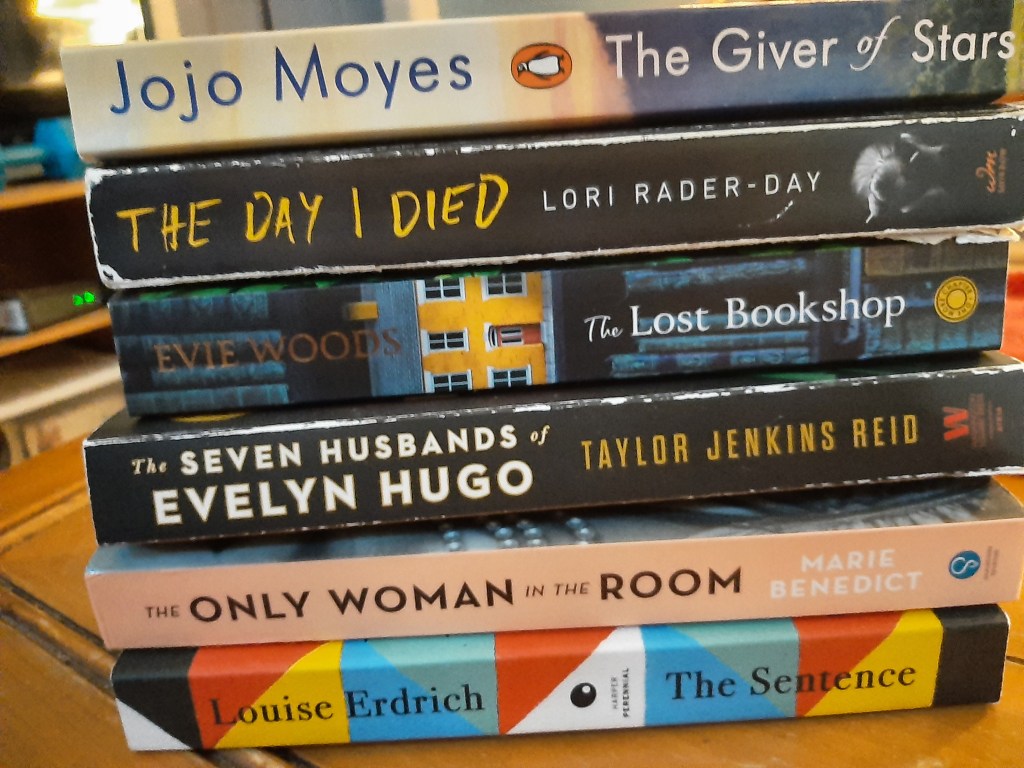
The Giver of Stars by Jojo Moyes

This book had been on my Want-to-Read list for ages, and it did not disappoint. Based on a true event and set during the Depression era, the story highlights a group of women who volunteer to deliver books to poor residents in rural Kentucky as part of Eleanor Roosevelt’s traveling library. According to the marketing blurb on the back cover, it’s a “captivating tale of friendship, true love and reaching for what’s possible.” I’m looking forward to reading more of Moyes’ books.

The Sentence by Louise Erdich

Here’s another author I’ve wanted to read for a while. The Sentence takes place in Minneapolis over the course of one year from November 2019 to November 2020, taking readers through the narrator’s experience during the Covid pandemic and the George Floyd murder and ensuing riots. All the while, she deals with a capricious ghost haunting the book shop  where she works as well as her conflicted feelings about her marriage and her efforts to reconcile her own dark past. An intriguing character study of one woman’s life in turbulent times, and Erdich’s Native-American heritage brings an added narrative layer. I’m sure I’ll be reading more of her works.

The Seven Husbands of Evelyn Hugo by Taylor Jenkins Reid

Evelyn Hugo, a retired film star of the 1950s and 1960s, hires a novice magazine writer to help her draft her memoir. Over several ensuing weeks, the actress shares her life story, though she does so at her own pace and is determined to control the narrative. The hired writer wonders why she was chosen for the job because the two women have nothing in common. Hugo, by her own admission, is not the kindest person in the world and her relationships are fraught with tension. This was another fascinating character study, and the story stayed with me longer have I closed the book.

The Lost Bookshop by Evie Woods

Fans of magic realism will enjoy this novel by Woods, set in Dublin where a vanishing bookshop casts its spell over three unsuspecting characters who have played minor side roles in their own lives. Told through two timelines and three characters’ point of views, readers follow them on their journey to self-discovery and self-empowerment. What I enjoyed most is the way Woods weaved and intertwined the characters’ lives despite the different timelines and how she created a magical bookshop that only a few could see.

The Only Woman in the Room by Marie Benedict

In her novels, Benedict often features bright, talented young women whose career achievements are suppressed by the strong, dominating men in their lives. This story is no exception. Most people knew Hedy Lamarr as a stunningly beautiful Hollywood film star of the 1950s. What they don’t know is that she was also a scientist. She grew up in an aristocratic family in Austria, and through her marriage to an Austrian arms dealer, she often overheard conversations detailing the Third Reich’s  plans. After escaping to the United States and becoming a screen star, she used her scientific knowledge to design a communications system that would help the U.S. fight the Nazis. Except as a woman, no one would listen to her idea.

Murder Under the Tuscan Sun by Rachel Rhys

File this one under gothic romantic suspense. In some ways, the tone and storytelling of this novel reminds me of Daphne DuMaurier’s Rebecca. When a recently widowed woman responds to an ad for a companion to an ill aristocrat at his estate in rural Italy, she has no idea what to expect. While there is no actual murder, there is plenty of suspense as the widow experiences strange dreams, ghost sightings while she cares for her charge who doesn’t seem to want her help. Over time, the two grow closer even as he seems close to death. This was a surprising read that kept me turning the page.

The Day I Died by Lori Rader-Day

After reading two earlier works by Rader-Day (Little Pretty Things and The Black Hour), I fully expected another stellar novel. I was not disappointed.  From the opening pages, I was taken on a wild journey through the eyes of the story’s protagonist Anna, who has a unique talent of analyzing people’s handwriting. The local sheriff isn’t convinced of Anna’s abilities, but hires her anyway to help in his search for a missing boy. But to solve this mystery, Anna has to face her own fears about her past and her relationship with her own teenaged son.

Honorable Mentions:

The following didn’t make my best list but are all worthy of your time.

Mexican Gothic by Silvia Moreno-Garcia
I don’t usually read horror novels–I get too easily creeped out–but Garcia’s writing helped create a dark and suspenseful story. I just didn’t buy into the romantic relationship.

Book Lovers by Emily Henry
After hearing so much about Emily Henry, I had to check out one of her books. This was a solid, engaging story, but the more compelling story line was the relationship between the two sisters.

The Midnight Library by Matt Haig
I was fascinated by the premise of this novel. Imagine what your life would be like if you made different choices.

The Memory of Lemon by Judith Fertig
A mix of magical realism and contemporary romance, this story is about a young baker who has a knack for tasting people’s emotions and has the ability to sense which ingredients will touch her customers’ hearts.

The Ten Thousand Doors of January by Alix Harrow
A young woman unwittingly uncovers a network of secret doorways to other worlds and explores many of them to find her father who had disappeared long ago. I don’t read many fantasy novels, but this was a surprising and entertaining read.

What about you? What books did you read this past year that impressed you most? Which books would you recommend?
Create a Reading Challenge That Truly Challenges You

It’s usually at the start of every New Year that I look forward to my annual reading challenge. While I aim to read on average 30-34 books, I really try to focus on diversifying my reading interests. I like to challenge myself by reading new authors, different genres that I don’t normally read. By mixing things up, I expose myself to different writing styles which can only make my own writing better.

This year I decided to switch things up by creating a challenge based on monthly themes. I considered each month’s holidays and seasons for potential book themes, then browsed my TBR shelf for books that matched that theme. For example, January is the start of a new year. It has a wintry theme, with cold, snow and wind. It’s hockey season too.

Photo by Mikhail Nilov on Pexels.co

Selecting books from my TBR shelf that fit these themes was fairly easy. I wound up reading The Ice Queen by Alice Hoffman and The Snow Child by Eowyn Ivey. I’m already looking ahead to February with two more novels based on the month’s themes (Valentine’s Day, President’s Day, Mardi Gras and African-American Heritage month), and I only have to look at my TBR shelf to find those selections. Other options are the local library and the Little Free Library in your neighborhood.

This is one way to complete a reading challenge. The beautiful thing about them is that you can create your own challenge based on your own goals and interests and start it at any time. They can last three months, six months or a full year. They can either be focused on diversifying your reading selections or increasing your reading time. It all depends on what goals you set for your reading challenge.

Since there are so many ways to go about completing a reading challenge, it may be difficult to decide the best one for you. If you’re not sure what type of reading challenge you want to do, check out this nifty quiz at MindJoggle.com. The site also has some cool resources you can use to get the most out of your challenge, such as reading journals and book lists.

The first step for any reading challenge is to set a goal. If your reading goal is to squeeze more reading time into your life, there are several ways to approach this:

* Increase the number of pages you want to read every day. For example, if you usually only read 10 pages, see if you can increase that total to 20 or 25.

* Increase the amount of time you spend reading. If you currently read 15 minutes a day, see if you can increase that reading time to 30 minutes a day.

* Set a goal for the number of books you want to read in a given month. If you’re used to reading only one book, challenge yourself to increase it to two.

On the other hand, if your focus is to expand and diversify the types of books you read, there are ways to accomplish that too.

* Focus on monthly themes. For example, during the month of February, you might read a romance novel (Valentine’s Day), a political thriller or presidential biography (President’s Day) or a novel written by an African-American author (African-American Heritage month). Pick one or two to fulfill the February theme, then do the same for March (St. Patrick’s Day, Women’s History month and the start of spring) and the other months that follow.

* Focus on one genre for a short time period. For example, if you’re used to reading the latest bestsellers, you might do a three-month challenge featuring classic novels that you’ve never read before.   

* Using the monthly system, you can select a book for a different genre each month. For example, in January, you might read a fantasy novel, in February a biography, in March a historical fiction novel, etc.

These are just ideas to get you started thinking about your own reading challenge. When you create a  challenge that fits your interests and schedule, you’re more likely to stick with it.

Here are a few other tips to maximize your reading experience:

1. Start by determining your reading goal. Do you want to increase the amount of time you spend reading in a given week? Or would you rather experiment by reading books in different genres?

2. Think short-term mini-challenges. Sometimes all you need is a three-month challenge to kickstart a reading habit or improve the one you already have. With shorter challenges you can do a deeper dive into specific genres, like mysteries or historical fiction that you probably didn’t read before.

3. Create a reading calendar. Whether you commit to a full one-year challenge or a mini-challenge of three months or six months, use a calendar to choose the books you want to read. Create a mix of longer and shorter books so you don’t get bored with books of the same length. When you see the calendar at a glance and know what books you’ll read and when, it will be easier to stick with the schedule and with the challenge.

4. Join a reading community. To keep yourself motivated, it might help to join a reading community where you can share book reviews and reading experiences with other like-minded book lovers. Check the internet for possible online communities, or visit your local library to see if they have a reading community. (Note: Don’t confuse a reading community with a book club. Reading communities focus on the reading experience, no matter what you’re reading, while book clubs read the same book for the purpose of discussion.)

5. Be consistent with your reading. A little bit each day builds a new habit and will keep you motivated to keep reading. Also be flexible with your challenge. If a book isn’t working out for you, skip it and come back to it later. Switch to something you will stick with. It’s okay to change the schedule as you go along.

6. Beat reading slumps by mixing up formats. It never fails that by late autumn, my reading interest lags and I just don’t feel like reading. Experts suggest changing up book formats with shorter pieces that don’t require as much time or energy. Think short stories, an essay collection or a novella.

Remember, reading challenges are meant to help you stretch yourself, learn new things and get out of reading ruts. Most important, have fun with them. That’s what makes them worthwhile.

Rediscovering the Local Library for Lifelong Learning

books-4

It’s been a busy week and I haven’t had time to write a fresh post. So in light of my focus on education and training, here’s a repost of a story I did back in 2016. Enjoy. I’ll be back next week with a fresh new post and a new writing prompt. As always, thanks for reading. RL

Have you visited your local library lately? When was the last time you did?

It had been a long time since I visited a library, but a few weeks ago I decided to go to the one in my neighborhood to escape the heat. Once inside the glass doors, I was quickly reminded how much I loved the hushed atmosphere. People spoke is low voices amidst the rustling of newspapers and the hum of laptops as people worked. I love that low-level noise, just enough to know that other people are around, but not loud enough to interfere with a person’s studying or reading activity.

As I wander the aisles, I imagine myself getting smarter just being there in the presence of so many books. I feel like my body absorbs their creative energy, the ideas, the discussions, and the desire for learning. No wonder there is a hushed reverence as soon as I walk through its doors. Knowledge is at work among those who visit.

In an era where Google rules the Internet, local public libraries have been a mainstay in many communities. New research by Pew Research Center finds that libraries still play a vital role in our local communities. Where would we be without these places of learning? Like print books, they’re not going away any time soon. And that’s great news for self-described lifelong learners like me.

But like many people, I tend to forget that the library is there, ready to welcome readers and students of all ages and education levels to browse its shelves and delve into subjects to expand their understanding of the world. Most Americans believe that libraries do a good job of providing a safe place to hang out, according to a study by the Pew Research Center. Consider these additional statistics:

* 77 percent say public libraries provide them with the resources they need.

* 58 percent of respondents believe libraries help open up educational opportunities for people of all ages.

* 49 percent think libraries contribute “a lot” to their communities in terms of helping spark creativity among young people.

* 47 percent said libraries provide a trusted place for people to learn about new technologies.

We may occasionally forget that the library exists, but thank goodness they still play a vital role in our communities. While most people may prefer to use the Internet initially for learning new things, it’s nice to know that libraries are still a viable place for reading, research and studying.

What Makes a Story Memorable?

book-2170910_1280

Have you ever read a book that stayed with you long after you finished reading the final page? Or watched a movie that kept you awake all night as scenes replayed over and over in your mind?

There are few stories that are so memorable that they grab you by the throat and throttle your senses, or grip your heart so tightly that you want to cry or scream. Most reactions to stories are more subtle, of course, but still effective. Sometimes, a film or book drains you instead, so all you want to do is clutch a warm, soothing cup of tea and sit huddled on the sofa staring into space trying to relive the story in your mind or erase it because it was too horrible to experience again.

Recently I re-discovered one of my favorite all-time films on cable and again, I experienced that “stickiness” of a good story. I grew up watching Fiddler on the Roof enchanted by the music and the romance in a time and place far away from the here and now. The story is about a Jewish peasant in prerevolutionary Russia contending with the marriage of three of his daughters. It wasn’t until I was older and watched it as an adult that I understood the historical and religious undertones of the story. Still, as I lay in bed that night a few weeks ago, the story, the characters and the music continued to play in my head, delaying sleep.

What stories have you read or watched that made you feel sad, angry, joyous, surprised, frightened or ecstatic? What films have made you take notice of an issue, a person or a piece of history that you had not noticed before? What stories or characters made you want to take some sort of action — to dance and sing, to hug your children to make sure they were safe and felt loved, or hop on an airplane to a place you had never been before, just because you saw it on the movie screen or read such a vivid description that you had to see it in person?

In the business world, the term “stickiness” refers to a website’s ability to keep eyeballs browsing its pages. I suppose the same “stickiness” can be applied to a story’s ability to stay on in your memory long after you closed the book. The story gives us so much pleasure that we want to experience that pleasure again.

So what makes a story memorable? What elements do memorable stories have in common that make them worth seeing or reading over and over again? Here are a few common elements, based on my own observations.

Fully developed characters. If fictional characters were real human beings, they wouldn’t be flat, emotionless people. Characters need depth, flaws, and qualities that makes them more like one of us. Strong characters don’t necessarily have to be good characters and they certainly shouldn’t be perfect or we wouldn’t be able to relate to them. Complex, multi-dimensional characters make the most memorable characters, and they aren’t always the most likable. Think Ebinezer Scrooge or Harry Potter’s Lord Voldemort.

Sense of time and place. We might remember a story for its unique setting or its place in history. For example, the yellow brick road in The Wizard of Oz is memorable because its unusual color transcends what we believe to be true of traditional paths that are made of other materials and other colors. It makes us realize that this is not part of our world.

Emotional connection. A story can be memorable by the emotional connection it creates between the characters and their readers or viewers. We can sympathize with Topol’s father figure in Fiddler on the Roof because of the emotional conflicts he faces. We feel the love he has for his family and his community, and we witness the pain and confusion in his eyes as he sees his old comfortable world falling apart, and he feels helpless to do anything to stop it.

Suspense. Without suspense, there isn’t much of a story, just a bunch of scenes with no connection to one another. Suspense creates tension, which is the engine that drives the action forward. As each chapter unfolds, another clue, character, or plot twist keeps our interest. If we want to know what’s going to happen next, we have to keep reading.

A satisfactory conclusion. There is nothing more disappointing than reading a page-turner only to get to an ending that makes you wonder, “What happened?”  The ending may not be what you or I have in mind, but it makes sense from the author’s or director’s perspective. We are so conditioned to believe in “happily ever after” that we expect happy outcomes in movies and books. So when a story ends differently, like Thelma and Louise driving their convertible off a cliff, or two young lovers split up at the end of La La Land, it can be a bit startling. The satisfaction comes with understanding that there is a resolution to the conflict in the story; it just may not be the one we wish it to be.

Granted most of these examples are films, but these tips work just as well for books, TV shows, even song lyrics. They tell stories too. Whether you write stories, or just enjoy reading them or watching them on film, remember that stories aren’t worth experiencing unless you can make them memorable.

Eight Books Worth Reading in 2017

CAM00666

As the first week of the new year comes to a close, I’m still closing the door on 2016. I did a lot of reading last year, getting caught up on books that were lying on my book shelf for months, and in some cases, years.

If you’re looking for a good read in 2017, I might suggest the following titles which I read last year. Some are well known, while others are rather obscure. All are entertaining, thought-provoking reads, guaranteed to stay with you long after the story ends.

The Dovekeepers by Alice Hoffman 
Historical fiction set in 70 C.E. in ancient Israel during the Roman invasion of Masada, where 900 Jews held out against the Roman army. According to ancient historians, only two women and five children survived. Five years in the making, this is their story, told by four incredibly bold, resourceful women. The writing is authentic and poignant. At times, I felt I was watching an epic movie unfold. Considered to be Hoffman’s best work, so be prepared to be swept away by her colorful and dramatic storytelling.

To Kill a Mockingbird by Harper Lee
This book sat on my shelf for several months until I learned of Lee’s death last spring. I can’t believe I waited so long to read it. The writing is authentically southern, so at times it was difficult to follow. But beneath the language lay a story of racial tensions in a small town in the South and one man’s attempt to teach his children to treat all people, no matter how different in color or religion, with dignity and respect. Written from the viewpoint of a six-year old girl, the story is both timely and timeless, and just as important today as it was then.

Orange is the New Black by Piper Kerman
Long before the Netflix series, Kerman shares her observations and experiences during her 15-month prison term at a federal correctional facility for women in Danbury, Connecticut. She also shares the stories of many of the women who she met along the way. The first-hand account reveals how Kerman and her fellow inmates managed to survive the day-to-day boredom of prison life, as well as their compassion for each other. Fascinating, if not sobering, read.

The Heart is a Lonely Hunter by Carson McCullers
McCullers was only 23 when she wrote The Heart is a Lonely Hunter, a book filled with humanity and compassion far beyond her years. Like Lee’s Mockingbird, this book also tackles racial tensions with grace and dignity. Even more poignant is how McCullers paints her characters, showcasing their strengths and vulnerabilities, and just how isolated each one is amidst their personal and moral crises. I was most fascinated by Singer, the deaf mute who everyone seemed drawn to, yet who understood very little of what they were telling him. It is through his thoughts and his eyes that we ultimately see how the heart is a lonely hunter, constantly searching for connection with like-minded souls.

Reading Lolita in Tehran by Azar Nafisi
Most of us in the free world would have difficulty imagining living in a society that banned certain books and prohibited women from furthering their education. Nafisi was a professor of English Literature in Iran. When Islamic morality squads began, Nafisi had the courage to set up secret gatherings for seven of her most committed female students to read forbidden Western classics. Reading this memoir and their discussions of famous writers like F. Scott Fitzgerald and Henry James, made me appreciate the freedoms we have in our country as well as the classic writing I have yet to experience.

Still Alice by Lisa Genova
Genova’s book reads like a memoir, and I suppose it could be. Still Alice is a poignant look at Alzheimer’s disease. The story opens with Alice Howland living a full and active life as a psychology professor at Harvard and a renowned expert on linguistics. As the story progresses, we see her become increasingly disoriented and forgetful. This is her journey and her fight to prolong the onset of the disease for as long as possible. This heart-breaking story will make you think, “Gee, this could be me someday.”

An Unnecessary Woman by Rabih Alameddine
Another novel that reads like a memoir, An Unnecessary Woman is the story of a book-loving, obsessive and isolated 72-year-old woman, whose belief that she is “unnecessary” in the world is shaped by her upbringing in the Middle East. She used her love of books and her translation work to hide from the world. Despite her efforts, circumstances force her to come out of her shell and interact with the world. The ending gives us all hope that we don’t have to be alone, that we are all necessary to one another, no matter where we live.

10% Happier by Dan Harris
Written with wit and journalistic integrity, 10% Happier is the memoir of Dan Harris, the weekend anchor of Good Morning America. This is his journey into the world of mindfulness and meditation, which at first, Harris fights. What I found intriguing about this book is the journalistic approach that Harris takes in which he interviews numerous high-profile experts about the experience of meditation, from Deepak Chopra to the Dalai Lama. We learn from Harris’s lessons, his experiences. Meditation is not as easy as it looks, and the lessons we learn about ourselves aren’t so simple either.

Happy New Year, and Happy Reading!

Rediscovering the Local Library for Lifelong Learning

books-4

Have you visited your local library lately? When was the last time you did?

It had been a long time since I visited a library, but a few weeks ago I decided to go to the one in my neighborhood to escape the heat. Once inside the glass doors, I was quickly reminded how much I loved the hushed atmosphere. People spoke is low voices amidst the rustling of newspapers and the hum of laptops as people worked. I love that low-level noise, just enough to know that other people are around, but not loud enough to interfere with a person’s studying or reading activity.

As I wander the aisles, I imagine myself getting smarter just being there in the presence of so many books. I feel like my body absorbs their creative energy, the ideas, the discussions, and the desire for learning. No wonder there is a hushed reverence as soon as I walk through its doors. Knowledge is at work among those who visit.

In an era where Google rules the Internet, local public libraries have been a mainstay in many communities. New research by Pew Research Center finds that libraries still play a vital role in our local communities. Where would we be without these places of learning? Like print books, they’re not going away any time soon. And that’s great news for self-described lifelong learners like me.

But like many people, I tend to forget that the library is there, ready to welcome readers and students of all ages and education levels to browse its shelves and delve into subjects to expand their understanding of the world. Most Americans believe that libraries do a good job of providing a safe place to hang out, according to a study by the Pew Research Center. Consider these additional statistics:

* 77 percent say public libraries provide them with the resources they need.

* 58 percent of respondents believe libraries help open up educational opportunities for people of all ages.

* 49 percent think libraries contribute “a lot” to their communities in terms of helping spark creativity among young people.

* 47 percent said libraries provide a trusted place for people to learn about new technologies.

We may occasionally forget that the library exists, but thank goodness they still play a vital role in our communities. While most people may prefer to use the Internet initially for learning new things, it’s nice to know that libraries are still a viable place for reading, research and studying.