
Tips for Pre-Planning Your Novel

Photo by Lisa Fotios on Pexels.com

Writing the first draft of a novel is the easy part. Revising it is the hard part. The next hardest, I believe, is pre-planning your story.

Sure, you can begin drafting the story as you see it in your head (as I usually like to do). But most authors have to do some pre-planning to know what they will write about in the first place. Otherwise, you can get through six or seven scenes then draw a blank about where the story will go next.  

Pre-planning is important for several reasons.

  • It helps you know how your story will begin – and end – and the major plot points in between.
  • It helps you understand who you protagonist is, what they most desire and what is getting in the way of getting what they want.
  • It helps you figure out who the other characters are and what their motivations are.
  • It helps you get a clear idea of the back story and setting.
  • It helps you understand how the story will progress, and how the tension will develop.
  • It helps you organize your notes so that you’re not stopping and starting your writing.

There are different approaches to pre-planning depending on the type of writer you are. If you’re a planner, then pre-planning will come naturally to you. The downside is you may get so caught up in the pre-planning, that you delay starting your novel.

If you’re a pantser like me, you prefer to write intuitively, letting the scenes and characters show up organically. However, even among pantsers, pre-planning can help you organize your ideas and give some structure to the story before you begin writing. The good news is the pre-planning process provides a skeleton layout of your story while giving it enough flexibility to allow new characters and scenes to develop.

There is no right or wrong way to plan your novel. It all depends on how much planning you like to do ahead of time. Some plans are more detailed than others. But there are a few common steps.

  1. Know what kind of story you want to write, and who your audience will likely be. Do you want to write a mystery? Women’s fiction? Literary? Or historical fiction?
  2. Write the story’s premise in 1-2 sentences. You might consider playing the game “what if” to come up with different scenarios for your story. For example, what if a rising figure skating star is kidnapped as a revenge against her father and the skater’s coach must work against the clock to find her? Be sure the premise hints at the conflict.
  3. Write a bio of your protagonist. It might help to write it in their voice so you can easily get inside their head. What is their greatest desire? What or who is getting in their way of getting it? Who are their friends and family? Know your protagonist inside and out.
  4. Brainstorm different scenes. Just jot down the ideas for each scene in 2-4 sentences. You’ll flesh them out more fully later.
  5. Create a timeline for your story. Does it take place over several days in a thriller? Or several years as they might in historical fiction. Understanding the timeline ahead of time helps you figure out when each scene will occur in relation to one another. Otherwise you’ll have to address the timing of events in the revision phase. (I highly recommend this step. I wish I had done this with my current work in progress.)
  6. Know your audience. This can be several sentences. Who are your potential readers? What else do they like to read?
  7. Do your research. If you’re writing historical fiction, this is especially important to understand the setting and customs of that time. But even if you’re not writing this genre, some research is needed. Do any of your characters suffer from a rare medical condition? You’ll need to know the symptoms and treatment. What types of poison are least likely to be detected? You’ll need to know the answers before you begin writing.
  8. Begin writing. You can start anywhere in the story. I find it helpful sometimes to write individual scenes that you can see in your imagination. You can always figure out where it will appear in the story later. Another option is to begin at the end. Writing your ending first can help you figure out how to start your novel. If you know your protagonist has to end up at Z, then you know you have to have her begin the story at V, and get through W, X and Y.  

You’ll find numerous resources and articles about planning your novel on the internet. There are numerous approaches, and you may have to experiment with several of them before you find one that works for you.

Good luck and happy writing!

Too many story ideas? Writers need a back burner   

Photo by Pixabay on Pexels.com

It never fails that as I’m slogging my way through revisions of my current work in progress, a fresh new story idea teases me. I’m tempted to drop what I’m doing to follow that shiny new idea to a more tantalizing destination, but I know I have to hold back. I know that once I follow that shiny new idea, I may never finish my current project. Sure, it’s more fun to create new stories. And I don’t want to lose the enthusiasm for writing that the new story idea promises. But work has to come first. I need to finish what I start.

So what is a writer to do? Put it on the back burner, of course. Before you do, however, it might be wise to spend an afternoon jotting down notes related to the idea. Writer Charlie Wetzel writes in this LinkedIn post that it helps to give the idea some immediate attention, then put it away to simmer, as if you’re preparing a recipe. He compares the creative process to cooking broth from scratch, which is an apt analogy. Once you pull together all your ingredients in one pot of boiling water, let give the broth time to mix.

No need to feel guilty about leaving your story idea on the back burner. There are several good reasons for doing that, most notably to allow yourself time to finish a current work in progress and take care of every day responsibilities, like shopping and doing household chores. But leaving the story on the backburner allows it to percolate so all the ingredients come together.

Reasons to use the backburner

Reason 1: The story idea needs more time to develop. When you get that flash of inspiration, the idea may come only as a single scene, a character, a piece of dialogue or a unique setting. Perhaps you come up with an interesting premise or you read a passage from a book. That single piece of information is only a seed, when what you want is to grow an entire garden. Stories are created from multiple seeds that you blend together. That requires time and patience. 

Reason 2: The backburner allows the story idea to receive additional seasoning. Like the cooking analogy above, stories require different ingredients. Wetzel believes that while ideas simmer on the backburner, additional ideas from outside stimuli can flesh out the original concept. Things like other books, news articles, an art exhibit, watching a play or TV program – all these things can contribute to your original story idea. Wetzel shares the example of writing a historical novel set during war time. Only after reading about different battles of World War I did he settle on that time period as the setting for his novel. That’s how a back burner can work for you.  

Reason 3: You are still working on your story, even though you’re not physically working on your story. The funny thing about backburners is that your subconscious mind goes to work on the idea while you’re doing other things. So while you might be busy with your day job or your current work in progress, your mind is still working out the kinks in your story idea.

“My best scenes and story ideas are always those that emerge from my subconscious. I don’t create them; I just watch them unfold,” writes author and writing coach K.M. Weiland. Her pre-writing routine is worth reviewing.

By the time she’s ready to start writing, more of the details have been fleshed out. By then, you may understand your protagonist better, named most of your characters and worked out several scenes. You have enough details to begin writing it down on paper (or screen.)

Idea generation is like any other muscle;

the more you use it, the stronger it gets.

Unknown

Choosing the next idea

Writers are funny people. No sooner do they finish one project that they look around for the next great idea to write about. It’s always a good idea to complete your current project before starting anything new, advises Weiland. But when those revisions are complete and you’re sufficiently rested from your previous work, it’s time to dust off the ideas to determine which story idea to work on next.

Weiland says writers should ask themselves several questions when considering their next story.

  • Which idea excites you the most? The more excited you are, the more likely that enthusiasm will carry you through the first draft.
  • Which idea is the most marketable? Will readers buy that novel? Will bookstores and libraries stock their shelves? The most marketable stories are worthy of your attention.
  • Are the story ideas sequels to current projects? Most likely, those sequel concepts should be given the green light ahead of others.

I suggest asking another question: Which story is the most developed from the pre-planning phase? Do I have a clear idea of the protagonist and their desires and challenges? What is the conflict? How will I grow the tension? How the story will conclude? If I’m able to sketch out the first five or six chapters as well as the closing chapters, then I will likely dive into that story before any of my other ideas.  

What if the ideas don’t work out?

Not all story ideas are created equal. Some ideas are not worth pursuing, and after a given time on the back burner, you may have to make the tough decision to let them go. Maybe they don’t excite you the way they used to when you first thought of them, or maybe they didn’t flesh out in meaningful ways as you hoped. It’s okay to dump ideas. There are always more ideas in the pipeline to replace them. I’ve found that by letting go of an unborn idea that never developed, I can make room for another more tantalizing new idea that can develop into a meaningful story.

Back burners aren’t just for cooking. They’re a useful tool for writers to keep track of fledgling story ideas that spring forth from your imagination.

Must-Read Historical Fiction with Strong Leading Female Protagonists

Photo courtesy of The Regal Writer

March is Women’s History Month, and to commemorate the occasion, this week’s post will focus on historical fiction featuring strong female protagonists.

Throughout history, women have made huge contributions to our world – in science, politics, lifestyle, sports and, of course, literature. It makes sense to tell their stories to showcase their accomplishments. Even fictionalized accounts of real events can bring meaning to today’s readers.

Historical fiction can mean a number of things. It could be fictionalized stories that take place during  true events, such as World War II (Kristin Hannah’s The Nightingale), or it could be a fictionalized story of the lives of real people (Becoming Jane Eyre by Sheila Kohler).

While I don’t read a lot of historical fiction, I’ve read enough of them to compile my list of must-reads. Below are my top choices of historical fiction featuring strong leading female characters. They are not listed in any particular order. In some cases, I’ve included alternates choices.

Do you read historical fiction? Which of the stories you’ve read would you recommend?

* The Nightingale by Kristin Hannah

The Nightingale is the story of two sisters who find themselves facing life-changing horrors during Germany’s occupation of France during World War II. Vianne and Isabelle resist the war in ways they never thought possible. Beautifully written and at times heartbreaking, The Nightingale has one of the most poignant and memorable endings. It is currently being made into a movie starring real-life sisters, Dakota and Elle Fanning.

Alternate choice: Winter Garden, also by Kristin Hannah

Set in the year 70 C.E, 900 Jews held out for months against the Roman army on Masada, a mountain in the Judean desert. Historians say only two women and five children survived. Hoffman’s novel tells the stories of four bold and resourceful women, each of whom has come to mountain by different means. It took Hoffman five years to research and write this lengthy novel. Beautifully written but at times painful to read. Be patient; the book starts out slow and meanders in the opening section, but with each women’s story, readers get a view of the horrific pain and devastation that affected so many lives.

Alternate choice: The Museum of Extraordinary Things, also by Alice Hoffman

  • In The Time of the Butterflies by Julia Alvarez

    In November 1960, three sisters were found dead near their wrecked Jeep at the bottom of a 150-foot cliff in the Dominican Republic. A fourth sister lives however. The sisters, whose code name was Las Mariposas (the Butterflies) were leading opponents of the country’s dictatorship. The story is told through the voices of the four sisters who speak across several decades of their lives up until their deaths. I found the story intriguing and heartbreaking at times.

Set in Charleston in the early 1800s, The Invention of Wings tells the story of the two Grimke sisters, Angelina and Sarah, who became early abolitionists and advocates for women’s rights. When 11-year-old Sarah is given 10-year-old Handful to be her personal maid, Sarah balks. With alternating viewpoints, the story shows how their relationship evolves over 35 years.

Alternate: The Secret Life of Bees also by Sue Monk Kidd  

The only book on my list written by a man, The Book Thief is also set during World War II. While standing at her brother’s grave site, Liesel finds a book buried in the snow, which spurs her love of books. With the help of her step-father and a Jewish refugee that her family hides, she learns to read. Anyone who loves books and reading can empathize with young Liesel who goes to great lengths to spare books from destruction by Nazis. One of the few stories I enjoyed as both a book and a film.

  • Becoming Jane Eyre by Sheila Kohler

    Interestingly, I find this fictionalized account of the life of Charlotte Bronte far more compelling than the original Jane Eyre. The story covers the last nine years of Bronte’s life, her relationship with her father and sisters and how she came to write Jane Eyre.

Rewriting a Novel Isn’t Easy. Here’s Why.

Photo by Suzy Hazelwood on Pexels.com


I began writing a novel in earnest last February and finished it by Memorial Day (end of May in the U.S.). It was satisfying to finally type the words “the end.”

But writing the first draft was the easy part. It’s the rewriting that was harder than I expected.

I let the manuscript cool off for several weeks before I decided to tackle the revision. That first week, I stared at the manuscript, wondering what I had gotten myself into. I had no idea how to go about editing and rewriting a project that size. I quickly got bogged down by the process, but I never got discouraged. I was determined to finish this manuscript, if only to prove that I could finish it.  

I reworked some chapters that seemed salvageable and chopped away at a few others. I set it aside again. Now I am making my way through a second revision. But as I gradually proceed, I feel I’m taking one step forward and two steps back again.

That brings me to the main point of my post today. Writing the first draft was easy. Rewriting it was where the hard work began.

Since starting the rewriting process – twice now – I’ve learned quite a bit about myself as a writer. I’m happy to share those lessons with you.

Lesson 1: Rewriting a novel is much harder than writing the first draft.

When writing the first draft, I can let my imagination fly. I may sketch out the first few chapters ahead of time, but I allow the ideas for characters, scenes and dialogue to take over. So what if I write 120,000 words for an 85,000-word story? That’s where the editing and rewriting can make a difference.

But rewriting is hard work. You can become emotionally connected to your work, and to cut so much of it can be excruciating. But it’s also necessary. As I reread the material, some scenes didn’t make sense, others were out of sequence. You may find that some characters lack depth and others aren’t needed at all. It takes time to rethink the plot and make sure it follows proper novel structure. It can take up to five rewrites – sometimes more – before the novel is truly complete.

Lesson 2: Instead of “killing your darlings,” save them for another story.

One of the toughest things to do when editing your own work is cutting material that you’ve created. It’s a painful experience. You can be so proud of the work you’ve done, only to be forced to “kill your darlings,” because they know no longer fit the story. It takes great courage to recognize that a scene or character isn’t working.

But here’s a thought. Rather than “kill off” those offending pieces of prose, send them away for adoption. Keep a file of unused material that you’ve killed off. Those sections may not work for your current novel-in-progress, but perhaps they can be adapted to fit another manuscript later.

Lesson 3: Have a clear vision of the novel’s ending.

When I began my current work, I wasn’t sure how the story would end with my protagonists besides a happily ever after. The conclusion should tie up all the loose ends. I found once I drafted my story’s ending, it was easier to handle the rewriting because I knew where the story was headed. For some writers, it might be helpful to draft the final chapters first before starting the novel’s beginning. You can also revise the ending if needed, but at least you have a direction for your story.

Lesson 4: Find the best place to jump into the story.

While it helps to have a clear vision of the novel’s ending before you begin writing (and rewriting), you might experience the beginning differently. It may come across as vague, unfocused and meandering. Perhaps there’s no conflict facing the protagonist. Or the main character has no personality.

I usually have to write and rewrite multiple versions of the first few chapters to find the right scene to jump into the story. Sometimes you start the story in the wrong place. But it’s important to determine that inciting incident that moves the story forward, or you won’t be able to engage readers’ interest.

Photo by Andrea Piacquadio on Pexels.com

Lesson 5: When the going gets tough, take a break.

There will be times during the revision process when you might feel stuck, unsure what to do with the rewrite. Should that character get cut? How do I go about changing this scene? When stuck like that, I’d often step away for a few days to tackle household chores or do some other writing. When I came back to it, I could usually figure out what to do next. Rewriting can be overwhelming, and sometimes you need to give yourself a break to see the way forward.

Lesson 6: Keep your material organized.

When I began writing my novel, I didn’t realize how much organization was required. Keep copious notes, and don’t lose them. When I started writing, I had notes in different places. I’m still trying to figure out a system that works for me.

Organization is necessary to keep track of multiple versions of a scene or chapter. It’s also helpful when figuring out the proper sequence of events within the story. To make sure each scene is set up in proper sequence, I list each chapter along with a brief summary. Then I review the chapters to make sure they made sense in the order I had them. I can usually tell at a glance if I need to add another scene or rearrange the ones I’ve already written.  

Lesson 7: Be patient with your progress.

I’m not the most patient person in the world. Writing (or more accurately, rewriting) is hard work and it usually takes longer than you think it will. Rewriting is a painstakingly slow process. It comes in fits and starts, and you may never be satisfied with your progress or with the words on the page. Be patient with yourself during the rewrite. A little bit of work every day can help you move closer to your finished manuscript.  

What about you? Are you rewriting a novel? What lessons have you learned from the rewriting process?

Storytelling Lessons from Hallmark Movies

Photo by rovenimages.com on Pexels.com

Say what you will about Hallmark movies. You either love them or hate them. Or somewhere in between.

When I discovered Hallmark movies in 2015, I was going through a difficult period of my life. These movies helped me see that there are happy endings to stories. Certainly I could find a happy ending to my own, right?

Still if you’re aspiring writer of fiction, especially romantic fiction, you might want to watch a few of them. You might learn a few tips and tricks about storytelling.

There is nothing scientific about my observations below. They are strictly subjective based on my life perspective. Be free to agree or disagree with these lessons.

  • Create compelling characters. While Hallmark characters might lead idyllic lives compared to our own, they are flawed and often misguided. While their own troubles aren’t nearly as traumatic as some of the ones you or I might face, they are very real to them. For your own fiction stories, create characters with depth – depth of emotions and motivations.  What is their greatest desire? What obstacles stand in their way of getting it? What false belief or assumption have they been living with that prevents them from finding happiness? These are some of the questions you need to ask yourself about your lead characters so you can make them more believable on the page.
  • Create closure for characters. In Hallmark movies, there’s always a happy ending. I like happy endings, especially ones that are wrapped in brightly colored ribbons and bows. I want to see the characters solve their problems in a way that makes sense for them. You may not have a story that ends with a passionate kiss, but it should end with all loose ends tied up.  
  • Find humor in everyday situations. While some of the Hallmark movies border on silliness, the lighthearted spirit of these films appeals to audiences. The best humor comes from everyday —  and sometimes embarrassing – events. Like someone walking out of the bathroom not realizing with a piece of toilet paper stuck to the bottom of their shoe. That kind of stuff happens in real life, and readers can relate to them.  Even if you’re writing a film noir or a horror story, a little humor can lighten the mood. When Buffy the Vampire Slayer utters a sharp wisecrack just when she’s about to put a stake in a vampire’s heart, it makes for satisfying entertainment. Think about how you use humor in your own stories, but don’t add it just for humor’s sake.
  • Story lines don’t have to be overly complex to be effective. Surely, the plots for Hallmark movies are rather simplistic and not necessarily innovative. But they still work. There’s still an inciting incident (when the two romantic leads meet), a build-up of suspense and a climax when the two romantic leads finally come together.  
  • Avoid predictability. The knock on Hallmark movies has been that they are predictable, often rehashing the same story lines over and over. If you have several manuscripts in various stages of completion, make sure they’re not the same plot rehashed with different characters and settings. Readers expect more than that. Be surprising. Show them a twist that they may not have seen before. Introduce a character with an unusual background or trait. Write something unexpected to keep readers wanting more.
  • The best stories tug at the heart strings. If there’s anything that Hallmark does excel at, it’s creating heart-warming stories. You don’t have to write a romance novel to bring heart into your own story. Any work of fiction should touch the heart of your readers. Start by crating characters that you care about. If you care about them, readers will too. Then add a plot that is real and honest. You’ll have readers following your every word.
  • Create a compelling title. I find most of the Hallmark movie titles either aren’t memorable or they lack connection to the plot. They’re more cute than accurate. When you come up with a  title for your own manuscripts, think of something that adds a meaningful connection to the story and at least hints at what the story is about.

Whether you write romance, mystery, or something else, put a little heart into your stories by including these key elements. Your readers will appreciate you for it.  

Nine Lessons I’ve Learned on My Writing Journey

Image courtesy of the Regal Writer

After a brief hiatus, I’m back to writing for The Regal Writer. The time away has cleared my head. I’ve been writing this blog since 2016, and I found that I was running out of story ideas. I’ve had a lot of time to think about my writing journey, and I wanted to share what I’ve learned with you. Hopefully, my lessons will resonate with you.

Lesson 1: It’s never too late to begin your writing journey.

I’ve dreamed of writing a novel since I was in my 20s when I dabbled with a few story ideas. But nothing concrete ever took shape. Once I got to my 50s, well, it seemed all the more pressing to begin the process. So I took a few classes to learn about the writing process and experimented with different storytelling techniques. I realized early in this journey that I was not alone. I’ve met several new writing friends along the way with similar goals. I also learned that numerous other authors were late bloomers. Laura Ingalls Wilder wrote Little House on the Prairie and its series at age 65, Bram Stoker wrote Dracula at 50 and Raymond Chandler penned his first novel The Big Sleep at 51. I figured if they could find success, so could I.

Lesson 2: Read widely in different genres.

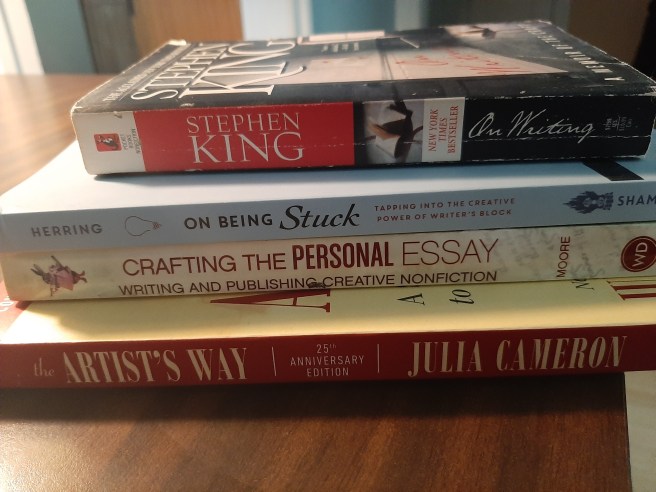
One of the first books I read about the writing life was On Writing by Stephen King, which I highly recommend. The book freed me to start this writing journey and to take chances with my writing. One piece of wisdom he shared was to read and to read widely, not just my chosen genre but others, because reading is the best way to learn about crafting stories. My library is stocked with everything from non-fiction, romance, literary and the classics. There is something to learn from each one.

Lesson 3: Keep learning – and growing.

Much like reading books of different genres, it’s important to keep up with your education about writing. It seemed that the more classes I took and the more articles I read, the more there was to know and understand about writing. I’m still learning and growing, and I expect I will continue for as long as I call myself a writer. I have also learned that the best education was the actual process of writing. The more I experiment with ideas and characters and plot lines, the more I’m learning about the craft of storytelling. You learn best by doing.

Lesson 4:  Fiction writing is very different than writing for the business world.

I’ve enjoyed a successful career as an editor and communications professional. I’ve seen my work published in association publications and earned a byline. But I quickly learned on this journey that writing fiction is a very different animal. Like other newbies, I had to start at the bottom and learn how to craft a story, how to create the plot, develop characters with depth, and how to create suspense that will satisfy readers. It’s been a long, arduous process, and I’m still working on it. That said, writing fiction is more fun.

Lesson 5: Don’t be afraid to experiment with different writing styles.

When I began this journey, I had yet to settle on novel writing. The first classes I took focused on essays of about 1,000 words. The hardest part of this experience was revealing personal details of myself, which made me uncomfortable at times. I wondered if essays were the best avenue for me. I experimented with other styles – short stories, novellas, and eventually worked my way up to a full novel. I’ve dabbled with writing suspense, romance and women’s fiction, because I enjoy reading all those types of books. Experimenting with the different genres and lengths helped me determine that women’s fiction is probably the best outlet for my talents.

Lesson 6: Don’t be afraid to fail.

I once heard those words of advice from someone interviewing me for a job some years ago, and they’ve stuck with me ever since. In writing, it’s easy to fall into the mind trap that I’ve failed just because I never finished a manuscript or an editor rejected your latest piece. But no writing effort is ever a true failure. There’s always something to be salvaged from the manuscript – a piece of dialogue or a character with a unique perspective – that you can adapt to another piece of work. In writing, the only true sign of failure is giving up. Which leads to lesson 7.

Lesson 7: Never give up on your writing dreams.

I’ve had this dream of being a writer since I was in my teens. I’ve had teachers who encouraged me along the way. While I didn’t write a word for a couple of decades while I focused on my career, built a home life and enjoyed a social life, I was still compiling life experience. When I was ready to write again, I had plenty of fodder to draw from. So if you’re grappling with how to fit writing into your life, all I can say is there are ways to make it happen if you want it badly enough.

Lesson 8: Finishing the first draft is easy; it’s the revision process that is most challenging.

With several manuscripts in various stages of completion, I can honestly say that drafting stories is so much fun. I may sketch out the first few chapters, then begin writing. That’s when my imagination takes over. Characters show up that I never envisioned and plots develop in unexpected ways. It’s when I get to revising, shaping it into a marketable piece, that the hard work begins. That’s when I need to arm myself with patience to get through the often slow, painstaking revision process.

Lesson 9: It’s not the destination; it’s the journey. Enjoy the ride.

As I mentioned above, once I begin writing, I allow my creative muse to take over. My hands on the pen or keyboard are only the conduit for the words that come. It’s that part of the process that I enjoy most. I rarely think about what the end goal is. Maybe I’ll get my work published, more likely I won’t. But I relax and enjoy the process all the same. Don’t worry about what the end looks like, just enjoy the ride. Hope these lessons inspire you to keep writing.

On Being Thankful for Being a Writer

affection appreciation decoration design
Photo by Carl Attard on Pexels.com

Hello readers,
The article below was originally posted in 2018, but I wanted to share it again. It never grows old. I am truly grateful for sharing my thoughts and insights with you, and I am grateful to have you as my loyal readers. I’m putting my blog on hiatus at least through January 2022. Between freelance writing assignments and a new part time job that requires a lot of my energy, I find I don’t have as much time for my blog. Plus it will give me a chance to refuel for new content in the coming year. You are always welcome to return and read what I’ve posted previously, and I will try to keep the weekly writing prompt going as well. Enjoy, and have a safe and wonderful holidays. Regina 

As you gather with your families and friends this Thanksgiving holiday, think about what you are most grateful for, especially as it pertains to your writing. Perhaps you are grateful to have a mentor to guide you through difficult lessons, or maybe you are grateful for Daniel Webster for publishing a dictionary.

I was inspired by a post by Laura Stigler, President of the Independent Writers of Chicago, “On Being Thankful We Can Write,” to create my own list of things I’m thankful for.

* A mother who loved to read and instilled that love of reading in me. When you see a parent reading a book, I believe it encourages kids to become readers too.

* Former teachers who recognized my skill from as early as seventh grade and encouraged me to participate in writing contests. Each compliment and kind word of support made me want to keep writing. There’s nothing like a personal cheering section to keep you motivated.

* Former bosses who appreciated the fact that I could find the best words to explain a process or write a letter to an important client. Other times their tough love approach to critiquing my work only strengthened my resolve to improve.

* Friends who have shared a love of books and reading and who don’t mind talking about the latest book that they liked or didn’t like.

* The authors whose work I have enjoyed over the years, from Louisa May Alcott’s “Little Women” to Carolyn Keene’s Nancy Drew mysteries when I was young girl to the early works of romantic suspense authors Mary Higgins Clark and Joy Fielding that I enjoyed in my twenties and thirties to more recent favorites, such as Alice Hoffman and Sue Monk Kidd.

* Libraries and librarians, book stores and book discussion groups, who all keep the love of books and reading alive and makes sure there is always a potential audience for the stories writers write.

* For my blog followers, thank you for reading my posts, sharing comments and showing your support.

Most important, I am grateful that I have the talent (or gift, as some writers suggest) for writing and the desire to use it in personal and professional ways. In fact, I think I enjoy the world of books, reading and writing more now than I ever have.

As you spend Thanksgiving with family and friends, remember it’s a time for bonding over shared experiences and swapping stories. And as you share old family legends and tales for the umpteenth time, don’t forget to create new ones to share next year.

Happy Thanksgiving!

How many drafts do writers need to complete their story?

Photo by Lisa Fotios on Pexels.com

No, that is not a trick question.

That very question was posed recently by author Samantha Hoffman at the Chicago Writers Association blog. It got me thinking about my own writing journey and the multiple manuscripts that lie in my desk drawer. The ones I’ve begun but never quite finished. It should make you think about your own writing process too.

I’m impressed by people who can knock out a 90,000-word novel in three drafts. I figure they’re either doing something right, or their stuff is still needs significant editing and they don’t realize it yet.

As the calendar flips over to November and National Novel Writing Month begins, it’s a question that may run in the back of your mind too. How many drafts do I need before my story is truly polished and ready for publication?

That all depends on who you ask, of course. Hoffman has her own response: “Finish draft one, then keep going until it’s the best it can be, keeping in mind you’re not looking for perfection because perfection is a myth. Make it the best it can be at the time. Or keep going until you’re simply sick of it.”

Tegan Atkins at Writers’ Edit blog writes that the answer depends on the type of writer you are as well as several other factors:

* Genre – Fantasy authors may go through more drafts of their story than someone penning a memoir because they’re creating an entire new world from their imaginations. That creative process can take more time to iron out all the details.

* Writing experience – Newer writers are likely to go through more drafts of their story than someone who has published previously, although that’s not always the case. Kristin Hannah, who has published 24 books in her career, has been known to go through 10 drafts of her novels before they’re published, according to her website. Newbies are still conquering the nuances of fiction writing, such as plot development and character arcs. Because they’re working their way through the creative process, it will likely take them longer for them to be truly finished with their manuscript. In many situations, Sabre says, new writers never finish.

* Hobby vs. career – Career writers are more used to the writing process and have developed their systems for getting the manuscript done. Hobbyists may approach the effort more leisurely and may not be as nit-picky in their self-editing process. For their work to be taken seriously, career writers may hire a professional editor to critique their manuscript while hobbyists may bypass the services of a professional editor. Hobbyists’ goal may be to write a collection of stories for their family while career writers are more serious about getting their writing published to the masses.

In the end, the number of drafts you need depends on you – your goal for the story, how complex the story line is and how much of a planner and perfectionist you are with regards to your writing. I’ve heard that the industry standard is five to seven drafts to get a story in shape. As I finish the second draft of my work-in-progress, I can take comfort in knowing I’m on track.

So as we enter the month of November and National Novel Writing Month, remember that you can’t begin to think about multiple drafts until you get the first one down on paper. The real answer to the question “How many drafts are needed to complete my manuscript?” is this:

However many it takes to make you feel satisfied that you’ve done everything you can to make it the best it can be.

Or at least until you’re sick of looking at it.

10 Ways to Fund Your Creative Writing Projects

Photo by cottonbro on Pexels.com

Managing a writing career is tough. It’s even tougher when you’re worried about money and how you’ll pay bills every month. Not everyone who begins a writing project or business will have the financial wherewithal to support themselves – at least not at first. Most writers, including yours truly, have had to find ways to support themselves while keeping alive their creative passion.

Below are 10 possible avenues that you can pursue to fund your writing career or a specific project. Granted, it might mean less free time to work on your masterpiece, but it will also give you some peace of mind, knowing that you can make ends meet.

  1. Personal savings. If you’ve been in the work force awhile, or were lucky enough to have had a previous career that offered a savings plan, such as a 401K, those funds can act as a cushion for when you’re transitioning to your writing lifestyle. Experts suggest having at least six months of savings in case of emergencies, and with the current economic climate, I’d recommend more than that. Things always cost more than you think. Be sure to budget yourself and refrain from overspending on non-essential items. That will stretch out your savings even further.
  2. Part-time jobs. There is such a thing as scaling back on your schedule to allow more time to do what you love. As with your personal savings, budgeting will be key to success because you won’t have as much of an income to live off of. But at least a part-time gig will give you some cash flow to cover basic expenses while freeing up valuable time in your schedule for writing.
  3. Freelance and contract gigs. Most writers I know choose this option because it gives them the freedom to set their own schedule. On the other hand, you may spend more time marketing yourself and searching for well-paying assignments than actually working on your own writing projects. Many clients don’t pay enough to cover your basic expenses, so you have to pile on lots of small assignments for any reasonable income, which can cut into your personal writing projects. You’re better off with three or four steady gigs that pay well rather than 10 or 12 that pay pennies.
  4. Temporary assignments. Temping can provide some stability and a somewhat steady income whenever you need it. But the days when temp agencies automatically offered assignments is long gone. These days you need to apply for assignments as if they were regular full-time jobs, which means you may be competing for work against other candidates. On the positive side, you can choose to work a few days at a time or longer assignments that last more than a year.  You can opt for part-time or full-time assignments too. Even with its somewhat inconsistent nature, temp work can provide financial support when you need it.
  5. Internships. If you’re starting out with little or no experience, internships can help you gain valuable real-world experience that looks good on your resume and helps you build a portfolio of samples that you can show to future clients and employers. Some internships pay, others do not. But you gain in real-world experience while on the job. Find internships on job sites like Indeed or Internships.com.
  6. Grants and fellowships. If you don’t mind working for the experience and earning living expenses while you do so, then grants and fellowships may be right for you. Grants are an outlay of cash that doesn’t have to be paid back. They may require a certain expertise or writing focus such as writing about social justice issues or being of Native American descent. Read the grant application requirements carefully.

    Fellowships are usually offered through a university and allow you to earn money while you contribute in some way to the writing department. You may be required to teach classes, manage the writing lab and attend workshops in exchange for a stipend. Fellowships give you a chance to work on a specific project and get feedback on your work from fellow students in the program and instructors. Some fellowships can be done at a distance while others require in-person sessions. Study the application carefully to make sure you understand the requirements. To find grants and fellowships near you and to learn more about them, check out Profellow.com.
    .
  7. Home equity. Tapping into your home’s equity can be a practical choice, especially if you’ve lived in your home long enough to earn significant amount of equity. If you’re uncomfortable tapping in your home’s equity, author and artist Cassandra Gaisford suggests another option. Instead, ask the bank for a mortgage holiday of two or three months. Then use the savings to finance a business startup or live off of it while you focus on your writing project.
  8. Crowdfunding. If you have a specific project you’re working on, try setting up a crowd funding page on one of the crowdfunding platforms. Some have categories for publishing and other creative projects. Crowdfunding can help you test your book idea with potential readers and gain financial support from them if they like your idea, especially if you plan to self-publish. Check out Indiegogo, Kickstarter and Unbound.
  9. Sponsorships. Is there a local business you support that could help you in return? Perhaps a coffee house you frequent where you’ve been drafting your novel? Or some other place that knows of your efforts to get published? Ask them to sponsor your work-in-progress. Even a small amount of cash can help you defray publishing expenses. In return, off something that can help them, such as offering a free banner ad for their business on your website or plug their business via social media.
  10. Seek investors. Don’t be shy about asking friends and family members for their financial support, which can help you get the project or business off the ground. Just be sure to put all expectations and financial requirements in writing so all parties know what’s at stake. Be clear about what your needs are and whether and when you’ll be able to pay them back.

Starting a writing project can be both exciting and daunting. There’s no cost to you to begin your writing project, just a steady supply of paper and pens will suffice. But when you’re ready to publish the manuscript, produce a play or design a website, that’s when costs can become apparent. Still, if you plan your time well and stick to a budget, you can make your writing dream a reality.

12 Tips to Survive – and Thrive – National Novel Writing Month (NaNoWriMo)

Logo courtesy of NaNoWriMo

This article is reposted from October 2020.

Have you always wanted to write a novel but wasn’t sure how to start writing it? Maybe you’ve had a story idea swirling inside your brain for the past decade and just never made the time to write it. With November right around the corner, here’s your chance.

National Novel Writing Month is an annual creative writing challenge that takes place every November in which participants aim to write 50,000 words in 30 days toward a completed novel. The event is hosted NaNoWriMo, a nonprofit organization that encourages writing fluency and education for all ages. According to its website, the NaNoWriMo group believes in “the transformational power of creativity.”

Participation in this annual event has escalated from a mere 21 people in 1999 to 306,230 in 2017, according to the Novel Factory. You don’t have to sign up on their website to participate. You can do this in the comfort of your home, which is what I plan to do. While the goal is 50,000 words for the entire month, that is only the goal. If you can only achieve 30,000 words – or 1,000 words a day – that’s fine too. This is a personal challenge to motivate writers to write every day and work toward a larger goal.

Whether this is the first time you take part in the event or the tenth, here are some helpful tips for surviving this 30-day writing challenge. You can find other helpful tips here too.

Photo by Negative Space on Pexels.com

Outline and research your story ahead of time. Since you’ll be spending your November days writing, you’ll need to know what you’ll be writing about. Plan ahead. Plot your outline in advance. The Novel Factory has some awesome free downloadable tools to help you plan your story.

The same goes for research. If you’re writing historical fiction, do your research ahead of time. If you get to a place in your story where you need to do more research, make a note of what you need to do and come back to that place during the revision phase. Don’t get distracted by the desire to look up something or you will never get back to your writing.

Plan your schedule. With a hefty 50,000 word goal, you’ll need to plan how you will achieve it. That’s roughly 1,667 words a day with no days off, or 2,000 words a day with one day off each week. Those daily word goals can be daunting. So it’s important to plan how much you’ll be able to write. It might mean getting up an hour early each day to write, or doing mini sessions throughout the day. Remember, you don’t have to write in one huge chunk of time.

Try something new. Many writers use NaNoWriMo to experiment with their writing. It might be re-writing a current work-in-progress from an alternate point of view, or trying their hand at writing a different genre – science fiction when they normally write psychological suspense. This approach can be applied to your writing schedule too. For example, try getting up an hour earlier in the morning to start writing rather than waiting until the evening when you may be too tired.

Participate in live write-ins. If you’re looking to stay motivated throughout the month, check out a live write-in in your area. If you sign up at the NaNoWriMo website, you’ll be given locations of write-ins near you. With the pandemic, I imagine there might be virtual write-ins too. 

Work with a writing buddy. When you participate with a friend, you can motivate each other and help you through the rough spots. If you’re both competitive, set up your own contest to see who can write more words each day. Try putting a giant thermometer on your wall. As you complete your daily word count, fill in the thermometer with red to see your progress. Then compare your progress with that of your friend’s.

Be prepared to put some activities on the backburner. That may mean less time hanging out on social media, less time watching Netflix or Hulu or shutting off the TV. It could also mean spending less time socializing with your friends and fewer Zoom meetings. You’ll have to decide what you can live without for the short term while you work on your masterpiece.

Silence your inner critic/editor. As you write, turn off the internal critic who tells you that your work isn’t good. It’s easy to get sidetracked by negative thoughts. First drafts usually aren’t very good, so relax and just tell your story without judgment and self-criticism. The whole point of NaNoWriMo is to challenge yourself to write your story. There will always be time for editing later.

Avoid going back to the beginning. If you are ever tempted to read what you’ve already written or rewrite it, don’t. You may decide that your work is terrible and give up. Or you may want to start editing it, which only wastes time. If necessary, read the last page or two that you wrote to remember where you left off, but otherwise, keep a forward focus.

Find your writing rhythm. You may find one week into NaNoWriMo that you’ve hit your stride. That’s great news. If you get to the end of your 2,000 word goal and you still feel motivated to keep going, then by all means, keep writing. That’s one way to build up your word count early on in the challenge so if you feel a bit sluggish by the end of the month, you can slow down without harming your end goal.

Reward yourself when you reach milestones. When you get to the 5,000 word mark, for example, treat yourself to your favorite snack or watch a favorite movie. Set another reward at 10,000 words, 20,000 words and so on. Occasional rewards serve as great motivational tools to keep you writing.

Don’t beat yourself up if you don’t meet your writing goals. So you only wrote 30,000 words. Congratulate yourself for your accomplishment. That’s better than not writing at all. Remember the purpose of this event is to challenge yourself to make quick, steady progress.

Make time for exercise and fresh air. All work and no play can stifle your creativity. Make sure you get outside if the weather is nice, and go for a walk or a bike ride. It’ll help clear the cobwebs from your brain and you can return to your desk with a fresh perspective.

Most important, have fun with NaNoWriMo. Yes, there will be plenty of hard work involved, but stay positive. Look at how much you will learn and grow as a writer. No matter how many words you eventually put down on the page, you can be proud of your accomplishment as you see your story develop.

For more great tips to survive NaNoWriMo, check out this article from Reedsy.