Alternative Pre-Writing Methods to Kickstart Your Novel

Photo by Pixabay on Pexels.com

Last week, I wrote about becoming a puzzler, which combines elements of plotting and discovery writing (pantser). It’s a happy medium for those who need some structure in the way they plan their novels, but still want the flexibility of organic story development.

One of the tools puzzlers may use is storyboarding, which helps them visualize key plot points. In fact, there are numerous other methods writers can use to help them structure and visualize their stories before they begin writing, such as mind mapping, collages, tarot cards and Enneagram personality types. I’ll describe each of these below (plus a couple others). Granted, they may not be for everyone, but they might be worth exploring to see how they might work for you.

  • Collages – Collages are a collection of photos that help writers “see” the details of their story. By cutting out images from magazines and pasting them on poster board, or using a digital platform like Canva or Pinterest, you can compile images representing the characters and settings.  You can add other elements, such as a car that a character might drive, a restaurant where two characters meet, or a school where a particular event takes place. Add swatches of fabric to represent a dress a character wears, as well as sketches, drawings, symbols or anything else that might inspire a key plot point. Collages not only provide a visual cue, they can be fun to put together and provide inspiration for those times when you feel stuck.

  • Mind mapping – Also known as clustering, this method helps writers see the connections between unrelated ideas. It can also help them understand theme, conflict, and character development. Start with your main concept in the center captured with some central image such as a cloud. From that image are branches that represent the main themes of your story. Each branch comprises a key word that’s printed on its associated line. Topics of lesser importance are represented as twigs. Viewed together, the twigs and branches form a structure of interconnectedness. For more information about mind mapping, visit Mindmapping.com.

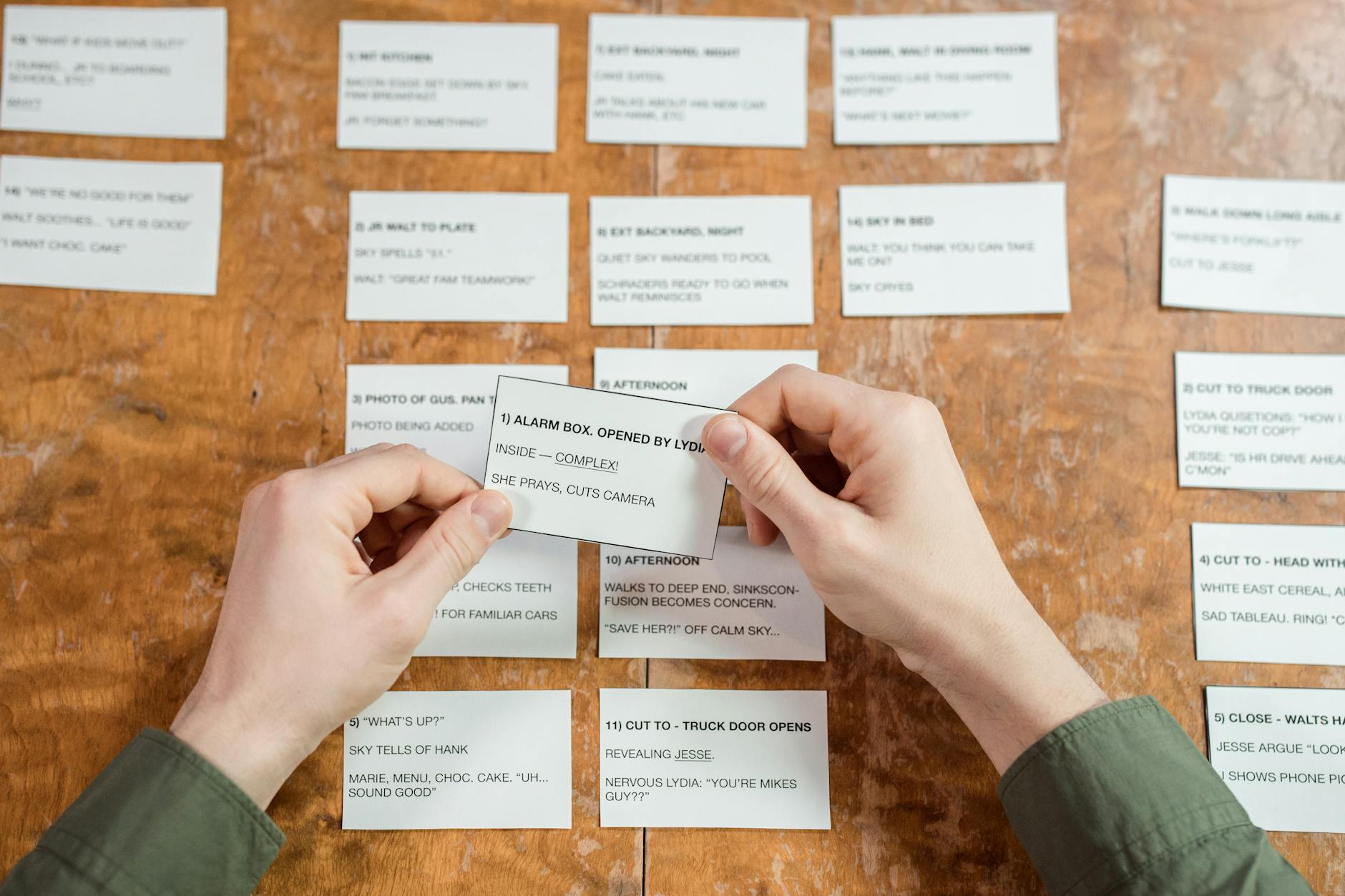
  • Storyboarding – Using index cards or post-it notes, or even sketches, jot down each scene as you think of them. One scene per card. Then rearrange them in the order that seems to make the most sense for your narrative. By looking at the cards, you can see whether the sequence of scenes makes logical sense and if there are any scenes that need to be added or changed. It provides a tool for planning your story before you begin writing it so you’re not wasting time on writing scenes that will only be cut later.  Learn more about story boarding at Gilliam Writers Group.

  • Tarot Cards – Tarot cards provide a range of meanings whether they appear upright or reversed. Cards representing the king, queen, prince and page can represent individual characters while the four main elements each have their own meaning: Swords for intellect, Cups for love and emotion, Wands for work and physical activities, and Discs for wealth and resources. Some writers, like Quinn Diacon-Furtado, turn to tarot cards when they feel stuck in their story and seek clarity about their characters, settings or plot.

    “As a writer, I’ve learned to use the tarot to explore my characters, intuit plot, and to reflect on my creative process,” she explains in a Writer’s Digest article.  “Unlike conventional writing guides, I’ve found that tarot cards offer a dynamic landscape of symbols and archetypes that help me work through the nuances of character development, the intricacies of plot dynamics, and the richness of world-building.”

  • Enneagram – The Enneagram is a geometric diagram with nine points, each representing a personality type. It shows the interconnectedness of the personalities. Writers have used the Enneagram to understand characters’ personalities, their strengths and weaknesses, and how they might relate to characters of other Enneagram personalities. Some personalities will get along better with other types while other combinations may become rife with conflict.  You can find out more about the Enneagram diagram here.

  • Timelining – This tool is especially helpful if you’re writing a story with multiple timelines. How do you keep those timelines straight so readers don’t get confused? Timelining can be as simple as a straight line across the page with each major plot point marked. Or it can be more complex as a spreadsheet with multiple timelines for multiple plots. Doing a timeline before writing helps writers organize their thoughts and ensure a logical progression of events as well as the character’s arc of development over time.

  • Zero drafting – Only recently did I learn about zero drafting, which falls somewhere between a basic outline and the first draft of a novel. It can sometimes be used as a brainstorming session. Writers use this method to work out key details of their story, using phrases, slap-dash prose, or bullet points without any consideration for word count, quality of writing or formatting.  Zero drafting allows writers to get to the spine of the story without expending time and energy on a first draft. It’s ideal for writers who are still working out the basic framework until they feel ready to start writing.

    Though I have never used this zero drafting myself, I can see how it can be useful, not just for creating your story framework, but also for drafting your synopsis.

No matter where you are in your project, these pre-writing methods can help you explore your stories before you begin to put pen to paper.

Neither a Plotter Nor a Pantser? Try Becoming a Puzzler

Photo by Ron Lach on Pexels.com

Writers usually fall into one of two categories: the plotter or the pantser.

Plotters prefer to plan out every aspect of their stories ahead of time, from the setting, character, theme, structure. They will plot out every scene from the opening paragraph to the final resolution. They have to know every detail in advance before starting to write. Plotting allows writers to view their story from all detailed angles. They know exactly what they want to write before writing it.

I’ve tried this plotting approach once before early in my fiction writing. It was the first story I attempted to write. I quickly gave up on it because I found it limiting. My plotting didn’t allow for new characters to show up, and I struggled to find the right place in the story for new scenes as I thought of them.

Still there are plenty of authors who have plotted their way to success. Fantasy author K.M. Weiland is a big proponent of outlining and story structure, and goes into a deep dive on these subjects on her blog. She’s also written several books about plotting if you want to learn more.

One disadvantage I see is the extra time it takes to get the details “just right.” It can take the wind out of your creative sails too. By the time you’re done plotting, you could lose interest in your story because you feel you’ve already written it in plotting form.

But not every writer works that way.

Then there are the pantsers . . .
I always believed I was a pantser, also known as a discovery writer, because I enjoyed discovering my story as I wrote. With only a vague sense of main characters and a few scene ideas, pantsers tend to begin writing if only to see where the story takes them, or whether there’s a story at all.

The advantage of writing by the “seat of your pants” is that it gives the imagination free rein. The story, without the limits of plotting, can go in a multitude of directions, and it can be fun to discover new characters and settings that you didn’t think of initially. Writers feel free to explore their story world without the limitations of a set of rules or structure.

The downside, however, is that by the end of the drafting phase, what writers have is a ton of material with no cohesiveness between scenes, characters or plot. That only makes the editing phase much harder because there’s so much material to dig through, and much of it will land on the cutting room floor anyway. As I quickly learned, pantsers usually have to do several rewrites to get the story to where you want it to be, which can be a drain on time and energy, not to mention patience.

What if you’re neither a pantser nor a plotter – or you’re a little of both?
While I’ve experimented with both of these approaches, I realized that I don’t fit neatly in either one. While I love exploring plots and characters organically, I also recognize that I need to plot my story to some extent so I know where it’s going. Otherwise, I’m only spinning my wheels, editing and rewriting sections until they feel right.

Enter Puzzling.

The Novel Smithy Lewis Jorstad explains that puzzling works by bringing elements of plotting and pantsing together.  For example, perhaps you have a brilliant story concept and can visualize several scenes in your mind, have a rough idea of characters and an inkling of how it will end. Using index cards or post-it notes, jot down each individual scene – one idea per card. You may not think of every scene right off the bat. You may only have three or four scenes to start. But that’s okay. What you are doing is creating a puzzle with various pieces that will eventually fit together. This is the discovery part.

Once you have a collection of scenes on index cards (or post-it notes), spread them all out on a table or tape to the wall so you can see them all at a glance. Then rearrange them in the order you think they should go. This is the plotting aspect.

Once the cards are in some story order, review them again. Note if there are any gaps in the sequence. Wherever there is a gap, insert a card indicating a scene to come.

The advantage to puzzling is that it allows you to generate scenes on the go. You don’t have to think of every scene before writing. You can write the scenes you do know, knowing the rest will come eventually. You don’t have to follow any structural rules.

Even while drafting, you may still come up with new scenes. When that happens, jot them down on a card and insert them where you think they might fit in the story. You can add or delete scenes and change the order of them as you go along. It gives you more control and flexibility than a straight plotting structure, which can be limiting to those who want to give their imagination free rein.

Another benefit is the ability to review your story at a glance scene-by-scene and make adjustments to the timeline. You can also identify which scenes are the key plot points of your novel.  I suspect this approach results in fewer rewrites.

Are there any downsides? So far, I haven’t found any, though I just started working with it for my current work in progress. In the short time I’ve been using this puzzler approach, I’ve learned a few things:

  1. It has helped me maintain my interest in the story. With previous approaches, I’ve invariably lost interest in my manuscript and given up on it, or got lost in the muddling middle.
  2. It allows me to assess my scene sequence and rearrange them as I see fit, without  having to rewrite anything.
  3. It helps me stay focused on one scene at a time. With one scene per card, I know what I’m writing next and I’m not left staring at a blank screen. The cards give me a clue and keep me on track.

    If you’ve tried plotting or pantsing, and they haven’t provided the results you want, give puzzling a try. You may find that being a puzzler makes you a more productive writer.  

Dictate Your Way to Publishing Success

Photo by PhotoMIX Company on Pexels.com

Writers are always looking for ways to work smarter and get more done in less time.

Enter dictation.

When I think of dictation, I think of the old-school way of recording correspondence back in the 1980s. Managers would dictate letters and other correspondence in a recorder with a tiny cassette, then their secretaries would play it back to transcribe them.

Fortunately, as technology evolved, so did dictation and transcription tools, making it easier for writers to draft larger projects, like full-length novels. Several well-known authors routinely used dictation to help them draft their novel, including Dan Brown, Henry James, Barbara Cartland, and Agatha Christie. TV executive Sidney Sheldon reportedly dictated novels for several hours in the morning and then had his secretary transcribe them later.

I must confess I have never used dictation to draft any of my own stories, but I know that option is available. You can’t overlook its value to authors. While writing 1200 words can take a couple of hours, with dictation, it takes roughly 30 minutes.

Sarah Elizabeth Sawyer of FictionCourses.com who writes Native American historical fiction, also teaches courses about dictation. Of her 19 published books, at least 10 have been created by dictation.

Sawyer cites several benefits:

* Improved health – With dictions, there’s less strain on the eyes, back and shoulder.
* Better time management – You can dictate while waiting for appointments or walking the dog.
* Improved speaking skills – With practice, you speak more confidently which helps prepare you for author readings.
* Experiment with character voices – You can test out character voices with accents and dialects, and inject personality into their voices.

Users have noted several blocks to getting started with dictation. Some said the practice just didn’t work for them or they felt their brain didn’t operate that way. Others cited the cost of dictation software, although there are plenty of free options available, or the software was difficult to use. Still others said they drew a blank when they pressed the record button.

There are other downsides, such as messy punctuation. That only means you have to be prepared to review and edit the drafted material more carefully afterwards. The software may not recognize unusual spellings and pronunciations of character and location names, especially those you might find in science fiction and fantasy novels. Like any new skills, there’s a learning curve before you’re able to do it well.

Still if you have the patience and determination to try to produce creative work in less time, dictation might be worth a try. But which software and apps work best? Do you need any special equipment?

Jason Hamilton at Kindlepreneur shared the best dictation tools, giving the pros and cons of each.

  • Dragon – By far, Dragon software performed the best though the cost may put off many potential users. The Professional Individual version cost $500 while the Home version is $200.  
  • Windows Speech Recognition – free option that comes with most Windows computers
  • Apple Dictation – a free option for Mac users
  • Google Docs Voice – a free option with the power of Google
  • Otter.ai – a free trial is available for new users. I’ve heard mixed reviews on whether this works for long form documents like novels. That said, I have used it for transcribing notes from interviews.

No matter where you are in your writing process or what kind of projects you work on, any tool that can help you produce more words in less time is worth checking out.

Story Starter Scenes Can Spark Creative Storytelling

Photo by Tairon Fernandez on Pexels.com

Ever have a scene idea strike you from out of the blue and get stuck in your head, but you’re not sure what to do with it? You’re sure that it’s a brilliant idea because you’ve never seen it in any book before. No matter how hard you try, the idea sits with you, often for days, weeks or even months. Yet you can’t seem to settle on a story around it. Nor does it fit any of your current works-in-progress.

What you’ve got is a story starter. Some say a story starter is a type of writing prompt, something to get your imagination “started.” In a recent post at Writer’s Digest, author Andrew Welsh-Huggins describes a story starter as a “lightning bolt of inspiration.”  

“The fun thing about a story starter scene is the freshness it brings to the creative process; so much more invigorating than staring at a blank page yearning for inspiration. The challenge is following up on that novelty,” Welsh-Huggins says.

I know what he’s talking about. I’ve had a story starter scene stuck in my mind since at least 2018. The scene features a woman who wakes on the morning of her birthday and sees the face of her deceased mother in the bathroom mirror.

I know there’s a story behind this scene somewhere, but for months I couldn’t figure out what it was. Since that image began haunting me (pun somewhat intended), I’ve played with different plot lines. The first novel I tried to write with that scene changed so much after several revisions that the scene no longer seemed appropriate. I set the scene aside, but never dismissed it.

Lesson learned: Never, ever dismiss a story starter idea. When a new plot idea inspired me last fall, I knew I had found the right place for my story starter scene.   

What Welsh-Huggins shared and what I’ve learned shows that these random scenes from out of the blue can serve as the impetus for creative story telling in ways you can’t imagine.

Here are a few of my tips for using these random story starter scenes especially when the right novel concept is nowhere in sight.  

* Keep a notebook of writing ideas. You should be doing this anyway for all of your novel and short story concepts. When you get that image of a particular scene and you can’t get it out of your head, write it down in that notebook. Write out the scene as you see it in your mind, describing every detail and nuance and emotion. Even if you do nothing more with the written scene at that moment, getting it down on paper will help you remember the details later when you need them. You can always refer back to your written scene later when you begin a new project to see if there’s a place for it.

* Review current works of your own or any manuscripts that are tucked away in a desk drawer to see if the story starter scene might work in any of them.

* Draft a short story around that story starter scene. Starting with a smaller writing project might spark other scenes or evolve into a larger, full-length novel.

* Brainstorm possible scenarios and actions that could be happening in your story starter scene. For example, let’s say you keep imagining a man sitting down to play the piano in an auditorium, but realizes suddenly that he cannot play. Create a bullet point list for each of the following details:

  • Who is the man? A musician? A piano tuner? A building custodian with a hidden talent?
  • Why is the man on the stage? Is he supposed to perform? Is he fixing the piano? Is he pretending to be a prolific musician?
  • Why can’t he play? Maybe he doesn’t know how. Perhaps he has amnesia or some other illness or has a physical ailment, like arthritis. Let your imagination fly.  

    The next time a story starter scene strikes you from out of the blue, don’t dismiss it. It can be the start of something fresh and unique.

Tips for Creating a Flexible Writing Routine

Photo by Kaboompics .com on Pexels.com

We’ve all heard that well-worn piece of advice to write every day.  This is certainly ideal if you’re starting a writing practice. It doesn’t take into account work schedules, domestic responsibilities and health.

The reality is, sometimes health issues like ADHD, autism, auto-immune disease, even cancer, can wreak havoc on our energy levels, which can affect our productivity. In those situations, it may not be possible to write every day, like the experts suggest. It might feel like you’ll never finish your manuscript.  That you will always have to choose between your personal life and your writing life.

Believe it or not, it doesn’t have to be that way. Yes, you can be a writer, and you don’t have to force yourself to write every single day to get there. The key is creating a routine that fits your needs and obligations. You create a process that is flexible so you don’t have to feel guilty if something comes up and you have to skip a day or two of writing.

During a writing summit recently, Amy James, author of A Five-Letter Word for Love, suggested that before starting a writing practice, writers should ask themselves a series of questions about their writing needs. This initial assessment can help you determine how you handle disruptions, noise, social media, and technology. This is especially critical if you have ADHD or other health issues that can interfere with your energy levels and productivity. Once you understand your preferences, you can create a process that is flexible and more in tuned to your personal needs.

Self-assessment questions:

1. When do you feel most productive and creative? Many writers I know love writing first thing in the morning. Others feel more productive in the evening before bedtime. Is there a time when creative inspiration strikes more easily than others?

2. Do you need the Internet shut off in order to write? Are you too tempted by the internet that it interferes with your ability to write? It may be helpful to turn off access to all online platforms while you write. Even better, try handwriting your story in long hand. I use that approach often for my fiction writing, and it helps me to stay focused on the project in front of me.

3. Do you need to avoid social media before you write?  Social media can be emotionally draining and can easily upset our creative process. It might be wise to avoid browsing your social media until after you’ve finished your writing.

4. Do you need to keep your phone in another room or turn it off? Our phones can be useful when we need them. But do you really need it when you write? If you feel it’s too much of a distraction—or worse, a temptation—try turning it off or leave it in another room with the door closed. Trust me, your messages will still be there when you finish you’re working on your creative project.

5. Do you prefer working in a quiet setting, or can you work with some noise or music in the background? Many writers I know need it completely quiet so they can hear themselves think. I’m amazed at the people who can sit and write in a coffee shop with so much activity and conversations nearby. How do they concentrate? I need quiet so I can hear the dialogue of my characters. If you’re having difficulty concentrating, try working in a quiet setting and see if that makes you feel calmer and gives you a clearer head.

6. Are you a discovery writer or do you need to know how the ending will be? Some writers can’t begin to write until they’ve plotted out every scene and chapter through to the end. Others can sketch the first few scenes before digging in to their story. Knowing what kind of writer you are can determine what kind of process you’ll need.  

7. Do you need a writing goal to get you motivated? It could be a word count of, say 500 words per session. It could be a time limit, like a half hour. It can also be an internal goal too, such as that moment when you simply run out of energy.

8. Do you need a break from writing? Perhaps it’s been difficult to return to a routine because you’re overworked already and need a break. Sometimes we stop being in love with our story because we’ve been working on it for too long. Stepping away from it for a few days or weeks can help restore your mental and physical energy and give you a fresh perspective. When you’re ready to get back to work, start slow. Start by rereading what you’ve written and do some light editing to restore your motivation.

9. Can you be patient with yourself during the writing process? And can you be patient with the process itself? Writing a novel or memoir is like running a marathon. It takes time to train yourself and get yourself in proper physical and mental shape. Then it takes time to run the race. Our growth as writers doesn’t happen overnight. If you can be patient with yourself, then you know you can count on yourself to be consistent with your writing practice, even if you’re not writing every day.  

10. Do you need to change your writing process depending on the type of story you’re writing? Only you can answer that since you know your story best. The beauty of having a flexible writing practice is that you’re not locked into it. You can change it as your needs change—and as your story changes.

Writing every day isn’t going to work for everyone. Creating a flexible routine can help you take advantage of those times when you have the most energy and focus, so you feel more productive.

Tax Prep Strategies for Writers

Photo by Mikhail Nilov on Pexels.com

No sooner have you put away the holiday decorations that it’s time to start thinking about taxes. It’s never fun, I know, to pull together all your important tax documents and receipts. Believe me, I’d much rather bury myself in my next writing project than deal with Uncle Sam. But with some sound advice and resources, tax prep can go smoothly.

In this post, I’ll cover several things writers and creatives should consider when planning for taxes, such as whether to hire a tax expert and how to keep your receipts organized.  

I’ve found in my 12 years of freelancing that the key to a seamless tax prep session is keeping good records and having a system for organizing your receipts. Trust me when I tell you that keeping good records will make your preparation easier and save you a lot of headaches later on. It’s surprising how many people don’t keep track of their income and expenses for their writing business.

Once I became a homeowner, I knew I needed help at tax time. So I didn’t hesitate to ask around for referrals from friends and colleagues. Working with a tax expert has been a godsend because they know the tax laws best and they provide guidance on how to reduce expenses and improve my tax deductions for the following year.

“A tax expert is not just for filing taxes. They also help you plan to reduce liabilities,” says Julia White, a Certified Financial Educator, Accountant and Tax Strategist, speaking to members of the American Society of Business Publication Editors as part of their Solopreneur educational webinar series.

White suggests hiring a tax expert when you have:
* Multiple income streams
* Significant business growth
*Complex deductions, such as a home office, vehicle usage, and retirement plans.

Conversely, you can try doing taxes yourself if you have a single income stream, a limited number of deductions and a simple tax situation. The more complex your situation becomes, the more likely you can benefit from getting professional tax advice.

No matter how you plan to do your taxes, White cautions against committing some of the common mistakes that people make. For example:

* Mistake 1: Not separating personal and business expenses. It’s helpful to track expenses on a spreadsheet, but make sure to keep the business expenses in their own categories. I also keep my business receipts in a file marked Tax Receipts, so I know where to find them at tax time.  

* Mistake 2: Ignoring quarterly tax payments. This is more important if your business is set up as a C corporation or an LLC. If you operate as a sole proprietor, like I do, you’ll likely pay taxes annually and file using Schedule C. Having a tax expert can help you with this.

* Mistake 3: Poor record-keeping for deductions. Any expenditure you make for your business should be recorded, either on a spreadsheet or some other platform like Quickbooks. At tax time, it will be easy to refer to that data when you need it.  

For example, after recording my business expenses on my monthly budget worksheet, I save the receipts in a file folder called Tax Receipts. At tax prep time, I sort through them to make sure I have everything I need for my accountant. While I may still have to track down additional receipts, mainly from online purchases, I know I have most of what I need at my fingertips.

Obviously, while there are common mistakes, there are ways to create healthy savings habits for success. In addition to regularly tracking income and expenses, White suggests obtaining professional advice early on and to be proactive rather than reactive when it comes to making financial and tax planning decisions.

White also offers these professional tax prep tips:

1. Keep a personal budget. This will help you know your spending habits and see where you can cut unnecessary expenses.

2. Invest in business bookkeeping software. This will help you track your income and expenses for the year and prepare for tax season.

3. White recommended software programs like Quickbooks, Wave, Monarch Money or even a simple Excel spreadsheet. With Excel, you can create your own spreadsheet with categories customized for your business, or download a pre-formatted form from Microsoft.

Planning for tax time is never fun. But with the right tools and strategies, and an organized mindset, tax prep can be a breeze.

Helpful Websites and Resources for Writers

Photo by Negative Space on Pexels.com

If you read my blog, you’re likely embarking on a writing journey, whether it’s toward publishing success or simply trying to finish your first draft. Wherever you are on your journey, there’s plenty of help and advice from writing and publishing professionals. We’re all here to learn from one another.

Over the years I’ve followed numerous writers and editors to understand how to navigate the publishing world. Even though I’ve learned a lot since my own journey began, I still turn to the experts for guidance whenever I feel stuck.

I’ve compiled a list of my favorite experts which I follow regularly on social media or subscribe to their newsletters. No doubt you’ve heard of most of them or even already follow them. If you haven’t, feel free to check them out to see what they offer. Every little bit of advice helps, and reminds us that in our solo writing journeys, we’re never completely alone.

Jane Friedman (www.janefriedman.com). Jane is a former editor at Writer’s Digest, so she is well connected in the publishing industry and has a good, strong handle on the latest trends and news. While she writes some of the posts on her blog, most posts are provided by regular contributors such as Tiffany Yates Martin and Allison K. Williams. Best of all, she hosts numerous online workshops at reasonable prices, some as low at $25.

Janice Hardy (www.janicehardy.com). Janice is another writer I follow regularly. She’s an award-winning author of teen fantasy books as well as the Grace Harper urban fantasy series for adults. She has also published several non-fiction books about writing, revising and plotting. Sign up for her newsletter, and you’ll get something in your inbox every day, from writing tips to guest posts. 

K.M. Weiland (https://www.helpingwritersbecomeauthors.com/). If you want a deep dive into plotting, story structure and character arcs, Weiland’s website and newsletter is the place to go. Her specialty is archetypal characters, which may be more detailed that you might need for your own writing projects, but they might be worth a look to see if her insights work for you.

C. Hope Clark (https://chopeclark.com/). Clark is a veteran mystery writer and speaker with a weekly newsletter that is chock full of helpful insights about the writing life. The newsletter also includes resources, such as writing contests, fellowships, freelance opportunities, and publishers. While I have not directly benefited from any of the listings, I do find her insights and support inspirational and uplifting for those times when I feel discouraged.

Kat Boogaard (https://katboogaard.com/). If you’re serious about starting a freelancing business, check out Kat Boggaard, a veteran freelancer who has earned six-figures most of her career. She is incredibly down-to-earth and practical about the business. In her  newsletter, (now distributed monthly) , she is very open about the ups and downs of a freelancing career as well as work-life balance issues while raising a family, which makes her relatable. Check out her website, where she offers numerous forms and checklists that she uses in her own business. Sign up for her newsletter or follow her on LinkedIn.

Brooke Adams Law (https://www.wearewritingbrave.com). Author and host of Writing Brave, Law occasionally hosts a free online summit focused on the emotional aspect of writing, working through fear and self-doubt. It’s a topic that’s rarely touched upon and one that most writers I know deal with frequently. If you’re looking to Write Brave, check out Law’s site.        

Writer Unboxed (https://writerunboxed.com/). This community of writers offers an array of perspectives about the writing business. I especially enjoy the insights of Kathryn Craft and Donald Maass, who are masters of storytelling. Check out the weekly Flog a Pro feature, which highlights the opening page of a current bestseller and asks readers if they would read the book based on the those opening paragraphs. (More often than not, it’s a resounding “no.”) If you’re serious about writing fiction, this is the place to go for valuable tips and motivation.

The Brevity Blog (https://brevity.wordpress.com/). So you say fiction isn’t your thing, but narrative non-fiction is? You should feel right at home at The Brevity Blog. Similar to Writer Unboxed, it’s a community of writers that specialize in writing memoir and narrative non-fiction. Many of the articles, submitted by members of their community, deal with the challenges and triumphs of the writing life. Even if you don’t write literary non-fiction, this site is worth checking out.  

Writer’s Digest (https://www.writersdigest.com/).  WD is the go-to resource for any kind of writing you care to pursue. While they offer numerous online classes and webinars, they can be a bit pricey, and if you sign up for their newsletter, you’ll get a lot of promotional ads for their products. Still, the magazine is top notch and their weekly Monday Motivation is well worth reading.

Reedsy (https://reedsy.com/)  You don’t have to use Reedsy’s online writing app to take advantage of its various publishing resources, such as a weekly writing prompt. Check out their YouTube channel for their backlist of webinars and online discussions about the publishing business. They also lead live write-in sessions, editing sessions and first-line critiques, so even as they assist other writers, you can learn too.   

Writing and Wellness (https://writingandwellness.com/). Writing isn’t just about getting published. Sometimes, it’s also part of a wellness plan, to deal with emotional and mental health. Activities like journaling, writing poetry or personal essays are outlets to deal with anger, grief or sadness. Writing can also help you deal with physical pain, backaches and burnout. Freelance writer and author Colleen Story hosts this site to help writers deal with these issues, and put fear and self-doubt in the rearview mirror.

Hope you find these sites helpful in your own writing journey.

Favorite Reads of 2024

Photo by Leah Kelley on Pexels.com

Before we get too far into 2025, I’d like to take one final look back at the year that was and the books I most enjoyed reading. Below were my favorite reads of 2024 as well as a list of honorable mentions.

Have you read any of the following books? What were your favorite reads from 2024?

The Snow Child by Eowyn Ivey (magic realism). Imagine leaving behind the world you know  and making your home in the isolated wilderness of Alaska in the 1920s to explore new opportunities and make a fresh start. Jack and Mabel don’t know what awaits them when they make the move across country. Childless, they struggle as homesteaders. After making a snow child from freshly fallen snow, they awake the following morning to find the snowman gone, but a young girl running around their property. Faina is the child they wish they had, except when the winter snows end and it gets warm, she disappears into the woods. I thought I would be bored by the lengthy descriptions of snow and ice in the Alaskan wilderness, but Ivey does a great job keeping reader interest as the story unfolds and we’re brought into Jack and Mabel’s life.

The Truth about Forever by Sarah Dessen (YA romance). I think I found a new favorite author in Sarah Dessen. While this book is written for young adults, I didn’t find it juvenile in any way. Written in first person POV, I was immediately drawn into Macy’s world and the way she experiences the changes in her life. Macy’s internal dialogue is especially poignant at times, revealing a maturity far behind her teenage years. All the characters were drawn with depth and thoughtfulness. They were fun and interesting, especially when they interacted with each other as a group. I’m looking forward to reading more of Dessen’s books.

The Flight Girls by Noelle Salazar (historical fiction). This story is about a group of women pilots who became involved in the war effort during World War II. Known as the Flight Girls, their role was to support the U.S. military by delivering supplies and personnel across the U.S. One of the most intense scenes was the day that Pearl Harbor was attacked as our primary character gets caught in the middle of a mid-air battle with the Japanese fighter plane. It’s a fascinating look at a little known conclave of brave women who risked their lives with very little reward and recognition.

The Diamond Eye by Kate Quinn (historical fiction). While Quinn is better known for her earlier work The Alice Network, I thought The Diamond Eye was a more compelling story based on the real life of Mila Pavlichenko, a bookish history student from Kyiv turned deadly sniper in World War II. It’s well-written and well researched, providing a fascinating character study into the life, love and military career of a single mother who became Lady Death. The extensive author’s note provides some additional backstory that gives an added layer to the story.

Handle with Care by Jodi Picoult (women’s fiction). I can always count on Picoult to write a story that challenges my heart and soul. This one is no different about a mother who goes to great lengths to protect her youngest daughter who is diagnosed with a rare condition called osteogenesis imperfecta, sometimes known as brittle bone disease, in which the girl’s bones break easily. I always appreciate how Picoult looks at the conflict from multiple perspectives so readers see the complexity of the story.

Carrie Soto Is Back by Taylor Jenkins Reid (upmarket fiction). I wasn’t a huge fan of Malibu Rising, an earlier work of Reid’s. But as a tennis fan, I was intrigued by this story. In an interview with Reid, she admitted that she knew nothing about tennis when she wrote this book about a self-absorbed fast-rising tennis star. But as a former amateur player, I think she did a fine job capturing the details of the game. Carrie Soto isn’t an easy character to like, but underneath her harsh, brittle exterior was a vulnerable human being who didn’t understand how to connect with others. That’s what makes this story so appealing to me. It’s a great character study.

The Sugar Queen by Sarah Addison-Allen (magic realism/YA)
I read Addison-Allen’s debut Garden Spells several years ago, and I was immediately captivated by her imagination and storytelling. The Sugar Queen is a charming tale about 27-year-old Josey who still lives at home with her mother and feels she’s destined to live a life of disappointment and limitation in her mother’s household. Josey compensates by hiding out in her closet to eat sweets and read paperback romances. Until she meets tough-talking Della Lee who takes over the closet and the secret stash of sweets. Della Lee acts as both nemesis and fairy godmother to guide Josey out of the closet and into the real world.

Almost Home by Joan Bauer (young adult). Like The Truth about Forever, this young adult story reveals an emotional depth far beyond the young protagonist’s years. In this story, after her grandfather dies and her gambling father takes off again, 12-year-old Sugar and her mother must abandon their home in Missouri. They make their way to Chicago to make a new life and make new friends. As she learns to navigate her new world, she still harbors hope that she and her mother will return to their home in Missouri.

The Secret Lives of Dresses, Erin McKean (literary fiction). This surprising read is a coming-of-age story about Dora who has a job she hates but sticks around because she’s in love with a man who barely notices her. When her grandmother has a stroke, Dora returns to the small town where she grew up and helps out in the family’s vintage clothing shop. There, she discovers notes written by her grandmother describing the legacy and history of some of the dresses. A fun and entertaining read with interesting characters.

Honorable Mentions:
Every Note Played, Lisa Genova
One Italian Summer, Rebecca Serle
Open House, Elizabeth Berg
The Library of Lost and Found, Phaedra Patrick 
Stealing Home, Sherryl Woods
The Beach at Painter’s Cove, Shelley Noble

5 Life Lessons Learned from 2024

Photo by Alissa Nabiullina on Pexels.com

Happy New Year!

With another year in the books, I like to look back on what I’ve accomplished over the previous 12 months—both in my personal life and in my writing. Like most people, I know there are some things I could have done better, like sticking to my writing practice when events disrupted my flow or spending less time on my phone playing games.

Fortunately, taking time to look back also gives me perspective so I can learn from those miscues and form a plan for the coming year. There are always lessons to be learned from each year. Here are five lessons I learned from 2024.

1. Stay flexible with your writing routine. While it’s important to set goals for your writing practice and establish a routine, recognize that those plans aren’t etched in stone. Allow some flexibility to your routine because you can be sure that life will throw you a curve ball or two, such as a work assignment that needs a rewrite, a sick pet that needs to be taken to the vet, or a weather emergency such as a tornado or flooding.

In my case, it was minor surgery to remove a suspicious mass (it was benign) and my cat’s illness which meant putting him down. I didn’t plan for either of these events, so I had to work through them to keep my practice going. I admit it was a struggle. There were days I didn’t write at all because my head and heart weren’t in the right space. I needed time to mourn and to heal. Once those phases ended, I knew I was ready to recommit to my writing practice.

So stay flexible and recognize when you need to change your writing routine. You can always come back to your writing when the crisis ends.  

2. Decluttering can cleanse the soul as well as your closet. Decluttering was one of my resolutions for 2024. But with my health and pet emergencies, I didn’t get to it until the fall. I managed to fill two large bins to donate to a non-profit group. But looking ahead, I know there’s more work to do in 2025.

The process of decluttering forced me to confront some things I didn’t realize I was holding onto, old dreams I once had. I had to decide whether to keep them or let them go. It’s an emotionally draining process, but a necessary one. It meant removing old memories and old dreams that no longer served me, but might have been holding me back from achieving new goals. Funny thing is, after this first round of decluttering, I was contacted by a potential new client about a writing assignment.  I’ve heard rearranging furniture can have the same effect. So if you’re feeling stuck or want to move forward in a new direction, try decluttering or moving furniture around. It might just help make space for something new to show up in your life.  

3. Practice self-care. No matter how many obligations you have, no matter how many assignments you’re working on, it’s important to practice self-care. It doesn’t require a lot of time either. Go for a short walk, soak in the bathtub, take a nap, exercise, read a book, meditate, or chat with a friend. Any short break away from the heaviness of everyday life and responsibilities can give you a fresh perspective and renewed energy. It will help you be more creative and productive too. So make time to practice self-care. Your writer self will thank you.

4. Be open to unexpected opportunities. Every now and then, the universe provides an unexpected surprise in the form of an opportunity. It could be a writing assignment from a potential new client or a chance to travel. When the sky opens up like that, it seems like fate is intervening. When it happens, I trust in the universe and say yes. You never know where that new opportunity may lead. And when it comes to my writing career, any stroke of luck is welcome.

5. Keep on writing, no matter what life throws at you. Life happens. People get sick, beloved pets die and friends move away—or show up suddenly in our lives. Through all the upheaval, it’s easy to dismiss our writing practice as non-essential, or worse, you’re too distraught to think or to write. On the other hand, writing can provide comfort and stability during those times when life seems uncertain. Even if you spend only ten minutes a day on your writing practice, every little bit takes you toward your writing goal while also helping you heal. So keep on writing, no matter what happens in your life.

What lessons have you learned from 2024? How will these lessons guide you into the New Year and motivate you to achieve your next writing goal?

How to Keep a Writing Routine During Your Holiday Travels

Photo by Kaboompics .com on Pexels.com

With the holidays come opportunities to travel. Whether traveling for business to other parts of the world or to a neighboring state in your own country to get together with family and friends, new and unexpected adventures await.

But when will you find time to write? Your travels can demand a lot of your time and attention. There are parties to attend, gifts to wrap and cookies to bake. You can get so caught up in exploring the city or enjoying holiday festivities that your regular writing practice might fall by the wayside. While you’re traveling, is it possible to still maintain a writing routine?

The answer, says seasoned travelers, is a resounding yes. But to make it work, it’s important to plan ahead and schedule writing time so you don’t get distracted.

Well-traveled writers at the Writers & Artists community provide practical tips to help you maintain your writing routine while on the road.

1. Set realistic goals. Review your agenda if you have one, then schedule writing time around your schedule. Set goals that are realistic for that schedule, whether it’s the amount of time spent writing or a specific word count. If you set a small goal each day, it’s easier to keep to your writing routine. 

2. Always take notes. Keep a small notebook handy in your purse or pocket. When inspiration strikes or you see something that sparks your imagination, write it down. If you don’t take time to jot it down, no matter how briefly, you’ll lose the image. By the end of your traveling, you could have an entire mini-notebook filled with ideas and images from your trip.

3. Take photos. Sometimes words aren’t enough to capture the feeling and visuals of a setting. Photography is a writer’s best friend. Bring along a camera or use your mobile phone to capture visual details that you can recall later.

4. Aim for consistency. Schedule time every day to write, even if it’s only for a few minutes. Writing a few sentences or paragraphs is better than not writing at all.

5. Take advantage of technology. Your mobile phone has numerous features to aid in your writing. Try the voice-to-text feature, for example, to dictate a scene that suddenly pops into your head. The Notes app is helpful to jot down lists or story ideas. Remember to carry a portable charger so you can keep your devices powered up.

6. Make the best use of downtime. Whether you’re at the airport waiting for a delayed flight or you’re riding on a tour bus, use that downtime to take notes, do research, or read up on the writing craft.

While these tips answer the question of how to fit in writing while traveling, you might wonder, “How can I best use my travels for my writing?”

Writer Saanvi Thapar at The Writing Cooperative (on Medium) shares her three-step approach:

Write what you see. Traveling can sometimes disrupt the flow of words and ideas prompting a form of writer’s block, Thapar writes. Go easy on yourself and focus on writing what you see. Many tourist spots offer opportunities to focus on the details of what’s in front of you, whether that’s a stunning sunset over the ocean or the gleam of ice and snow on a mountain. This exercise hones your description writing skills.

Write what people say. If you’re visiting a foreign country, go where the locals go. Grab a table at a café or public park, then listen in on people’s conversations. Note not only the expression in their voices, but listen to how they tell their stories. Immerse yourself in their culture, and write about their history, folklore, and traditions. By listening and learning about others’ stories, you learn to write about them with empathy and understanding, says Thapar.

Write what you feel. Writing is as much an emotional experience as it is a mental and creative exercise. When you travel and experience unique sights and experiences, it’s bound to affect us on some deeper level. Keep those memories alive by recording them in a journal or using the notes app on your phone. Don’t just write about what you see and hear, but explore how those events affected you.

Make the most of your travels by writing about them. With a regular routine, the right note-taking tools, and a desire to share your adventures with others, you can bring your travels to life for readers.