As the calendar turns to April, my thoughts often turn to the events of the season, such as long walks outdoors, seeing flowers bloom and watching baseball games. Spring is a time of renewal and cleaning the house, getting rid of things we no longer need. I always feel like I’m being reborn at this time of year, especially after the long, dark, cold winter we’ve had.
Spring is the perfect time to refresh your writing routine or recommit to it. That’s not always easy to do when you’re stuck staring at a blank screen or empty page. Sometimes working with writing prompts can jumpstart your writing routine or give you the inspiration to start fresh.
To help you, I’ve compiled a list of spring-themed writing prompts. They cover everything from rainy weekends, gardening and celebrating Easter. You never know when any of these prompts might spark an idea for a longer story or essay. Challenge yourself and have fun.
——————————————————————————————————————–
Easter/Passover
Write a story about a child visiting the Easter Bunny at the local mall.
Someone receives an Easter basket filled with goodies plus one surprising and unusual element.
Write a story about someone choking on a jelly bean.
Write a scene or story about someone shopping for a new Easter outfit.
A young couple discovers a lone Easter egg, and they find a cryptic message inside.
A family comes together for Easter or Passover celebration. Over dinner, someone reveals a secret they’ve been keeping for years.
Write about someone who gets stuck in an Easter bunny costume.
Gardening
A new hybrid tulip has been introduced at the annual tulip festival. What is it? Why is it special?
You discover a package of seeds. When you plant them, something unusual and magical sprouts from them.
Describe the first spring flower you notice while out for a stroll in the park.
Imagine a snowflake and flower meeting for the first time, but neither knows what the other is. Write a dialogue between the two.
Write a story set during the annual cherry blossom festival.
Write about someone struggling to keep a houseplant alive.
Write about a small town or community as it prepares for celebrating Earth Day.
Miscellaneous
Someone experiences spring fever in strange ways.
Write about a springtime wedding in which either the bride or groom realize they’re making a mistake.
Write a story set during a spring music festival.
Imagine attending a class reunion. Someone there recognizes you right away, but you can’t remember who they are.
Write a story about a group of teens preparing for their first spring dance.
Write a story set in a treehouse.
Write a meet-cute in which two people fall in love over a spring weekend.
Write a story featuring three sisters named April, May and June.
Write about someone rushing to get their taxes done on time.
While cleaning out closets, someone uncovers an item that they haven’t seen or worn in years. What memories does it bring back? What do they do with the item?
On a weekend getaway, someone gets lost on the road or has a flat tire. What do they do next?
Describe someone attending their first baseball game. What do they experience? How do they respond to it?
Write about someone who is auditioning to be the mascot of the local baseball team.
Spring is a time of fresh starts. Write about what plans you want to make for this spring.
The following is an edited post from six years ago, but the ideas are just as pertinent today as it was then.
One of the most common complaints I hear from writers for not writing is the lack of time in their schedules. That’s understandable with all the responsibilities we’re juggling these days, whether it’s work (or looking for work), household chores, taking care of kids or parents, and maintaining an active social life. Yet writing every day is helpful to create a consistent practice.
Fortunately, you don’t need hours of time to write. Try 15 minutes. Where can you find those pockets of time to sneak in writing? If you can find 15 minutes in your schedule, whether that’s part of your lunch break or waking up earlier or eliminating social scrolling time, you can accomplish more than you think. Sometimes 15 minutes is all you need to make progress towards your writing goals.
Stop worrying about finding more time to write. Even if you did have more time, would you use it for writing? Or would you find other ways to use it, like housework, sleeping or catching up on the latest streaming shows?
Because here’s the honest truth: It’s not about finding more time to write. It’s about having a system that allows you to make better use of the time you do have.
Start with a simple goal. What do you want to accomplish? What do you want to write about? Are you experimenting with flash fiction? Or are you trying your hand at poetry? There are plenty of ways to use your writing time. If all you have is 15 minutes, here’s how you can use that time:
1. Freewrite. Set a timer, then put your pen to paper and begin writing. Let the ideas flow from your brain to the page. Aim to write 100 words every session – at a minimum. Do not stop to edit or rethink what you just wrote. Just keep writing. You may be surprised at the ideas that you see on the page afterward. If you do this consistently, over 10 sessions (aiming for those 100 words), you should be able to complete a 1,000-word essay.
2. Draft a dialogue. Create a scene in which two characters have a conversation. Start with one character asking the other character a question. See where that dialogue takes your characters. Avoid writing back story or other narrative. Focus only on the dialogue.
3. Describe an object. Choose an object on your desk or somewhere close to you. Then write about it using descriptive details, such as color, shape and texture. Use the item in a short story or essay. How was the item acquired? By whom? What is the story behind that item?
4. Write an animal story. Draft a story featuring your pet and give it a voice. Write a few paragraphs as if the pet is speaking to you. What would the animal say? Would he lavish you with praise, or whine and complain that you don’t pay enough attention to them, or give enough treats?
5. Brainstorm potential story ideas. Create a bullet list of stories you’d like to write. It might help to use prompts like “I remember” or “What if?” to jump start the ideas. At the top of the page, write the prompt, then fill in the blank. For example, I remember…my first day at school, learning to ride a bike, getting my first story published. Then from the list, choose one that resonates most and begin writing about it.
6. Write a book review. Recall the last book you read and write a review about it. Alternately, write a review about a movie you watched. What did you like or did not like about it?
7. Write the final chapter. Review your current work in progress and draft the ending. Sometimes by writing the ending first, you have a clearer idea of how to start your novel.
8. Write about a vacation you took. Browse through vacation photos, old or recent. Describe the place as you remember it. Add as much detail as you can recall.
9. Create a character sketch. Think about your protagonist, antagonist or other major character. Describe their appearance, then write as much detail as you can about their personality. What do they want? What does it mean to them? What is the character’s back story?
10. Write about a dream. Recall a dream you had recently. Then write the dream as a scene in a book or movie. Be sure to include as many details as you can remember.
11. Write a letter. Is there a friend or loved one you haven’t seen in a long time? Draft a letter to someone you care about. You don’t have to mail it, just focus on expressing your heartfelt emotions. Alternately, write a letter to a historical figure you admire and wish you could meet. What would you say to them?
12. Play writing games. For example, choose three words at random from the dictionary (close your eyes, open to a random page and let your finger stop on a word) and write a story using those three words. The story can easily be two to three paragraphs.
13. Rewrite the ending of a book or movie. Think of a book or movie in which you did not like the way it ended. Rewrite the ending. Remember you only have 15 minutes, but you can jot down the key ideas.
14. Write a story about the sounds you hear. What do you hear? Describe the sounds and the images that come to mind when you hear them. Are there birds chirping? Is there a plane flying overhead? Is someone playing their stereo loudly? You can do this same exercise with other senses as well, such as touch, taste and smell.
15. Write about a piece of music. Listen to a song you love (or alternately, one you dislike). Try an instrumental piece with no lyrics. Close your ideas as you listen to it. What images come to mind? Does it bring back any memories? Then write about the music. Does it inspire a story?
No matter how busy you may be, I believe you can always find time to write, even if it’s only 15 minutes. Your writing practice shouldn’t suffer because your time is limited. As long as you have the desire to write, you can make space in your schedule for it.
If you like this post, please feel free to share it with your friends. Don’t forget to check out the latest writing prompt: Write a scene or short story about someone getting lost while hiking in the woods.
I recently came across several discussion threads on Reddit where participants shared the worst and best writing advice they’ve received.
In most cases, they felt the advice didn’t quite fit their skill level or genre. Others felt the advice was unrealistic. “How am I supposed to write every day when I have a full-time job, a family and other obligations?” was a common concern. In a few instances the advice was deemed inappropriate and downright wrong, like the former college professor who advised students to include more violence in dark fantasies because “that’s what readers expect.”
One thing to keep in mind: advice is just that–advice. Not rules which can feel more permanent and harder to shake (yet in the discussion threads the two terms were used interchangeably.) Advice is meant to be helpful; they’re recommendations or guidelines for improving our craft. We don’t have to accept any writing advice if it doesn’t work for us.
All the same, some words of advice can be confusing. So for the purpose of this post, I’ll try to clarify a few of the most common ones.
Advice #1: Write every day. It’s understandable that writing every day is unrealistic due to work schedules, school, family obligations, etc. This advice is usually given to new writers to encourage them to establish a consistent routine of writing every day. Even 15 minutes can make a difference. When you make time to write every day, you create momentum, you establish a consistent practice, and your craft improves exponentially. While many writers wish they had more time in their schedules for writing, the reality is, “more hours to write doesn’t guarantee they’ll be productive ones,” writes author Polly Campbell in the current issue of Writer’s Digest. “Writers who finish books and publish regularly aren’t the ones with more time to write–they’re the ones with a system that helps them write during the time they have.”
So sit down with your schedule, find pockets of time, even if it’s only 15 minutes. Then develop a system for writing every day.
Advice #2: Write what you know. Writing requires two types of knowledge: personal experience and external supplemental knowledge. The “write what you know” part refers to personal experience, events that you’ve lived through that you can tap into while writing your story.
External knowledge represents the things you don’t know or perhaps isn’t commonly known. If you’re writing a crime novel, for example, you might need to understand how a police detective solves a crime. If your character works in a library or hair salon and you don’t know anything about either profession, it’s helpful to your story to find out about those professions.
So, yes, it’s important to write what you know, but there will be times when you need to find out what you don’t know.
Advice #3: Join a critique group. Some writers swear by getting involved in critique groups and have successfully honed their craft from their feedback. Others have gotten so bogged down by feedback that they never seem to progress toward the end of their piece. Critique groups can slow a writer down because the writer feels compelled to implement every piece of advice – whether that advice is suitable or not. Only you know if a critique group is right for you. If the group option doesn’t appeal to you, try working with a single critique partner or two. The important element is trust. No matter if you join a group or work with a single partner, you benefit from having your work seen by people you know and trust.
Advice #4: You need a detailed outline before you start writing. The thought of using a detailed outline fills pantsers like myself with dread. A detailed outline is not for everyone and, in fact, can be limiting to the creative process. On the other hand, working with no outline can be problematic too because you may end up producing extraneous material that needs to be cut later. Most writers, I believe, fall somewhere in between. They might do a rough outline up front that is flexible enough to allow for new characters and plot points to show up during the initial draft. Or they will draft first, then create their outline afterwards before revising. Either way, it’s important to have some semblance of outlining to understand the structure of your story.
Advice 5: Don’t include a prologue. In my opinion, most novels don’t require a prologue. They tend to be dumping grounds for backstory and setting that’s not necessarily important or interesting. However, there are some situations and genres in which prologues can be helpful, or even expected. Many thrillers, mysteries and science fiction stories, for example, include prologues, usually written from a different character’s perspective or focused on an earlier time period. For most other fiction, prologues aren’t necessary and may only drag the story down.
Advice #6: Write only when you’re inspired. Any writer will tell you that waiting for inspiration to strike before writing is a terrible waste of time because you’ll likely be waiting a long time. You have to prime the pump, so to speak. The best writers start writing even when they don’t feel like it or have anything meaningful to write about. There have been plenty of times when I didn’t feel inspired to write or my heart wasn’t in it. When I forced myself to sit and write, the words might come out wrong – at first – but eventually, the faucet turned on and the words started flowing. You almost have to show the universe that you are serious about writing before the creative muses show up for you. So even if you don’t feel inspired, start writing anyway.
Advice #7: Leave all editing until the end of the first draft. I’m inclined to agree with this advice. I prefer to finish the first draft before editing, and usually only after I’ve let the manuscript cool off for a few months. Then when I’m ready to review it, I’m able to see it with fresh eyes. Like everything else, there are exceptions. Some writers can’t progress through their first draft until they’ve edited the sections they wrote the previous day. One writer I know drafts the first five chapters, then goes back and edits them before continuing with the drafting process. As with anything else, you need to experiment to see which process works best for you.
Hope these insights help clear up any confusion about writing advice. As writers, we’re all trying to figure out this writing craft together. Take whatever advice you hear with a grain of salt, then find what works best for you.
This weeks writing prompt: Imagine yourself hiking in the woods, either by yourself or with a friend or two. It’s getting dark out and it’s beginning to snow/rain. You realize you are lost. How do you find your way out of the woods?
No matter how long you’ve been working at this thing called writing, you’re bound to experience writer’s block. You know, that horrible state of limbo you feel when your mind draws a blank staring at the screen because you can’t think of a single thing to write?
Writing blocks come in all shapes and sizes. In fact, the writing experts at ProWriting Aid (PWA) have identified nine different blocks that can delay, if not entirely derail, your writing progress.
Knowing what your blocks are can shed light on behavioral and thought patterns that interfere with your enjoyment of the creative process. Learning what they are is easier than you might think, thanks to a new self-assessment tool created by ProWriting Aid.
The self-assessment tool is a series of questions that ask how you would react in different scenarios. I found it easy to use and it took about seven minutes to complete. As I answered the questions, I could sense which issues affected me the most. Afterward, PWA sent me a link to my results, which were ranked in order of the highest impact to the lowest.
In reviewing my results, I was relieved to know that I had no blocks in the High range, so I didn’t have a block that truly paralyzed me. However, five other blocks fell in the Medium range, which means I have work to do to improve my relationship with my writing and be more productive. I was also surprised that what I thought was my biggest block (Perfectionism) wasn’t, but there were several others that ranked higher (Idea Chasing, Procrastination and Overthinking).
Below are the nine common blocks that were identified (in alphabetical order):
* The Idea Chasing Block – This block proved to be my biggest challenge. It occurs whenever shiny, new ideas show up to tempt you to follow their development rather than finish your current work-in-progress. The new ideas may be more fun and interesting to work with at the start, but die out when you lose interest. The result is usually a lot of unfinished manuscripts.
* The Logician Block – This block causes your analytical mind to overshadow your intuitive, emotional side. It shows up most when you’re focused on structure and technique. But when you need to brainstorm creative ideas or you’re drafting scenes and characters, the Logician can stymie creativity.
* The Overthinking Block – Similar to the Logician, this block is characterized by constant loops of analysis where you revisit the same ideas over and over to the point you can’t move forward on your manuscript. You tend to rewrite scenes multiple times and second-guess plotting decisions. (Guilty!) You get stuck because you keep thinking a better option is out there and you’re afraid of making a wrong move.
* The People Pleasing Block – Thankfully this was at the bottom of my results. With this block, your writing efforts are overshadowed by your desire to please other people. You tend to put more time and energy into helping others with their writing rather than focusing on your own progress. This is about losing your creative vision while catering to the demands and needs of others.
* The Perfectionism Block – This block is driven by a fear of being imperfect and it prevents you from taking creative risks. You never finish your manuscript because you obsess over every word and plotting detail, and you worry that any imperfection means your writing isn’t done yet. You can tell you’re in this block when you’re constantly fixing and tweaking the story.
* The Procrastination Block – Procrastination causes you to delay writing, especially the most difficult parts of your story. Rather than tackle those parts, you find other tasks to distract you, or you wait for inspiration to strike. This isn’t laziness, but sidestepping discomfort and uncertainty, such as revising the messy first draft or writing complex scenes.
However, getting involved in other tasks isn’t necessarily procrastination or avoidance if you use that time to think through a plot problem. Whenever a writer friend of mine feels stuck, she goes for a walk. Usually by the time she returns to her desk, she’s found a solution to her plotting problem.
In my experience, procrastination seems more a symptom of being blocked rather than a block in and of itself. Perhaps that category should be renamed as Distraction or Avoidance Block.
* The Rebellion Block – This block occurs when you’re driven to defy expectations to the point that your creativity is squashed. You tend to get stuck because you insist on doing things your way rather than follow established structures or formulas. You seek creative freedom at all costs. While there’s nothing wrong with setting yourself apart from other writers and finding your own voice, the Rebellion Block stymies your efforts to grow as a writer.
* The Validation Block – In this block, you’re focused on external rewards and the trappings of success. Think positive reviews, seeing your name in print and receiving accolades. The drive for external validation can overshadow your love for writing. Because you’re focused on success metrics, not the creative process, your progress can be stymied.
* The Victim Block – This block causes you to feel perpetually misunderstood. A single rejection or bad review can linger in your psyche for months, making you feel hopeless and despondent. You’re convinced that others can’t see your creative talent or appreciate your vision. So you learn not to share your work with others or you give up on writing altogether.
I can see how blocks show up at different points in the creative process. For example, the Logician is more likely to show up in the revision phase when you need to focus on structure and technique. Meanwhile, Idea Chasing may be more ideal at the initial drafting or brainstorming phase. Blocks are a problem when they appear at inappropriate times during your creative process.
Which issue blocks you from achieving your creative dream? Give the assessment a try. Find out for yourself which writing block stands in the way of your success.
Many writers I know are more comfortable working behind the scenes on their novels than being in the spotlight. Which means they’re not usually comfortable blowing their own horn. Promoting their own work doesn’t “feel right,” they say. “I don’t want to come across as arrogant or narcissistic,” they might say, or “I don’t want to embarrass myself in front of people.” Neither could be further from the truth.
Self-promotion is neither arrogant nor narcissistic, and no, you won’t embarrass yourself, not if you plan how to promote your writing to the right audience. The truth is, If you want people to know who you are and what your book is about, you have to put yourself out there.
Self-promotion is about gaining visibility for yourself as a published author and for your work. These days, it doesn’t matter if you are self-published or traditionally published, writers are expected to carry some of the marketing workload.
Children’s author Linda Kay Hardie at the Writers and Publishers Network suggests not thinking of this process as self-promotion. “Reframe it as getting acquainted with other writers and meeting your readers,” she explains.
You’re not cold calling or going door to door to strangers’ homes, adds Hardie. You’re talking to people you already know about something that you’re passionate about–books and writing.
General tips for self-promotion
Browse the internet and you’ll come across numerous articles about self-promotion tips for writers. Here are a few that are valuable for any writer no matter where they are on their writing journey.
1. Make sure to create a good product. Take the time to produce something that people will want to buy and read. Keep in mind that just because you love your work doesn’t mean it’s quite ready to spring out into the world. Have a professional look over it to make sure that it’s not just technically clean but that the content is meaningful and relevant.
2. Start promoting your product Before the book is published, not just after publication. That means telling people about what you’re working on even while you’re still working on it. Talk it up. Tell people what the book is about and why you decided to write it. Use social media to share snippets from the book so readers get a taste of what to expect. Or offer a discount on pre-sale orders. Then once the book is finally released, readers will (hopefully) be excited to buy. If you wait to promote your book until after it’s released, you’ve lost time and opportunity for initial sales.
3. Know your genre. Different genres require different approaches to self-promotion, says literary agent Carrie Pestritto on the Manuscript Wish List blog. For example, non-fiction writers will more likely need a strong online platform that promotes their expertise, such as a blog, website, or podcast. Meanwhile authors of middle-grade children’s books will likely do better with in-person events at libraries and schools.
4. Know your target audience. Who are your likely readers? Demographics can play a role in the type of self-promotion you use. Young adults in their 20s and 30s are likely to be found on X and Tik Tok (and Booktok), while older readers are more likely on Facebook, LinkedIn and Instagram as well as in-person events. Find out where your target readers go to learn about new writers. It’s important to meet your readers wherever they are.
5. Start within your local community. While it’s important to raise your online profile, in-person appearances are just as important. Children’s author Linda Kay Hardie suggests checking out libraries, universities and book clubs, which are usually eager to work with individuals to provide educational talks and performances as part of their programming. Also check out local bookstores, street fairs and book festivals where you can volunteer to do book signings or readings.
6. Become a good literary citizen. Help other writers promote their books. Share their book info via your social media channels or write a review. If you blog about your own writing journey, remember to talk about the other writers you’ve met along the way. If and when the time comes for you to publish your book, they may do the same for you.
7. Bring extra copies of your book wherever you go. This piece of advice is the most surprising, yet most common sense thing you can do to promote yourself. When you’re invited to a party or some other social event, either bring a backpack with a small supply or keep a few copies in your car. You never know when you might meet someone who expresses interest in your book and wants to buy it. Then you can sell it to them right there on the spot.
8. Consider offering a freebie. If you’ve produced a short e-book, consider offering it for free for a short time, say a week. The freebie introduces people to you and your writing, and can generate enthusiasm for larger works that you have in your portfolio.
If all this makes you feel overwhelmed, don’t fret. Choose the ideas that best suit your audience and your personality. It might help to develop a strategy for promoting yourself. Remember, quality of communication is more important than quantity.
Most importantly, don’t be pushy. No one likes an aggressive salesperson. Avoid hitting people over the head with your new product. Take a kinder, gentler approach, such as bringing it up naturally in conversation. Be yourself.
Hope these tips help you think about how to promote yourself as a writer. Remember that it’s all about being visible in your community and in your profession. You’ve put in the work to create a book close to your heart, so don’t be shy about telling people about it.
A professional colleague once told me, “Success comes before work only in the dictionary.” I remember her words today many years later because I’ve been thinking a lot lately about what it means to be successful as a writer. The truth is, you have to work at being a writer. Success doesn’t happen overnight.
Even before we put any words on the page or think about our next story, we should think about what success means. To truly enjoy success in this odd creative profession we call writing, it helps to picture what success looks like. That picture won’t be the same for everyone. For one person, success might be getting their novel published after slaving over it for five years. For another, it’s finishing a first draft of their first novel. For yet another person, it might be sitting down to write 500 words every day.
When you’re just starting out as a writer, it might be difficult to imagine the big picture of your writing life because you’re more focused on getting words down on the page for your current project, or simply finishing your story. Few writers have any clear idea what their writing careers will look like down the road. They only know that they want to write something that people will want to read and enjoy.
There are two good reasons why picturing success is an important first step in your writing career. It helps you to:
*Imagine a positive income for your efforts *Work toward a concrete goal
Picturing success isn’t always easy, at least not when you’re starting out as a writer. There are several steps to create that picture that will drive your creative efforts.
Step 1: Define Success Before you picture success, take time to define what it means for you. What does it look like? What does it feel like in your body? Write down that definition and meditate on it. Your definition won’t be the same as someone else’s, so don’t be shy about defining it in unique ways.
Step 2: Think Ahead Imagine what your writing life looks like one year from now or longer. Sometimes picturing your life in the future can help you set intermediate goals that will act as stepping stones toward that long-term goal. In the corporate world, they use a similar method called a Blueprint for Success. Apply it to your own writing career and see where it takes you.
Another trick is to use visualization exercises to help you “see” your success as if you’ve already achieved it. Close your eyes and visualize yourself receiving that writing award, reading a positive book review, or seeing your name as a byline. As you visualize your success, note how it feels in your body. That is the mindset you want to re-create as you move forward.
Step 3: Find a medium that best fits your picture. Once you’ve defined success on your terms, consider different ways to picture success. Some creatives might prefer drawings or photographs while others use words. Whichever medium you choose, make it something that is meaningful and helps you see the possibilities for your career success as a writer. Here are a few ideas to get started:
* Meditation. Take time out of your day to meditate for a few minutes. Meditation can slow your brain which can help clarify the picture of your writing life. The mind can get fuzzy at times trying to juggle so many thoughts and tasks. So a brief meditation about success can bring your writer self into sharper focus.
* Journaling – Write about your writing dreams. Jot down ideas on how to achieve them. This might be a good place to jot down your definition of success, what it looks like and feels like to you. Journaling can help you sort out any feelings of self-doubt or confusion or fear that you might have related to your writing career.
* Create a vision board or a collage. Compile photos from your own collection or cut them from magazines to create a collage representing your writing career. Choose the images that best tell the story of your writing life, the goals you want to achieve or what you want your writing life to look like.
* Sketch your vision of success. If you enjoy drawing, sketch pictures that demonstrate your picture of success the way you defined it. The act of drawing or sketching can reinforce your writing goals so you feel more connected to them.
* Repeat affirmations. Create several affirmations to reflect what you want to achieve in your writing life. Then once a day, repeat those affirmations several times. The act of repetition, just like the drawings, can reinforce your picture of success so you don’t lose sight of it.
* Write a note to your future self. With a pen and paper, describe the writing life you’d like to achieve a year from that moment. Remind yourself what your goals are and what obstacles you must overcome to achieve them. Most importantly, be kind to yourself. Then fold up the note and bury it somewhere out of sight. Make a note to retrieve it in one year to review and reassess your progress.
* Write a manifesto. A manifesto is a declaration of intentions. To picture her own success as a writer, Octavia Butler created a manifesto that helped her stay focused on her writing goals. Whether or not you aim as high as Butler, your manifesto can guide your efforts as a writer. Much like affirmations, a manifesto can reinforce your picture of success.
* Create a symbol of success. Think of a symbol or icon to represent what success means to you. It could be a star, a book, a smiley face, a rolled up scroll, a heart. Make sure the icon has meaning for you and relates to your vision of success. Then put the symbol somewhere where you can see it every day, whether it’s by your desk, a refrigerator, a mirror. Seeing the symbol everyday can serve as a reminder of what you want to achieve in your writing life.
Step 4: Revisit and Revise No matter which medium you choose, it’s important to revisit your picture every so often, usually six months or a year. Have your goals changed? Has your definition of success changed? Have you set new goals for yourself? If your picture of success hasn’t changed, keep working. If it has, rewrite your goal, resketch that picture of success, then get back to work.
Keep your picture of success close so you never lose sight of what you want to accomplish.
It’s often said that to be a successful writer, it’s important to connect with readers. That’s true, whether you’re writing nonfiction, memoir or fiction. Connecting with readers through social media and marketing newsletters is one thing, but connecting with them through story telling requires a different mindset and skills set.
Think of this connection another way, more like a partnership or collaboration. Each party brings certain skills and experiences to the table. That collaborative experience occurs during the actual reading of the book when the reader is consuming the author’s words. The two partners create the story together: readers with their imagination, and writers with their pen.
You can’t have the story without the reader in mind. Readers are always looking for good stories to consume. They want to love the stories you write, and they can’t wait to be your partner.
Think about your own reading experience. Which authors resonated with you? Which ones drew you into their stories, made you follow along on the protagonist’s journey, to feel their pain and joy? That is the value of the writer-reader connection. That is what it looks like and feels like, and that is what we, as writers, should strive to achieve.
In this collaborative relationship, writers contribute the following:
* Creativity and imagination, a spark of an idea for the story in the first place. * Sweat equity and perseverance to get the story done * Their heart to provide the emotional depth * Life experience to tap into to make the story relatable for their readers
Readers provide the following:
* Time away from their daily tasks to immerse themselves in the author’s work * A desire to be educated or entertained or to simply escape into a different world. * Life experience that contributes, and sometimes enhances, their understanding of the stories they’re reading.
Fantasy author K.M. Weiland describes this partnership this way:
“Our job is to guide the readers’ imagination, but it’s their job to put their imagination to work in the first place. The story that their minds project will never be exactly the one we, not to mention their fellow readers, see.”
As writers, how do you connect with readers? There are four steps to achieve this.
1. Understand readers’ expectations of your genre. Each genre has certain required elements and story structure. Without them, most stories fail to appeal to readers. For example, in contemporary rom-coms, readers expect a light-hearted tone, playful banter between the love interests and a happy ending. Without those elements, you can’t truly call it a romance and readers will be disappointed. To connect with readers, make sure you live up to their expectations and give them what they want.
2. Create relatable characters. Or more specifically, a protagonist they can believe in and relate to, one they are willing to follow on their journey. Give characters a flaw or two, make them face problems on the way to achieving their goals, and give them talents that will help them overcome those obstacles. Make readers care about your characters.
Book coach Karyn Fischer suggests giving your protagonist a quirk or unique personality feature to make them stand out, such as an odd-looking tattoo that has a personal meaning to them or an ability to do magic tricks. Those features or talents make them memorable.
3. Create emotional tension. Stories laden with emotion can leave a lasting impression on readers. That emotion can be created with conflict, opposing goals, secrets, danger, high stakes, even romantic tension. For example, the depth of emotion in The Nightingale by Kristin Hannah is what makes that novel so memorable and why many readers name it as one of their favorites.
4. Consider readers’ life experience. As part of the collaboration between writers and readers, life experience plays a big role. Writers tap into their own life experience to create their stories, but so do readers, who use their life experience to acknowledge the experiences of the characters. Writers may not know what their readers have gone through in their personal lives, but they can create stories with common themes that most people have experienced, such as grief and loss, career achievement, friendship, self-doubt, community and hopefulness. It is this shared experience that can create the best connections with readers.
Writing might be a solo endeavor, but readers are also part of the journey. When you think of story telling as a shared experience between writer and reader, you won’t feel so alone when you write your next story.
As much as I loved the holidays, I’m glad they’re over because I’m ready to get back to the business of writing. I haven’t looked at my current work-in-progress or completed any meaningful projects since October, and I have felt disinterested in any form of writing.
Now that 2026 is here, I’m ready for a fresh start but at the same time, I dread tackling the massive revision I’ve been putting off the past few months. Since then, I have felt disconnected with my writer self. Between the holidays, illness and a sore foot, I’ve had little interest in writing, not even a short story or essay. My only consolation is that several other writers I know have expressed similar experiences.
What does that disconnection look like? For me, it was staring at blank pages and having a calendar with no interviews scheduled. It also was a series of avoidance tactics and excuses for not writing. Anything to get out of my commitment to write or work on my novel. Everything felt like an effort. Disconnection affected my physical body too, such as brain fog and a general emptiness inside.
The good news is that there are numerous ways to climb out of this lull in writing activity and reconnect with your writer self. All it really takes is 15 minutes a day and a little ingenuity. Below are some of the tactics I’ve used to reconnect with my writing and jump back into a creative mindset.
1. Start your day with a warm-up writing exercise or brainstorming session. On a blank sheet of paper and pen (or your computer screen if you prefer) jot down whatever topics come to mind. It could be a bullet list of story ideas, a description of something you see out your window, or a description of the last thing you ate. You could write about your pet, your best friend, your spouse or your boss. Maybe write a quickie review of the last movie you watched or the last book you read. You don’t even have to keep what you write. The point of the exercise is to simply put words down on the page, so your creative juices start flowing again.
2. Write in your journal. If you already write in a journal, congratulations. If not, a journal can serve as a useful starting point to get back into a writing routine. While the exercise above is more about taking stock of your surroundings, the journal is meant to help you explore your internal landscape–your thoughts and feelings. Again, start writing for 15 minutes and see where it takes you.
3. Take a walk in nature. One of my writer friends swears by this technique. Whenever she feels stuck when writing a scene, she walks in nature, usually with her dog. By the end of an hour or so, her mind has cleared and she’s resolved her writing problem. The next time you feel stuck in your writing or need to reconnect with your writer self, go for a walk. Then when you feel refreshed, sit down at your desk and start writing, even all you write about is what you saw on your walk.
4. Use a writing prompt. If you’re still staring at a blank page, try using a writing prompt to get the words flowing. One common prompt is “I remember…” Fill in the blank with any number of situations you remember from your life. Other possibilities include: “What if…” and “I believe…” There are plenty of other sources for writing prompts you can find online, such as Reedsy and Writers Digest.
5. Re-read something you wrote and published previously. It will remind you of the success you’ve had in the past. Would you do anything differently? Perhaps rewrite paragraphs differently, or give it a different ending? By re-reading something you wrote, you might feel encouraged to try something new.
6. Find a writing buddy or join a group write-in. As writers, we tend to spend a lot of time alone in our own imaginations. But spending time around other like-minded souls can motivate you to write again. You can bounce ideas off each other, swap writing tips and review each other’s work. Besides, it’s comforting to know that you’re not alone, and that can be enough motivation to keep writing. Group write-ins are similar but in a group setting, like a library or classroom. Everyone is writing. There is a feeling of community when you’re all working alone, but together (if that makes any sense).
7. Skim through a book (or two) about writing. One way to reconnect with writing is to read about writing technique. Learning something new can inspire you to experiment with it in your own writing.
8. Sign up for a workshop or webinar. Much like reading about writing, taking a workshop or webinar can inspire you to try out a new technique, or to look at your own work with a fresh perspective. Or check out some videos on YouTube to get into the spirit of creative writing again.
No matter which strategy you try, remember to start slow and ease into your writing routine, one day at a time. You don’t need to spend hours either. Sometimes all it takes is 15 minutes. Before you know it, you’ll be reconnected with your writer self in no time.
For writers, authors and content creators, words are the most important element of our business. Without words, we wouldn’t have any work to do or any stories to tell. The popularity of words, however, come and go like the winds of winter. Here one day, gone the next.
As you may have heard on the news, Merriam-Webster recently revealed its word of the year for 2025. If you had the word Slop in the office pool, you would win bragging rights.
Slop refers to the low quality digital content sometimes produced by artificial intelligence, which may include fake news that appear to be real, talking cats, ridiculous videos, and AI-generated books. Simply put, slop is a product of little or no value.
“AI slop has turned social media into an antisocial wasteland,” reported CNET, an online site covering technology.
In addition to slop, there are several runners-up, according to Merriam-Webster:
* Gerrymander – the act of dividing a state, school district, etc. into political units to give one party an advantage over others
* Touch grass – to have real-world experiences and participate in activities away from the online digital world
* Performative – something made or done for show, usually to bolster one’s own image or make an impression on others
* Tariff – a tax on goods
* Conclave – often refers to the assembly of cardinals to elect a new pope
Merriam-Webster selected their top words based on how many times they were looked up. You can learn more about their selections on their website. Other dictionaries and literary sources have shared their words of the year as well:
* Parasocial = From Cambridge Dictionary, parasocial refers to the one-sided relationships that people form with celebrities, influencers, AI chatbots and book characters.
* Rage bait = From Oxford University Press, rage bait is online content designed to elicit anger or outrage by intentionally being frustrating, provocative or offensive in the hopes of increasing traffic or engagement on social media.
* Vibe coding = According to the Collins Dictionary, vibe coding is software development that turns natural speaking language into computer code using artificial intelligence.
All of these terms got me thinking about my own selections. Which words or terms did I hear the most throughout the year, or made an impact on our day-to-day business? I came up with the following:
* Affordability = With so much concern about rising costs, especially of health care insurance and groceries, affordability became a term everyone mentioned.
* Good trouble = peaceful activism without violence or aggressive tactics in order to make a point or persuade positive action. A good example of good trouble is the 25-hour marathon speech Senator Cory Booker of New Jersey gave earlier this year to protest the U.S. president’s administration policies.
* AI fatigue = a condition brought on by hearing too much enthusiastic discussions and news updates about artificial intelligence.
* Performance politics = Politically-motivated activities seemingly staged for the purpose of influencing the opinions of selected groups of people while making other groups or individuals feel uncomfortable.
* Inclusion = providing access to products, services and amenities to all individuals, especially in underserved communities, to provide equitable opportunities and experiences.
Editor’s note: I generally avoid writing about politics in my posts and prefer to keep this blog focused on writing and creativity. However, most of the words of the year reflect what has occurred in our world the past year, so I couldn’t ignore them.
What about you? Do you have a word or phrase of the year? What words do you think will dominate the news headlines in 2026?
I am taking the next two weeks off to celebrate the holidays and plan my posts for 2026, though I may post again during New Year’s Week if I feel inspired. Look for more news, trends and inspiration in the coming year. Until then, thank you for reading and have a Merry Christmas.
Looking back over the past year, 2025 was a banner year for reading. Not only had I finally gotten around to reading several authors I’ve wanted to read, but several books were true surprises.
My choices cover a range of genres from historical fiction to contemporary romance, from literary fiction to mystery and magical realism. I selected these books based on the following criteria:
* A compelling premise. Did the story hook me from the start? * Strong main character (and not necessarily likeable either) * Engaging storytelling that kept me turning the pages * A satisfying conclusion that actually made sense for the story
Below are my top seven picks of the year followed by honorable mentions. How many of these stories have you read and enjoyed?
The Best:
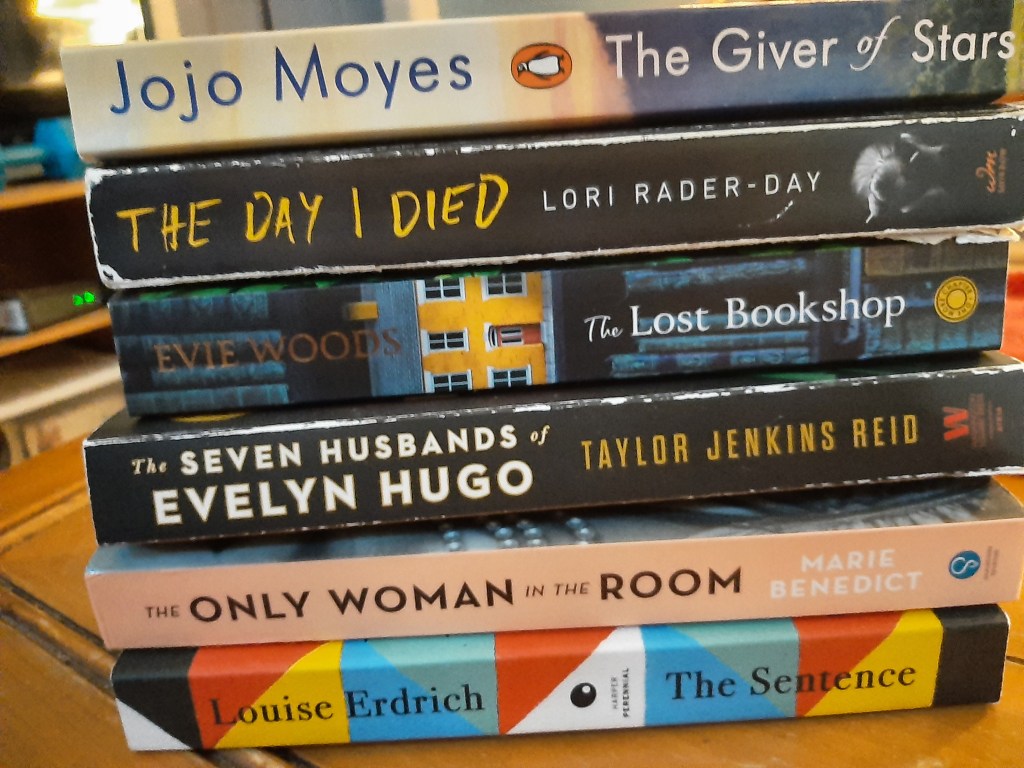
The Giver of Stars by Jojo Moyes
This book had been on my Want-to-Read list for ages, and it did not disappoint. Based on a true event and set during the Depression era, the story highlights a group of women who volunteer to deliver books to poor residents in rural Kentucky as part of Eleanor Roosevelt’s traveling library. According to the marketing blurb on the back cover, it’s a “captivating tale of friendship, true love and reaching for what’s possible.” I’m looking forward to reading more of Moyes’ books.
The Sentence by Louise Erdich
Here’s another author I’ve wanted to read for a while. The Sentence takes place in Minneapolis over the course of one year from November 2019 to November 2020, taking readers through the narrator’s experience during the Covid pandemic and the George Floyd murder and ensuing riots. All the while, she deals with a capricious ghost haunting the book shop where she works as well as her conflicted feelings about her marriage and her efforts to reconcile her own dark past. An intriguing character study of one woman’s life in turbulent times, and Erdich’s Native-American heritage brings an added narrative layer. I’m sure I’ll be reading more of her works.
The Seven Husbands of Evelyn Hugo by Taylor Jenkins Reid
Evelyn Hugo, a retired film star of the 1950s and 1960s, hires a novice magazine writer to help her draft her memoir. Over several ensuing weeks, the actress shares her life story, though she does so at her own pace and is determined to control the narrative. The hired writer wonders why she was chosen for the job because the two women have nothing in common. Hugo, by her own admission, is not the kindest person in the world and her relationships are fraught with tension. This was another fascinating character study, and the story stayed with me longer have I closed the book.
The Lost Bookshop by Evie Woods
Fans of magic realism will enjoy this novel by Woods, set in Dublin where a vanishing bookshop casts its spell over three unsuspecting characters who have played minor side roles in their own lives. Told through two timelines and three characters’ point of views, readers follow them on their journey to self-discovery and self-empowerment. What I enjoyed most is the way Woods weaved and intertwined the characters’ lives despite the different timelines and how she created a magical bookshop that only a few could see.
The Only Woman in the Room by Marie Benedict
In her novels, Benedict often features bright, talented young women whose career achievements are suppressed by the strong, dominating men in their lives. This story is no exception. Most people knew Hedy Lamarr as a stunningly beautiful Hollywood film star of the 1950s. What they don’t know is that she was also a scientist. She grew up in an aristocratic family in Austria, and through her marriage to an Austrian arms dealer, she often overheard conversations detailing the Third Reich’s plans. After escaping to the United States and becoming a screen star, she used her scientific knowledge to design a communications system that would help the U.S. fight the Nazis. Except as a woman, no one would listen to her idea.
Murder Under the Tuscan Sun by Rachel Rhys
File this one under gothic romantic suspense. In some ways, the tone and storytelling of this novel reminds me of Daphne DuMaurier’s Rebecca. When a recently widowed woman responds to an ad for a companion to an ill aristocrat at his estate in rural Italy, she has no idea what to expect. While there is no actual murder, there is plenty of suspense as the widow experiences strange dreams, ghost sightings while she cares for her charge who doesn’t seem to want her help. Over time, the two grow closer even as he seems close to death. This was a surprising read that kept me turning the page.
The Day I Died by Lori Rader-Day
After reading two earlier works by Rader-Day (Little Pretty Things and The Black Hour), I fully expected another stellar novel. I was not disappointed. From the opening pages, I was taken on a wild journey through the eyes of the story’s protagonist Anna, who has a unique talent of analyzing people’s handwriting. The local sheriff isn’t convinced of Anna’s abilities, but hires her anyway to help in his search for a missing boy. But to solve this mystery, Anna has to face her own fears about her past and her relationship with her own teenaged son.
Honorable Mentions:
The following didn’t make my best list but are all worthy of your time.
Mexican Gothic by Silvia Moreno-Garcia I don’t usually read horror novels–I get too easily creeped out–but Garcia’s writing helped create a dark and suspenseful story. I just didn’t buy into the romantic relationship.
Book Lovers by Emily Henry After hearing so much about Emily Henry, I had to check out one of her books. This was a solid, engaging story, but the more compelling story line was the relationship between the two sisters.
The Midnight Library by Matt Haig I was fascinated by the premise of this novel. Imagine what your life would be like if you made different choices.
The Memory of Lemon by Judith Fertig A mix of magical realism and contemporary romance, this story is about a young baker who has a knack for tasting people’s emotions and has the ability to sense which ingredients will touch her customers’ hearts.
The Ten Thousand Doors of January by Alix Harrow A young woman unwittingly uncovers a network of secret doorways to other worlds and explores many of them to find her father who had disappeared long ago. I don’t read many fantasy novels, but this was a surprising and entertaining read.
What about you? What books did you read this past year that impressed you most? Which books would you recommend?









 The Regal Writer