
Alternative Pre-Writing Methods to Kickstart Your Novel

Photo by Pixabay on Pexels.com

Last week, I wrote about becoming a puzzler, which combines elements of plotting and discovery writing (pantser). It’s a happy medium for those who need some structure in the way they plan their novels, but still want the flexibility of organic story development.

One of the tools puzzlers may use is storyboarding, which helps them visualize key plot points. In fact, there are numerous other methods writers can use to help them structure and visualize their stories before they begin writing, such as mind mapping, collages, tarot cards and Enneagram personality types. I’ll describe each of these below (plus a couple others). Granted, they may not be for everyone, but they might be worth exploring to see how they might work for you.

  • Collages – Collages are a collection of photos that help writers “see” the details of their story. By cutting out images from magazines and pasting them on poster board, or using a digital platform like Canva or Pinterest, you can compile images representing the characters and settings.  You can add other elements, such as a car that a character might drive, a restaurant where two characters meet, or a school where a particular event takes place. Add swatches of fabric to represent a dress a character wears, as well as sketches, drawings, symbols or anything else that might inspire a key plot point. Collages not only provide a visual cue, they can be fun to put together and provide inspiration for those times when you feel stuck.

  • Mind mapping – Also known as clustering, this method helps writers see the connections between unrelated ideas. It can also help them understand theme, conflict, and character development. Start with your main concept in the center captured with some central image such as a cloud. From that image are branches that represent the main themes of your story. Each branch comprises a key word that’s printed on its associated line. Topics of lesser importance are represented as twigs. Viewed together, the twigs and branches form a structure of interconnectedness. For more information about mind mapping, visit Mindmapping.com.

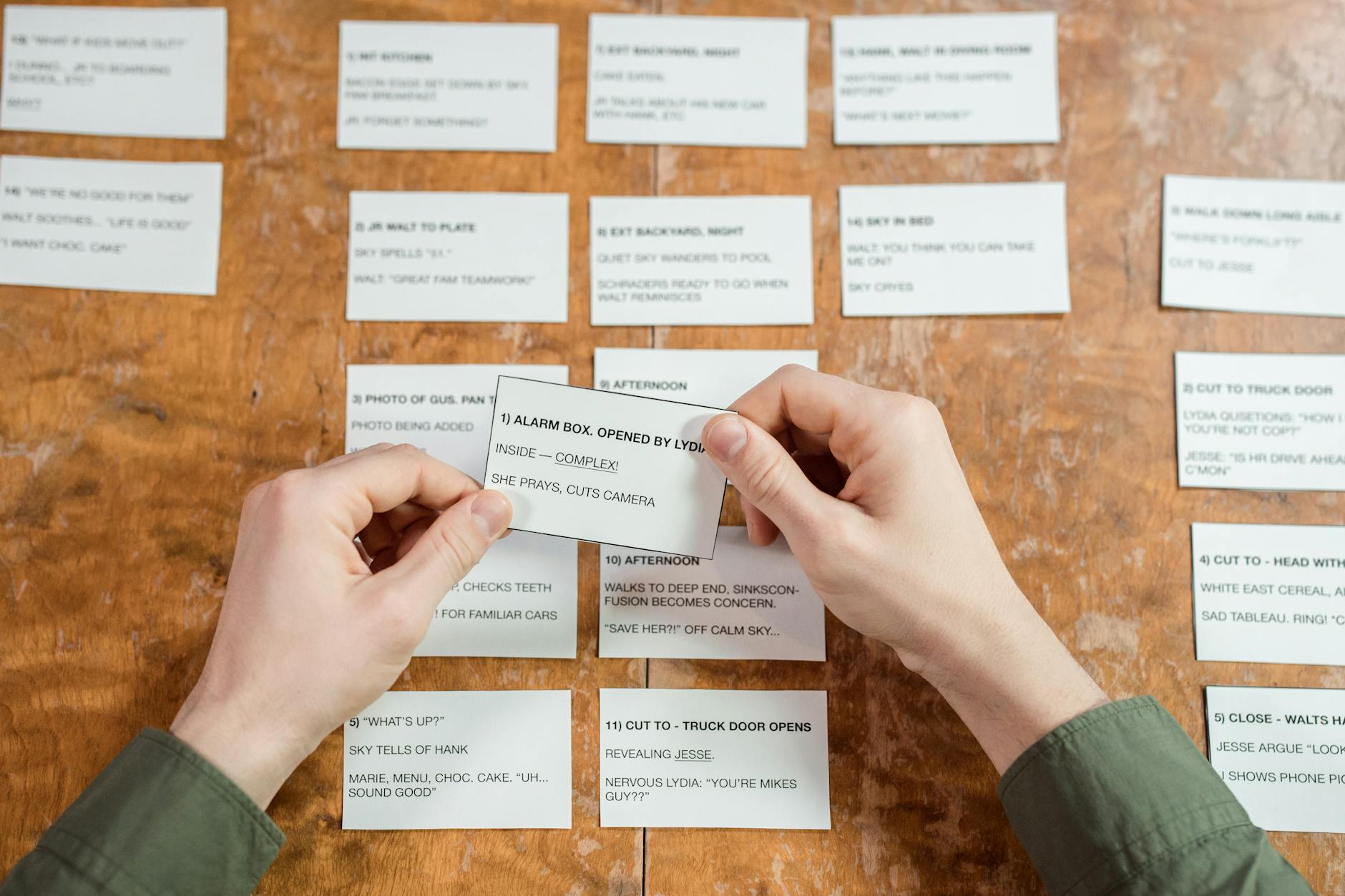
  • Storyboarding – Using index cards or post-it notes, or even sketches, jot down each scene as you think of them. One scene per card. Then rearrange them in the order that seems to make the most sense for your narrative. By looking at the cards, you can see whether the sequence of scenes makes logical sense and if there are any scenes that need to be added or changed. It provides a tool for planning your story before you begin writing it so you’re not wasting time on writing scenes that will only be cut later.  Learn more about story boarding at Gilliam Writers Group.

  • Tarot Cards – Tarot cards provide a range of meanings whether they appear upright or reversed. Cards representing the king, queen, prince and page can represent individual characters while the four main elements each have their own meaning: Swords for intellect, Cups for love and emotion, Wands for work and physical activities, and Discs for wealth and resources. Some writers, like Quinn Diacon-Furtado, turn to tarot cards when they feel stuck in their story and seek clarity about their characters, settings or plot.

    “As a writer, I’ve learned to use the tarot to explore my characters, intuit plot, and to reflect on my creative process,” she explains in a Writer’s Digest article.  “Unlike conventional writing guides, I’ve found that tarot cards offer a dynamic landscape of symbols and archetypes that help me work through the nuances of character development, the intricacies of plot dynamics, and the richness of world-building.”

  • Enneagram – The Enneagram is a geometric diagram with nine points, each representing a personality type. It shows the interconnectedness of the personalities. Writers have used the Enneagram to understand characters’ personalities, their strengths and weaknesses, and how they might relate to characters of other Enneagram personalities. Some personalities will get along better with other types while other combinations may become rife with conflict.  You can find out more about the Enneagram diagram here.

  • Timelining – This tool is especially helpful if you’re writing a story with multiple timelines. How do you keep those timelines straight so readers don’t get confused? Timelining can be as simple as a straight line across the page with each major plot point marked. Or it can be more complex as a spreadsheet with multiple timelines for multiple plots. Doing a timeline before writing helps writers organize their thoughts and ensure a logical progression of events as well as the character’s arc of development over time.

  • Zero drafting – Only recently did I learn about zero drafting, which falls somewhere between a basic outline and the first draft of a novel. It can sometimes be used as a brainstorming session. Writers use this method to work out key details of their story, using phrases, slap-dash prose, or bullet points without any consideration for word count, quality of writing or formatting.  Zero drafting allows writers to get to the spine of the story without expending time and energy on a first draft. It’s ideal for writers who are still working out the basic framework until they feel ready to start writing.

    Though I have never used this zero drafting myself, I can see how it can be useful, not just for creating your story framework, but also for drafting your synopsis.

No matter where you are in your project, these pre-writing methods can help you explore your stories before you begin to put pen to paper.
Neither a Plotter Nor a Pantser? Try Becoming a Puzzler

Photo by Ron Lach on Pexels.com

Writers usually fall into one of two categories: the plotter or the pantser.

Plotters prefer to plan out every aspect of their stories ahead of time, from the setting, character, theme, structure. They will plot out every scene from the opening paragraph to the final resolution. They have to know every detail in advance before starting to write. Plotting allows writers to view their story from all detailed angles. They know exactly what they want to write before writing it.

I’ve tried this plotting approach once before early in my fiction writing. It was the first story I attempted to write. I quickly gave up on it because I found it limiting. My plotting didn’t allow for new characters to show up, and I struggled to find the right place in the story for new scenes as I thought of them.

Still there are plenty of authors who have plotted their way to success. Fantasy author K.M. Weiland is a big proponent of outlining and story structure, and goes into a deep dive on these subjects on her blog. She’s also written several books about plotting if you want to learn more.

One disadvantage I see is the extra time it takes to get the details “just right.” It can take the wind out of your creative sails too. By the time you’re done plotting, you could lose interest in your story because you feel you’ve already written it in plotting form.

But not every writer works that way.

Then there are the pantsers . . .
I always believed I was a pantser, also known as a discovery writer, because I enjoyed discovering my story as I wrote. With only a vague sense of main characters and a few scene ideas, pantsers tend to begin writing if only to see where the story takes them, or whether there’s a story at all.

The advantage of writing by the “seat of your pants” is that it gives the imagination free rein. The story, without the limits of plotting, can go in a multitude of directions, and it can be fun to discover new characters and settings that you didn’t think of initially. Writers feel free to explore their story world without the limitations of a set of rules or structure.

The downside, however, is that by the end of the drafting phase, what writers have is a ton of material with no cohesiveness between scenes, characters or plot. That only makes the editing phase much harder because there’s so much material to dig through, and much of it will land on the cutting room floor anyway. As I quickly learned, pantsers usually have to do several rewrites to get the story to where you want it to be, which can be a drain on time and energy, not to mention patience.

What if you’re neither a pantser nor a plotter – or you’re a little of both?
While I’ve experimented with both of these approaches, I realized that I don’t fit neatly in either one. While I love exploring plots and characters organically, I also recognize that I need to plot my story to some extent so I know where it’s going. Otherwise, I’m only spinning my wheels, editing and rewriting sections until they feel right.

Enter Puzzling.

The Novel Smithy Lewis Jorstad explains that puzzling works by bringing elements of plotting and pantsing together.  For example, perhaps you have a brilliant story concept and can visualize several scenes in your mind, have a rough idea of characters and an inkling of how it will end. Using index cards or post-it notes, jot down each individual scene – one idea per card. You may not think of every scene right off the bat. You may only have three or four scenes to start. But that’s okay. What you are doing is creating a puzzle with various pieces that will eventually fit together. This is the discovery part.

Once you have a collection of scenes on index cards (or post-it notes), spread them all out on a table or tape to the wall so you can see them all at a glance. Then rearrange them in the order you think they should go. This is the plotting aspect.

Once the cards are in some story order, review them again. Note if there are any gaps in the sequence. Wherever there is a gap, insert a card indicating a scene to come.

The advantage to puzzling is that it allows you to generate scenes on the go. You don’t have to think of every scene before writing. You can write the scenes you do know, knowing the rest will come eventually. You don’t have to follow any structural rules.

Even while drafting, you may still come up with new scenes. When that happens, jot them down on a card and insert them where you think they might fit in the story. You can add or delete scenes and change the order of them as you go along. It gives you more control and flexibility than a straight plotting structure, which can be limiting to those who want to give their imagination free rein.

Another benefit is the ability to review your story at a glance scene-by-scene and make adjustments to the timeline. You can also identify which scenes are the key plot points of your novel.  I suspect this approach results in fewer rewrites.

Are there any downsides? So far, I haven’t found any, though I just started working with it for my current work in progress. In the short time I’ve been using this puzzler approach, I’ve learned a few things:

  1. It has helped me maintain my interest in the story. With previous approaches, I’ve invariably lost interest in my manuscript and given up on it, or got lost in the muddling middle.
  2. It allows me to assess my scene sequence and rearrange them as I see fit, without  having to rewrite anything.
  3. It helps me stay focused on one scene at a time. With one scene per card, I know what I’m writing next and I’m not left staring at a blank screen. The cards give me a clue and keep me on track.

    If you’ve tried plotting or pantsing, and they haven’t provided the results you want, give puzzling a try. You may find that being a puzzler makes you a more productive writer.  

Dictate Your Way to Publishing Success

Photo by PhotoMIX Company on Pexels.com

Writers are always looking for ways to work smarter and get more done in less time.

Enter dictation.

When I think of dictation, I think of the old-school way of recording correspondence back in the 1980s. Managers would dictate letters and other correspondence in a recorder with a tiny cassette, then their secretaries would play it back to transcribe them.

Fortunately, as technology evolved, so did dictation and transcription tools, making it easier for writers to draft larger projects, like full-length novels. Several well-known authors routinely used dictation to help them draft their novel, including Dan Brown, Henry James, Barbara Cartland, and Agatha Christie. TV executive Sidney Sheldon reportedly dictated novels for several hours in the morning and then had his secretary transcribe them later.

I must confess I have never used dictation to draft any of my own stories, but I know that option is available. You can’t overlook its value to authors. While writing 1200 words can take a couple of hours, with dictation, it takes roughly 30 minutes.

Sarah Elizabeth Sawyer of FictionCourses.com who writes Native American historical fiction, also teaches courses about dictation. Of her 19 published books, at least 10 have been created by dictation.

Sawyer cites several benefits:

* Improved health – With dictions, there’s less strain on the eyes, back and shoulder.
* Better time management – You can dictate while waiting for appointments or walking the dog.
* Improved speaking skills – With practice, you speak more confidently which helps prepare you for author readings.
* Experiment with character voices – You can test out character voices with accents and dialects, and inject personality into their voices.

Users have noted several blocks to getting started with dictation. Some said the practice just didn’t work for them or they felt their brain didn’t operate that way. Others cited the cost of dictation software, although there are plenty of free options available, or the software was difficult to use. Still others said they drew a blank when they pressed the record button.

There are other downsides, such as messy punctuation. That only means you have to be prepared to review and edit the drafted material more carefully afterwards. The software may not recognize unusual spellings and pronunciations of character and location names, especially those you might find in science fiction and fantasy novels. Like any new skills, there’s a learning curve before you’re able to do it well.

Still if you have the patience and determination to try to produce creative work in less time, dictation might be worth a try. But which software and apps work best? Do you need any special equipment?

Jason Hamilton at Kindlepreneur shared the best dictation tools, giving the pros and cons of each.

  • Dragon – By far, Dragon software performed the best though the cost may put off many potential users. The Professional Individual version cost $500 while the Home version is $200.  
  • Windows Speech Recognition – free option that comes with most Windows computers
  • Apple Dictation – a free option for Mac users
  • Google Docs Voice – a free option with the power of Google
  • Otter.ai – a free trial is available for new users. I’ve heard mixed reviews on whether this works for long form documents like novels. That said, I have used it for transcribing notes from interviews.

No matter where you are in your writing process or what kind of projects you work on, any tool that can help you produce more words in less time is worth checking out.